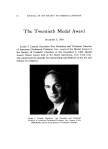
78 JOURNAL OF THE SOCIETY OF COSMETIC CHEMISTS Health Advisor to the Governor of New Jersey. His son Richard, hav- ing achieved his Ph. D., is presently Research Associate in Biophysics at the Institute of Molecular Biophysics at Florida State University, and his daughter, Paula, has trained for and served as an elementary school teacher. We can find no finer capstone to a man's life, than to witness the effects of his example in stimulating his family toward activities in behalf of the human race. Ladies and gentlemen, it is with a feeling of deep personal pride that I present to you the recipient of the Society's Gold Medal, Mr. Lester Conrad! Acceptance Address BY LESTER I. CONRAD Mr. President, Dr. Kanig, Honored Guests, Friends and Fellow Members of the Society of Cosmetic Chemists: I accept this Award with humility and a deep feeling of gratitude to the Society and its Medal Award Committee. I must admit that I am delighted to join the distinguished scientists who have received this Award in the past and to know that the results of my labor have not gone unnoticed by my fellow workers. The investigations on lanolin chemistry for which I am being honored tonight began over thirty years ago when I realized that lanolin is a unique and abundant natural source of a whole array of fascinating chemicals. In the very early days I was completely engrossed in the chemical and engineering problems involved in the separation and puri- fication of cholesterol and related sterols. However, it soon became ap- parent to me that many lanolin compounds contain reactive groups which offer intriguing possibilities for the synthesis of new derivatives having valuable functional properties when applied to skin and hair. Taking up the challenge, I decided to become active in cosmetic chemistry at a time when the field was just emerging as a new area of chemical specialization. Looking back from where I stand. at this moment, I can safely say that that decision was a wise one. It is a source of great personal satisfaction to me that I have con- tributed • o the growth of modern cosmetics, ! feel strongly that one

TWENTIETH MEDAL AWARD who is involved in the development of specialty chemicals for this in- dustry has a responsibility for the future. There are many unsolved problems awaiting the advent of new functional compounds as tools for cosmetic research and I expect to continue my efforts to help solve these problems. The current sophisticated state of the art and science of cosmetics still presents an exciting challenge to the neophyte chemist. It must be said that this is a field which requires a great deal in the way of train- ing but in exchange offers unusual opportunities to express originality and imagination, a satisfaction we all enjoy. Far more than a super- ficial knowledge of many diverse scientific disciplines is required. The cosmetic chemist himself must be a surface-active agent, capable of penetrating the interfaces between chemistry, physics, biology, medicine, and engineering seeking for and taking out of each discipline what his creativity demands. How do we train such people ? An organic chemist beginning employment in a cosmetic research laboratory has to literally "pick up" information on color and pigments, emulsion technology, special instrumentation, packaging materials, preservation, pharmacology, and the like, in order to be considered a cosmetic chemist. This is a lengthy and highly inefficient way to learn. An important step in the improvement of education in our specialized field lies in the newly proposed baccalaureate and graduate degree courses in cosmetic science to be offered by Columbia University's College of Pharmaceutical Sciences. Employing both lecture and labora- tory sessions, these courses will apply knowledge in depth from the basic sciences to cosmetics and perfumes. Incorporated in a work-study pro- gram they would have far-reaching effects in training young people in our field, and I am delighted to have been active in this project both as a Trustee of the College and a member of the SCC. The sound nature of the research carried out today on cosmetics, skin and hair by objective, well-trained scientists attests to the fact that cosmetic chemistry has truly come of age. The technical sessions and Congresses of our Society are well attended, and the proceedings are published in our respected Journal which is distributed and abstracted throughout the world. Because of its international character, the cosmetic industry requires close cooperation on an international scale to ensure uniform standards of excellence. The International Federation of Societies of Cosmetic Chemists has functioned well, both for the chemist and the industry, and I am proll• t. 0 b•e •S•sociated with this organization which represents over
Purchased for the exclusive use of nofirst nolast (unknown)
From: SCC Media Library & Resource Center (library.scconline.org)