114 JOURNAL OF THE SOCIETY OF COSMETIC CHEMISTS microbial flora of the human scalp (4-7). These surveys show that the scalp harbors yeasts, molds, and bacteria in great abundance. In all the surveys scurf was obtained by brushing the scalp with a sterile brush or comb and allowing it to fall upon the surface of enriched complex organic media considered to be best suited for the growth of the particular group of microorganisms that was being isolated. No distinc- tion was made between the presence of the resident and the nonresident microbial flora. The resident flora includes those organisms which are capable of living on the scalp by utilizing the nutrients available there. The transient flora includes microorganisms which do not subsist on the scalp, but are present as temporary contaminants from the air and soil. No attempt was made to correlate the degree of dandruff formation with the specific organisms isolated, nor was any consideration given to the scalp condition and type of grooming aid, nor to the interval of time between the last shampoo or dandruff treatment and the time of sam- pling. The purpose of these surveys was to obtain knowledge about the microbial flora of a random group of "normal" subjects in order to estab- lish a basis for future research on the possible microbial etiology to dan- druff. In 1964, VanderWyk and Roia (8) showed a relationship between the severity of dandruff and the presence of microorganisms on the human scalp. The application of broad spectrum antimicrobial agents elimi- nated almost completely the microbial flora, and this resulted in a signifi- cant decrease in the amount of scalp desquamation. More recently, VanderWyk and Hechemy (9) carried out a half-head experiment and showed that nystatin-sensitive yeasts, including _P. ovale, had a greater influence upon dandruff production than did those orga- nisms, principally bacteria, which were susceptible to tetracycline. Van Buskirk (10), using a HairVac technique (8) for obtaining scurf samples and complex organic media for isolating aerobic bacteria, sug- gested that a relationship existed between the production of scurf and the number of bacteria present. However, he made no attempt to establish a cause and effect relationship. Many other etiological factors have been associated with this scalp condition, and these have been summarized by Lubowe (ll). Due to the proved effectiveness of antibiotics in scurf reduction, it would seem that the influence of microorganisms is one of the more important con- tributing factors in excessive scalp desquamation. The purpose of this research was to find out if any specific micro- organism or group of microorganisms could be definitely linked to dan- druff production.

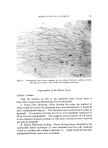
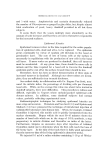
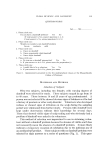
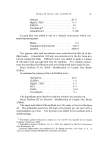
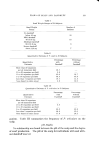
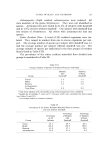
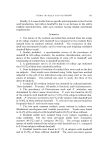
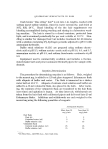
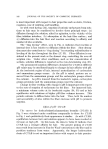
FLORA OF SCALP AND DANDRUFF QUESTIONNAIRE 115 Age Sex 1. Please circle one: Do you have a dandruff problem? Yes No (If your answer is Yes, answer questions 2, 4, 5 if your answer is No, answer questions 3, 4, 5.) 2. Please circle one: Would you consider your dandruff problem Severe moderate mild 3. Please circle one: a. I have no dandruff b. I have occasionally slight dandruff c. I have slight dandruff 4. Please circle one: a. Do you use a dandruff preparation? Yes No b. If your answer to 4a is Yes, please name the preparation(s). 5. Please circle one: a. I would like to be a volunteer. Yes No b. If your answer to 5a is Yes, please give name. Figure 1. Questionnaire presented to the five undergraduate classes at the Massachusetts College of Pharmacy MATERIALS AND METHODS Selection of Subjects Fifty-two subjects, including two females, with varying degrees of dandruff were selected for study. These subjects ranged in age from 18 to 49 years. Those between 18 and 23 years of age predominated. A person was not selected if he showed obvious signs of baldness or if he had a history of psoriasis or other scalp disorder. Volunteers who developed redness or showed signs of irritation on the scalp during the sampling period were eliminated from further study. Persons with dandruff were kept under observation without their knowledge for several days. Those that showed visible signs of scalp scaling and who obviously had a problem of dandruff were asked to be volunteers. This method of selection was impractical to use in obtaining volun- teers without a dandruff problem because the absence of visible scurf does not necessarily mean the absence of a dandruff problem. It more likely indicates a temporary cessation of exfoliation due to the judicious use of an antidandruff product. Those subjects with no dandruff problem were selected by their answers to a series of questions (Fig. 1). This ques-
Purchased for the exclusive use of nofirst nolast (unknown)
From: SCC Media Library & Resource Center (library.scconline.org)