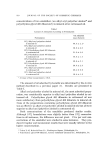
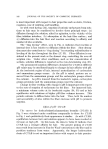
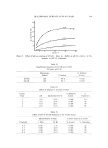
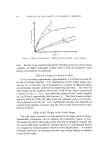
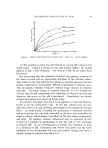
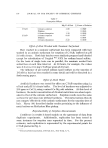
BATH OIL ADSORPTION 111 The experimental formulations were observed periodically for three weeks to evaluate the stability of individual bath oil emulsions. All were uniformly stable for the first 12 hours, after which differences were noted. However, the formulations' ability to make a stable emulsion did not correlate with their in vitro adsorption onto keratin. SUm•^RV Eight experimental bath oil formulations with various combinations and concentrations of emulsifiers were studied in vitro to determine their adsorption onto keratin. The most effective preparation was 10% alkyl aryl polyether alcohol in mineral oil. The importance of utilizing a proper dispersing agent, in its optimum concentration, in an appropriate type of oil, when preparing a bath oil formulation, was emphasized. (Received April 22, 1968) REFERENCES (1) Knox, J. M., Everett, M. A., and Curtis, A. C., The oil bath, A.M. A. Arrh. Dermatol., 78, 942 (1958). (2) James, A. P. R., Bath oil in the manageinent of senile pruritus, Southwestern Med., 40, 384-5 (1959). (3) James, A. P. R., Bath oils in the management of dry, pruritic skin, J. Am. Getlat. Sot., 9, 367-9 (1961). (4) Spoor, H. J., Measurement and maintenance of natural skin oil, N. ¾. State J. Med., 58, 3292 (1958). (5) Taylor, E. A., Cutaneous absorption of bath oils, Arch. Derrnatol., 87, 369-71 (1963). (6) Knox, J. M., Everett, M. A., and Curtis, A. C., New uses for surface aetive agents, Ibid., 74, 699-706 (1956). (7) Ogura, R., and Knox, J. M., Adherence of bath oil to keratin, Brit. J. Med., 2• 1048-50 (1964).

J. Soc. Uosmetic Uhemists, 20, 113-134 (Feb. 5, 1969) Resident Microbial Flora of the Human Scalp and its Relationship to Dandruff* FRANK C. ROIA, Jr., Ph.D.p and RAYMOND W. VANDERWYK, Ph.I).{ Synopsis--The entire resident microbial flora (including yeasts, molds, bacteria, and actinomy- cetes) from the scalps of 28 persons with dandruff was compared to the flora isolated from 24 persons without dandruff. The isolation methods, isolation media, and significance of the results are discussed. INTRODUCTION Since 1874, when Malassez (1) concluded that Pityrosporum ovale was the organism which caused dandruff, much research has been carried out on its possible etioloõical role in dandruff and other skin diseases. Although P. ovale has often been suggested as a possible etiological factor (2) in dandruff, it has never been proved to be the cause. This work has been summarized in part by Hechemy (3). Early workers isolated many other organisms from the human scalp, but the literature pertaining to this work is not clear. This confusion is due partly to the numerous methods of isolation and partly to incom- plete identification. The history of this early work on the scalp flora, as well as the flora of other parts of the body surfaces, is described in several surveys conducted at the Massachusetts College of Pharmacy on the * Research supported by a National Institute of Health Predoctoral Fellowship. t Department of Biology, Philadelphia College of Pharmacy and Science, Philadelphia, Pa. 19104. :• Department of Microbiology, Division of Biological Sciences, Massachusetts College of Pharmacy, Boston, Mass. 02115. 113
Purchased for the exclusive use of nofirst nolast (unknown)
From: SCC Media Library & Resource Center (library.scconline.org)