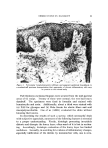
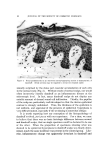
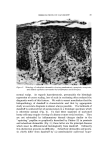
82 JOURNAL OF THE SOCIETY OF COSMETIC CHEMISTS Our aim has been to examine dandruff in breadth rather than depth as a first step in clarifying many aspects which are now mooted. So disparate are the views on dandruff that some progress will have been made merely by eliminating notions which are false or inaccurate. The main objective has been to delineate the fundamental features of the process, and to evaluate some of the factors which might influence its behavior. Definition A major deficiency of many explorations into the nature of dandruff has been a failure to define the disorder precisely. We define dandruff as chronic noninflammatory scaling of the scalp. Although chronic, the fluctuating character of dandruff has long complicated its study. Sub- jects initially observed to be free of dandruff may suddenly develop it, while others with dandruff of long standing may enter periods of quies- cence. Despite these swings, the process is fundamentally persistent and, if observed for a prolonged period, the true dandruff individual will eventually get his "dander up." Clinically, dandruff is wholly noninflammatory. The absence of inflammation sets dandruff apart from the other principal scaling condi- tions of the scalp, namely, seborrheic dermatitis and psoriasis. How- ever, inflammation is often exceedingly difficult to detect on the scalp this is especially true in the Negro where erythema is muted. Seborrheic dermatitis, with which dandruff is frequently grouped, displays not only scaling, but erythema and sometimes crusting. Some authorities regard dandruff as a mild form of seborrheic dermatitis, a view from which we dissent. Psoriasis is often patchy and reddened with a thick silvery scale. The presence of lesions in characteristic locations elsewhere is helpful in differentiating seborrheic dermatitis and psoriasis from dan- druff. The scalp, as all skin, undergoes continuous horny desquamation. In its mildest form, dandruff merges into physiologic scaling. The normal process of desquamation is necessarily more visible on the scalp because the rate of production of horny cells is greater on the scalp than on most parts of the body (1). Moreover, hair retains scale and renders it more visible. Merely not washing for a week or two will create the "appearance" of dandruff in the normal subject. However, there are significant differences between the scales of intense dandruff and normal desquamation.

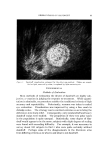
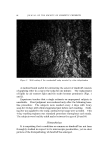
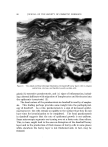
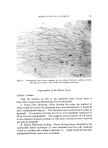
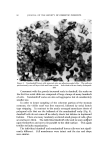
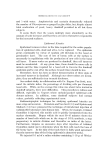
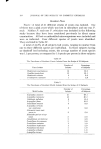
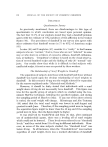
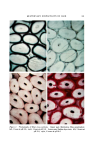
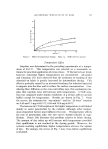
OBSERVATIONS ON DANDRUFF F,i,•o•tre 1. , ::: •' ,/':: ..'.:.•½ ..•., : • . ?-5 5'...½ i,• : ::' -•-' :•.., ,:t•-" .. .:• .•..... "•': .¾Z ' ' •:... . . Dandruff visualization enhanced by the ether cup method. Flakes are magni- fied as lipid, removed by ether, is replaced by light-scattering air EXPERIMENTAL Methods of Evahmtion Most methods of estimating the de,•ree of dandruff are highly sub- jective, a vexation in judging the response to treatment. While quanti- tation is admirable, no procedure satisfies the traditional criteria of high accuracy and repeatability. Reluctantly, recourse was taken to naked eye evaluation. Visualization was improved by using a fine comb to dislodge scales. The strategy was to contrast extremes so as to bring the differences into sharp relief. Consequently, only nondandruff and heavy dandruff scalps were studied. The proportion of these two polar types in the population is quite unequal. Statistically, some degree of dan- druff would appear to be the norm subjects with slight degrees of scaling were found with exceeding difficulty. For example, it was necessary to survey about 100 subjects to find 5 who were quite certainly without dandruff. Perhaps some of the disagreements in the literature arise from differing criteria as to what is and what is not dandruff.
Purchased for the exclusive use of nofirst nolast (unknown)
From: SCC Media Library & Resource Center (library.scconline.org)