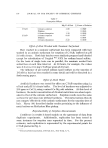
J. Soc. Coswetic Chemists, 20, 103-108 (Feb. 5, 1969) Antimicrobial Action of Soap Germicide Mixtures on Skin NICHOLAS M. MOLNAR, M.Sc.* Presented December 6, 11½67, New York City Synopsis--Three major bacteriostats in use today, 3,4',5-tribromosalicylanilide (TBS), hexachlorophene (G-11), and trichlorocarbanilide (TCC), were evaluated in a modified skin substantivity test against five realistic test organisms, including gram-positive and gram- negative organisms and fungi. Antimicrobial data are given for these bacteriostats singly and in combinations, tested in conventional soap solution and in a syndet. TBS alone was found to be superior to G-11 or TCC alone. Mixtures of these germicides showed enhanced activity, and those mixtures containing TBS were the most effective systems in soap and syndet. INTRODUCTION In the past twenty years three major classes of bacteriostats- halogenated bis-phenolics, brominated salicylanilides, and chlorinated carbanilides--have gained prominence as topical agents for use in toilet bars and cosmetic products. Important properties common to these agents are: 1. Antibacterial activity at very low concentrations 2. Compatibility with soap and detergent vehicles 3. Affinity for skin, resisting removal by water The attachment to or residence on skin is considered to be one of a loose complex between agent and skin protein, allowing the bacteriostat to act against the bacteria indigenous to skin. Residence on the skin may be demonstrated by antimicrobial activity or by removal from the * Fine Organics, Inc., Lodi, N.J. 07644. 103

104 JOURNAL OF THE SOCIETY OF COSMETIC CHEMISTS skin with an organic solvent. The antibacterial activity of the topical agents has been abundantly reported in scientific literature employing standard microbiological procedures and hand washing tests (1-5). It is the purpose of this report to compare the relative antibacterial potency of widely used soap bacteriostats singly and in various combina- tions left on skin following immersion in soap solutions. The test or- ganisms employed were gram-positive and gram-negative bacteria and fungi. For the most part, they represent microorganisms either indige- nous to skin, such as Staphylococcus aureus, or those that may pose a prob- lem for damaged or diseased skin. M•ATERIALS AND M•ETHODS The five germicides used in this study were: Hexaehlorophene (G- 11) * 3,4', 5-tribromosalieylanilide (TBS) t 1:1 mixture of TBS and 4',5-dibromosalieylanilide (PBS) •: 3,4,4'-triehloroearbanilide (TCC) õ and 4,4 '-diehloro-3- (trifiuoromethyl) earbanilide (TFC) II Commercial soaps were employed as indicated. In the case of the test germicides used in preparing experimental test solutions, the agents were first dissolved in about 1 ml of acetone and added to an 8% aqueous soap solution. Commercial antibacterial soaps were prepared as 8% aqueous solutions. Skin residency and antimicrobial activity were evahinted using the technique of Vinson et al. (1) with some modification. The skin discs of 7-ram diameter were prepared from de-pickled calf skin. Eight per cent (w/w) solutions in water were prepared for each test sample. These test solutions were maintained at a temperature of 45 øC throughout the test. The skin discs were steeped in the test solutions for 15 minutes, re- moved, and rinsed in running water for 15 minutes. Excess water was removed from the discs by squeezing. The discs were then placed grain side in contact with agar seeded with the particular organisms, then placed into the refrigerator for 18 hours at 4 øC. This allowed the diffu- sion of the antimicrobial agent from the skin disc into the agar but pre~ * Sindar Corp., New York, N.Y. t Temasept II and Temasept IV, Fine Organics, Inc., Lodi, N.J. :• Temasept I, Fine Organics, Inc., Lodi, N. J. õ Monsanto Co., St. Louis, Mo. II Geigy Chemical Corp., Ardsley, N.Y.
Purchased for the exclusive use of nofirst nolast (unknown)
From: SCC Media Library & Resource Center (library.scconline.org)