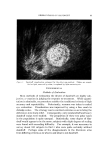
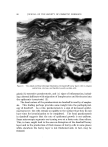
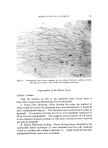
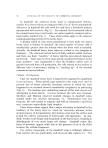
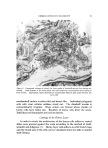
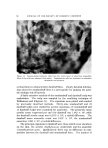
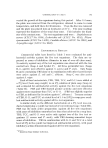
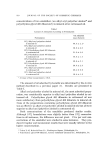
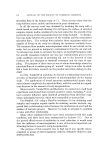
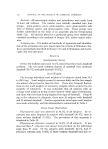
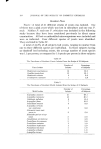
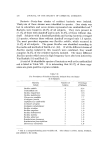
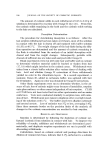
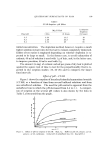
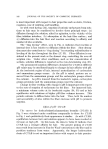
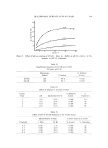
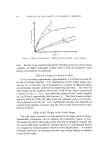
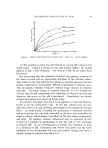
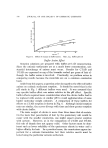
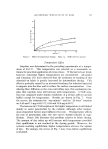
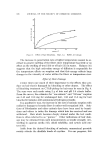
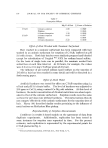
148 JOURNAL OF THE SOCIETY OF COSMETIC CHEMISTS 20 Figure 8. ß 5 I0 20 $o 4.0 (MINUTES) I/2 Effect of hair bleaching. Hair, 2 õ. Buffer, 3.6 citrate The increase in penetration rate at higher temperature cannot be as- cribed to greater swelling of the fibers since temperature has little or no effect on the swelling of wool (39) or of hair (35) in water. Holmes (16) suggests that the high activation energy of diffusion is responsible for the temperature effects on sorption and that this energy reflects large changes in the viscosity of water within the fibers as temperature rises. Effect of Hair Damage Creme rinses owe much of their importance to the effects they pro- duce on hair that is damaged by bleaching or other abuses. The effect of bleaching treatment on CTAB pickup by hair may be seen in Fig. 8. The runs were each made using 2 g of hair and pH 3.6 citrate buffer. From the curves, the estimates for "one-minute" and "24 hour" sorption are 0.43 and 10.3 mg for undamaged hair, 1.88 and 15.8 mg for hair bleached 40 minutes with ammoniacal hydrogen peroxide. In a qualitative way, the increase in the rate of cationic sorption with oxidative damage to keratin fibers is rather well recognized (40). Solu- tions of Rhodamine and other cationic dyes have been used by beauti- cians and others to index the damage which hair has received and can withstand. Hair which becomes deeply stained under the test condi- tions is often referred to as "porous." Other indications of hair dam- age may be obtained from such measurements as tensile strength (41), swelling in aqueous media (42), alkali solubility, and cysteic acid con- tent (40). Aside from the desired bleaching of melanin, ammoniacal peroxide mainly attacks the disulfide bonds of crystine. For our purposes, this

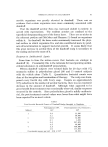
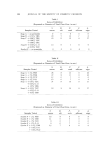
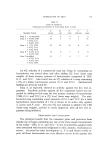
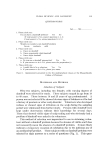
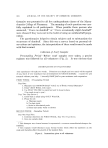
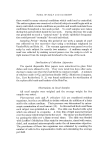
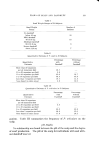
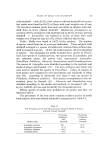
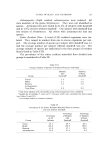
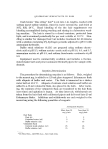
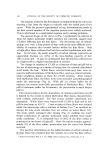
QUATERNARY SURFACTANTS ON HAIR 149 has a twofold significance. Disruption of disulfide cross links between polypeptide chains leads to a greater swelling of the hair in aqueous media. Conversion of cystine, principally to cysteic acid (43), pro- motes the formation of additional acidic sites. As with pH increase, bleaching increases the accessibility and the number of sorption sites for cationic. The effects of pH increase and of bleaching on sorption may be qual- itatively distinguished by comparing the pair of curves in Fig. 8 with, for example, the pair of curves representing pH 3.7 and 4.7 in Fig. 5. It appears that the number of new sites generated by this pH change in unbleached hair is greater than the number generated by one 40-minute bleaching. However, the change in penetrability at pH 3.7 produced by bleaching is greater than that produced in unbleached hair by the pH change from 3.7 to 4.7. 1)esorption of Cationics From a practical standpoint, rapid sorption of a large quantity of cationic may be of little consequence if the cationic is easily removed by a light rinse. For this reason the desorption behaviors of various cat- ionics were compared. The choice of procedure was not, however, un- complicated. Using sorption results, desorption runs could be planned wherein hair samples would initially contain equal weights or molar amounts of sorbed cation. Problems would be the variable penetration gradient of the cationics and the widely different sorption times needed for approximately the same weight or molar pickup of different cationics on hair. Preliminary equilibration of hair with cationic solutions ap- peared even less attractive because of the time requirements at acidic pH, especially for larger cationic molecules. Comparisons were made by using a procedure which is essentially an extension of the sorption procedure. Normal 24-hour sorption experi- ments were run and after the last sorption withdrawal, the solution in contact with the hair was drawn off and replaced with buffer solution. Desorption was then followed by again taking periodic withdrawals for analysis. The data in Table V show the sorption-desorption differences between CTAB and DTAB at pH 3.6. It can be seen that more CTAB than DTAB is retained on the hair for similar cationic concentrations in the final solutions. An even greater affinity was shown by some commercial surfactants in that they continued to sorb onto the hair after dilution.
Purchased for the exclusive use of nofirst nolast (unknown)
From: SCC Media Library & Resource Center (library.scconline.org)