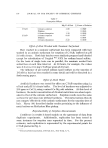
132 JOURNAL OF THE SOCIETY OF COSMETIC CHEMISTS was Bacillus subtilis (15.4%). If all the different strains of Bacillus species isolated in our research was combined, they would comprise 52.3% of the resident bacteria isolated. Gram-positive and gram- variable isolates accounted for 90.5% of the bacterial species. 10. Resident actinomycetes were found in 21.4% of subjects with dandruff and in 4.5% of those without dandruff. The eight resident isolates belonged to the genus Streptomyces. 11. There was no difference in the pH (,5.2) of the scalps of subjects with dandruff and those without. There is no correlation between scalp pH and dandruff. 12. No specific organism, with the possible exception of ?. ovale, showed any significant relationship to dandruff. It was concluded that an increase in the total microbial flora was a factor in the increase of dandruff production since almost twice as many species of organisms were found in the scalps of those subjects with dandruff than on the scalps of those subjects without dandruff. (Received April 26, 1968) REFERENCES (10) (11) (13) (1) Malassez, L., Note sur la champignon de la pelade, Arch. Physiol. iVorm. et Pathol., 1, 208 (1874). (2) Reddish, G. F., The etiology of infectious dandruff, J. Soc. Cosmetic Chemists, 3, 90 (1952). (8) Hechemy, K. E., The odoriferous principle obtained from Pityrosporum ovale when grown on a medium containing sesame oil, Master of Science Thesis, Massachusetts College of Pharmacy, Boston, 1965. (4) Roia, F. C., Jr., VanderWyk, R. W., and Beal, J. A., The human scalp as a habitat for yeasts, J. Soc. Cosmetic Chemists, 14, 81 (1963). (5) Beal, J. A., Isolation and classification of aerobic bacteria from the human scalp, Master of Science Thesis, Massachusetts College of Pharmacy, Boston, 1962. (6) Epstein, J. M., The isolation and identification of fecal organisms from the human scalp, Master of Science Thesis, Massachusetts College of Pharmacy, Boston, 1963. (7) Shaw, C. T., and VanderWyk, R. W., The human scalp as a habitat for molds, J. Soc. Cosmetic Chemists, 18, 563 (1967). (8) VanderWyk, R. W., and Roia, F. C., The relationship between dandruff and the micro- bial flora of the human scalp, Ibid., 15, 761 (1964). (9) VanderWyk, R. W., and Hechemy, K. E., A comparison of the bacterial and yeast flora of the human scalp and their influence upon dandruff production, Ibid., 18, 729 (1967). Van Buskirk, W. L., The aerobic bacteria of the human scalp and their relationship to scurf production, Master of Science Thesis, Massachusetts College of Pharmacy, Boston, 1967. Lubowe, I. I., Diseases of the scalp and hair, Soap, Perfumery Cosmetics, 34, 1028 (1961). Gordon, M. A., The lipophilic mycofiora of the skin. I. In vitro culture of oeityrosporum orbiculare n. sp., Mycologia, 43, 524 (1951). VanderWyk, R. W., Unpublished procedure, 1958.

FLORA OF SCALP AND DANDRUFF 133 (14) (15) (16) (17) (18) (19) (20) (21) (22) (23) (24) (25) (26) (27) (28) (29) (30) (31) (32) (33) (34) (35) (36) (37) (38) (39) (40) Pillsbury, D. M., and Rebell, G., The bacterial flora of tile skin. Factors influencing tile growth of resident and transient organisms, J. Invest. Dermatol., 18, 173 (1952). Bergelm, O., and Cornbleet, T., Acidity of the scalp, nature and possible relationship to seborrhea, Arch. Dermatol. and Syphilol., 56, 448 (1947). Anderson, D. S., The add-base baNnee of the skin, Brit. J. Dermatol., 63,283 (1951). Herrman, F., Behrendt, H., and Karp, F. L., On the acidity of the surface of the scalp and other areas of the skin in children, J. Invest. Dermatol., 7, 215 (1946). Beare, J. M., Cheeseman, E. A., Galley, A. A. H., and Neill, D. W., The pH of the skin surface of children with seborrhoeie dermatitis compared with unaffected children, Brit. J. Dermatol., 70, 233 (1958). Kapica, L., and Blank, F., Growth of Candida albicans on keratin as sole source of nitro- gen, Dermatologica, 115, 81 (1957). Kapica, L., and Blank, F., Growth of Candida parapsilosis with keratin as sole source of nitrogen, ibid., 117, 433 (1958). Noval, J. J., and Niekerson, W. J., Decomposition of native keratin by Streptomyces fradiae, J. Bacteriol., 77, 251 (1959). Pramer, D., The influence of physical and chemical factors on the preparation of silica gel media, Appl. Microbial., 5,392 (1957). Temple, K. L., A modified design of the Lees soil pereolation apparatus, Soil Sci., 71, 209 (1951). Lees, H., and Quastel, J. H., Biochemistry of nitrification in soil. Addendum by Lees, H. A., A soil perfusion apparatus, Biochem. J., 40, 812 (1946). Roia, F. C., Jr., The resident microbial flora of the human scalp and its relationship to dandruff, Doctor of Philosophy Thesis, Massachusetts College of Pharmacy, Boston, 1967. Lodder, J., and Kreger-Van Rij, N.J. W., The Yeasts: A Taxonomic Study, North Holland Publishing Co., Amsterdam, 1952. Roia, F. C., Jr., The human scalp as a habitat for yeasts, Master of Science Thesis, Massachusetts College of Pharmacy, Boston, 1960. Barnett, H. L., Illustrated Genera of Imperfect Fungi, 2ud ed., Burgess Publishing Co., Minneapolis, Minn., 1962. Martin, G. W., Outline of the Fungi, Win. C. Brown Co., Dubuque, Iowa, 1950. Alexopoulos, C. J., [ntroductory Mycology, John Wiley & Sons, Inc., New York, 1952. Lewis, G. M., Hopper, M. E., Wilson, J. W., and Plunkerr, O. A., An Introduction to Medical Mycology, 4th ed., The Year Book Publishers, Inc., Chicago, 1958, pp. 423-40. Smith, N. R., Gordon, R. E., Clark, F. E., Aerobic spore-forming bacteria, U.S. Dept. Agr. Monograph, 16 (1952). Breed, R. S., Murray, E.G. D., and Smith, N. R., Bergey's Manual of Determinative Bacteriology, 7th ed., The Williams and Wilkins Co., Baltimore, 1957. Waksman, S. A., and Leehevalier, H. A. The Actinomycetes, Vol. II, The Williams and Wilkins Co., Baltimore, 1959. Breed et al., op. cit., pp. 694-829. Waksman, S. A., and Leehevalier, H. A., Actinomycetes and Their Antibiotics, The Williams and Wilkins Co., Baltimore, 1953. Raper, K. B., and Fennell, D. I., Th• Genus Aspergillus, The Williams and Wilkins Co., Baltimore, 1965. Raper, K. B., and Thom, C., A Manual of the Penicillia, The Williams and Wilkins Co., Baltimore, 1949. Ridgway, R., Color Standards and Color Nomenclature, published by the author, Washing- ton, D.C., 1912. Ainsworth, G. C., and Bisby, G. R., A Dictionary of the Fungi, 4th ed., The Common- wealth Mycologieal Institute, Kew Surrey, 1954, p. 300.
Purchased for the exclusive use of nofirst nolast (unknown)
From: SCC Media Library & Resource Center (library.scconline.org)