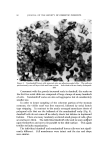
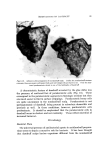
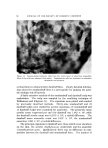
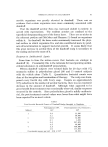
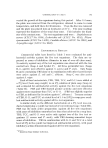
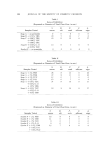
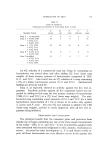
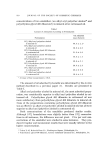
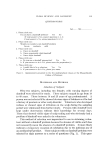
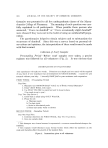
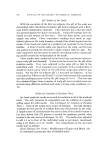
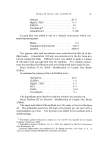
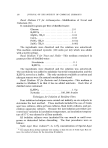
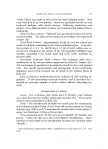
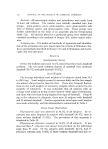
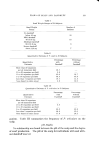
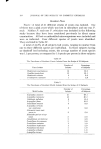
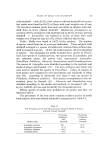
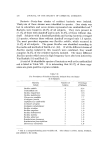
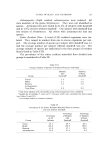
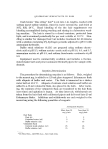
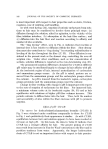
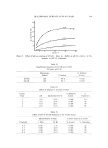
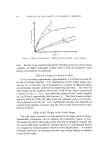
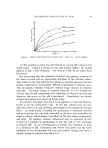
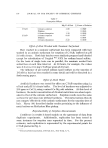
GERMICIDES OX SKIX 105 vented the growth of the organisms during this period. After 18 hours, the plate was removed from the refrigerator, allowed to come to room temperature, and held there for 30 minutes. Then the disc was removed and the plate was placed into an incubator at 37 øC. The zone readings represent the diameter of the total clear zone. This includes the diam- eter of the contact zone. The test organisms used were: Staphylococcus aureus (ATCC* No. 6538), t•scherichia coli (ATCC No. 4352), Pityro- sporum ovale (ATCC No. 14521), Candida albicans (ATCC No. 2091), and Aspergillus niger (ATCC No. 9642). EXPERIMENTAL RESULTS Commercial toilet bars listed in Table I were evaluated for anti- bacterial activity a,dainst the five test organisms. The data are ex- pressed as zones of inhibition (diameter in mm of over-all clear zone). No activity against any of the test organisms was observed with the two control bars (Soap A and Syndet F). All three germicidal bars (Soaps B, C, and D) were effective against S. aureus and P. ovale. Only Soaps B and C containing TBS alone or in combination with other bacteriostats were active against F.. coli and C. albicans. Soap C was also active against A. niger. Each of four bacteriostats, PBS, TBS, TCC, and G-11 were added at a 2% level (basis soap weight) to an 8% solution of plain soap (Soap A) and evaluated for antibacterial activity against the five test organisms (Table II). PBS and TBS showed greater activity and were effective against more organisms than TCC or G-11. (PBS was slightly superior to TBS, as indicated by its action against C. albicans.) Ternary systems of TBS, G-11, and TCC at a total level of 1.5 to 2.0% in soap gave excel- lent antibacterial activity against all five test organisms. A similar study on the different bacteriostats at a 2•c, level was con- ducted employing a syndet bar instead of conventional soap (Table III). PBS was the most active preparation (against all five test organisms) with zones of inhibition somewhat less than that achieved in a soap base. TBS, TCC, and G-11 were active only against two of the five test or- ganisms (S. aureus and P. ovale), with TBS showing somewhat larger zones of inhibition. TBS in combination with G-11 and TCC at a total level of 2% in the syndet bar improved antibacterial activity, with good inhibitory action demonstrated against all five test organisms. * American Type Culture Collection.

106 JOURNAL OF THE SOCIETY OF COSMETIC CHEMISTS Table I Zones of Inhibition (Expressed as Diameter of Total Clear Zone, in mm) Samples Tested S. E. P. C. A. aureus coli ovale albicans niger Soap A -- no germicide 0 0 0 0 0 Soap B d- 0.75% TBS 20 7 12 7 0 Soap C d- 0.66% TBS 20 9 13 8 17 + 0.66% TCC d- 0.66% TFC Soap D d- 0.75% G-11 15 0 7 0 0 + 0.75% TCC Syndet F -- no germicide 0 0 0 0 0 Table II Zones of Inhibition (Expressed as Diameter of Total Clear Zone, in mm) Samples Tested S. E. P. C. A. aureus coli ovale albicans niger Soap A d- 2% PBS Soap A d- 2% TBS Soap A + 2% TCC Soap A d- 2% G-11 Soap A d- 0.5% TCC -3- 0.5% G-11 d- 1.0% TBS Soap A -3- 0.5% TCC + 0.5% G-11 d- 0.5% TBS 28 8 12 9 16 22 8 11 0 13 12 0 7 0 0 15 0 7 0 0 24 9 15 8 17 18 8 14 8 17 Table iii Zones of Inhibition (Expressed as Diameter of Total Clear Zone, in ram) s. E. P. C. A. Samples Tested aureus coli ovale albicans niger _ Syndet F d- 2% PBS 13 8 8 8 8 Syndet F d- 2% TBS 11 0 9 0 0 Syndet F d- 2% TCC 9 0 7 0 0 Syndet F d- 2% G-11 9 0 7 0 0 Syndet F d- 1.0% TBS 12 7 8 8 8 + 0.5% G-i• + 0.5% TCC
Purchased for the exclusive use of nofirst nolast (unknown)
From: SCC Media Library & Resource Center (library.scconline.org)