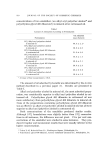
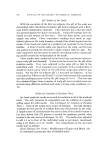
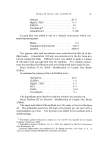
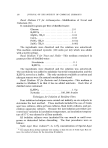
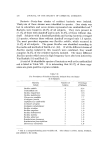
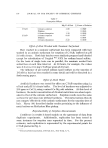
120 JOURNAL OF THE SOCIETY OF COSMETIC CHEMISTS Basal Medium IV for Actinomycetes--Modification of Noval and Nickerson (21). It contained in grams per liter of distilled water: Glucose ........................... 2.0 K2HPO4 .......................... 1.5 MgSO4' 7H20 ...................... 0.05 CaC12 ............................. 0.05 FeSO4.7H20 ....................... 0. 015 ZnSO4- 7H20 ....................... 0. 005 The ingredients were dissolved and the solution was autoclaved. This medium contained nystatin (100 units per ml) which was added with a sterile syringe. Basal Medium V for Yeast and Molds--This medium contained in grams per liter of distilled water: Novobiocin ........................ 0.1 K2HPO• .......................... 1.0 The ingredients were dissolved and the solution was autoclaved. The novobiocin was added to minimize bacterial contamination and the K2HPO• served as a buffer. The only nutrients available as carbon and nitrogen sources were the natural constituents of scurf. Basal Medium VI for Bacteria and Actinomycetes--This medium is similar to Medium V in that it has no added nutrients. Each liter of distilled water contained: K2HPO4 .......................... 1.0 g Nystatin ................. 100,000.0 units Techniques for Isolation of Resident Flora Four isolation techniques were carried out initially on six subjects to determine the best method. These methods included the use of Noble agar base cultures, silica gel base cultures, flask broth cultures, and per- colation apparatus cultures. Because the last isolation procedure pre- vented any variation in incubation temperature, an incubation tempera- ture of 37 øC was chosen for all four methods. All isolation cultures were incubated for one month or until over- grown or desiccated before discarding. The four procedures were as follows: Noble Agar Base Cultures*--A 1.5% concentration of Special-Agar * The isolates from all four methods were similar, so that the use of Noble Agar Base be- came the method of choice for the remaining 46 subjects.

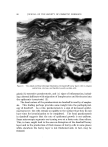
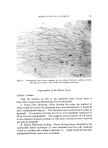
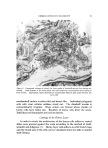
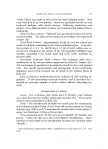
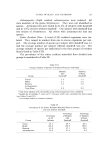
FLORA OF SCALP AND DANDRUFF 121 Noble (Difco) was made in each of the six basal isolation media. Into each Petri dish 25 ml was poured. Scurf was sprinkled heavily on each hardened medium with sterile forceps. Following incubation and growth, every different kind of colony was examined and studied micro- biologically. Silica Gel Base Cultures--Silica gel was incorporated into each of the isolation media. The silica gel was prepared according to the method of Pramer (22). Flask Broth Cultures--Approximately 20 mg of scurf was placed into sterile 50-ml flasks containing 25 ml of basal isolation media. At incuba- tion periods of 1, 3, 7, 14, and 30 days, 0.1 ml of broth culture was re- moved and streaked on the surface of the corresponding solidified basal medium containing 1.5% Noble Agar and 0.1% scurf, sterilized by ethylene oxide. Percolation Apparatus Broth Cultures--The technique used was a modification of the soil percolation apparatus described by Temple (23). The mechanism of operation is described in detail by Lees and Quastel (24). The specific measurements and photographs of the hand-blown apparatus used in this research can be found in the original thesis of Roia (25). Such an elaborate method insured the isolation of slow growing or- ganisms. It also maintained constant aeration, and it provided for a method of removing samples of broth culture without disturbing the scurf. Identification of Cultures Yeasts--The techniques and media used to identify yeast isolates were those described by Lodder and Kreger-Van Rij (26). These meth- ods have been summarized by Roia (27). Molds--The identification of molds was based upon the examination of wet mounts prepared from 10- to 12-day old cultures grown on Czapek Solution Agar (Difco) at 25 øC and upon the examination of slide cultures* using Corn Meal Agar (Difco) as the nutrient. Three taxonomic keys (28-30) were used to identify the families and genera. Lewis et al. (31) were also very helpful in classification. Other references to keys used in the identification of genera are included under "Results." * Shoe•naker Fungus Microculture Slides, manufactured by Clay-Adams Co., Inc., New York.
Purchased for the exclusive use of nofirst nolast (unknown)
From: SCC Media Library & Resource Center (library.scconline.org)