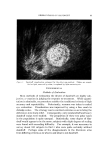
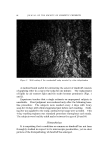
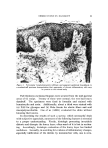
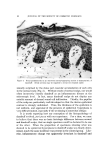
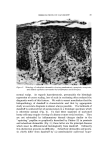
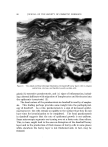
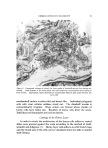
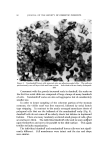
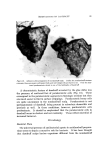
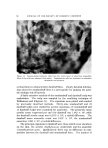
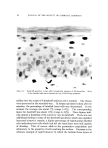
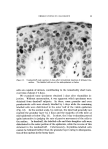
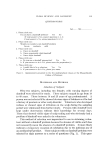
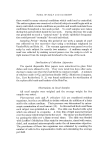
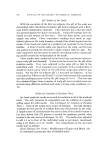
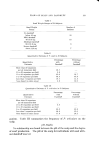
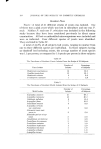
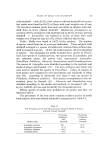
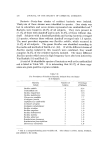
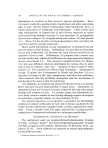
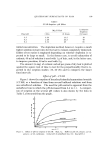
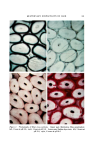
00 JOURNAL OF THE SOCIETY 01,' COSMETIC CHEMISTS In dandruff, the coherent horny layer is conspicuously thinner, usually 10 or fewer cell layers compared with 25 to 35 in the nondandruff. Moreover, in dandruff the cells swell less and have a disorderly pattern interspersed with crevices (Fig. 6). By contrast, the keratinized cells of the normal horny layer swell easily, are quite regularly arranged and re- main tightly bonded (Fig. 7). These observations apply to the coherent nondesquamating portion of the horny layer. A finding which at first seems paradoxical is that while the intact horny layer is thinner in dandruff, the total number of horny cells is considerably greater than the normal when the loose scale is included. Actually, the dandruff horny layer taken as a whole is very irregular in thickness. The coherent bottom bed is of fairly uniform width, but here and there one finds "boulders" of horny detritus precariously balanced on the bed. There may be 30 or more poorly organized cell layers in the large boulders. One explanation is that the boulders reflect sites of greatly increased horn cell production the cells stream to the surface at different rates of movement leading to "cracking up" of the stratum corncure in uneven fashion. Cellular Arrangement That the dandruff horny layer is imperfectly organized is manifested in several ways. When plastic cups sutured to the scalp were used to prevent loss of horny material, histologic section in which the scale happened to be retained showed considerable irregularity in patterning (Fig. 8). The laminae were undulating instead of flat and curved as if attempting to form whorls. Crevices between the cells were frequent. McOsker and Harmon observed marked changes in dandruff scales studied under the electron microscope (5). Desmosomes were less frequent the cells tended to separate and fold on themselves and there were numerous intracellular lipid droplets. These observations suggest that a major alteration in dandruff is the tendency of the horny layer to "crack up" unevenly, whereas, in the normal process of desquamation, tiny fissures occur near the surface and permit the orderly separation of microscopic cell aggregates. In dan- druff, breaks occur deeply and irregularly in the horny layer, resulting in dislodgement of very much larger cell clumps. Dandruff scales, like those of psoriasis, appear white due to the presence of air in the clefts between the cellular fragments. The surface topography of the dandruff scalp is strikingly different from normal this was particularly well shown in skin replicas (6). The

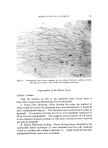
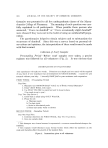
OBSERVATIONS ON I)ANI)RUFF Figure 8. Occasional instance in which the loose scales of dandruff are not lost during see- tioning. Total disarray of the horny layer with cells recurving on themselves and tending to form whorls. Appropriate stains demonstrate innmnerable bacteria and yeast between the horn cells nondandruff surface is rather flat and desert-like. Individual polygonal cells with clear cellular outlines stand out. The dandruff terrain is extraordinarily irregular. Huge craters are formed where chunks of horny cells have fallen out. Boulders of horny cells litter the scene. Individual cell boundaries are hard to discern. Cytology of the Ilorny Layer In order to study the architecture of the horny cells, adhesive-coated slides were pressed against the scalp according to the method of Gold- schmidt and Kligman (7). Horny layer cells adhere as with Scotch tape and the broad axis of the cells can be visualized when the slide is stained with Giemsa.
Purchased for the exclusive use of nofirst nolast (unknown)
From: SCC Media Library & Resource Center (library.scconline.org)