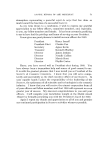
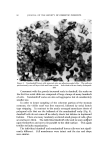
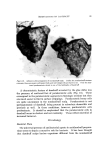
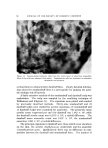
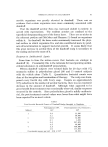
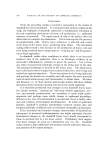
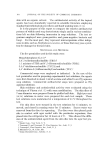
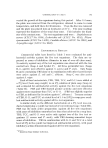
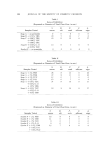
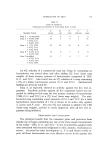
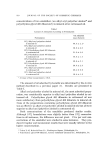
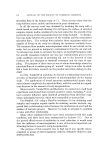
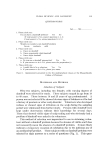
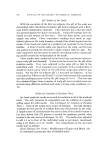
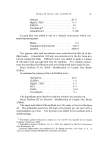
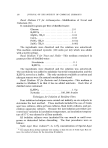
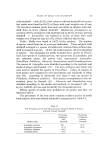
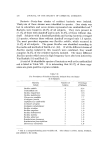
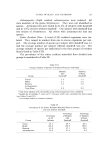
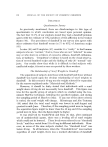
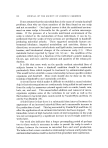
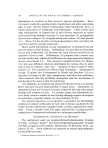
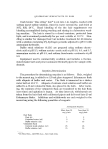
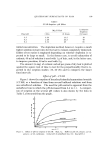
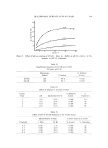
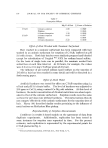
GERMICIDES ON SKIN Table IV Zones of Inhibition (Expressed as Diameter of Total Clear Zone, in mm) 107 S. E. P. C. A. Samples Tested aureus coli ovale albicans niger Soap A -- no germicide 0 0 0 0 0 Soap A q- 0.75% TBS 19 7 9 7 14 + 0.6% G-11 + 0.65% TCC Soap A q- 1.0% TBS 23 10 11 8 + 0.5% + 0.5% TCC Soap D q- 0.75% G-11 1,5 0 7 0 0 + o.75% TCC Soap D modified 2!2 7 9 7 17 + 0.75% + 0.75% TCC q- 0.5% TBS An 8% solution of a commercial soap bar (Soap A) containing no bacteriostat was tested alone and after adding 2% level (basis soap weight) of three ternary systems of bacteriostats comprised of TBS, G-11. and TCC. Also tested was an 8% solution of a soap containing 1.5% of a binary bacteriostat system (G-11 and TCC). Antibacterial findings are given in Table IV. Soap A, as expected, showed no activity against the five test or- ganisms. Excellent activity against all five organisms tested was im- parted by adding to this soap the two ternary systems of bacteriostats (TBS, G-11, and TCC) at a 2% level (basis soap weight). The anti- bacterial soap containing equal amounts of G-11 and TCC for a total bacteriostat concentration of 1.5% is shown to be active only against S. aureus and P. ovale. If to the 8% test solution is added 0.5% TBS (basis soap weight), activity is vastly improved, with all five test or- ganisms being inhibited. DISCUSSION AND CONCLUSION The principal benefit that the consumer gains and perceives from regular use of soaps containing any one of the three major bacteriostats in use today--TBS, G-11, and TCC--is one of protection against body odor associated with bacteria indigenous to skin, namely, Staphylococcus aureus. As noted by other investigators (1, 3-5) and shown in this re- port, all three bacteriostats are very effective at use levels against this

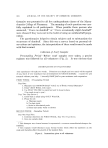
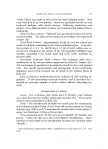
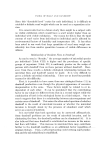
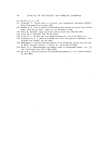
108 JOURNAL OF THE SOCIETY OF COSMETIC CHEMISTS gram-positive organism. However, such equivalency in activity does not exist when one considers other microorganisms usually associated with skin problems, such as gram-negative bacteria and fungi. Data presented in this paper indicate that toilet bars with 2% 3,4•, - 5-tribromosalicylanilide (TBS), either alone or in combination with 4•,5 - dibromosalicylanilide, are superior to soaps containing either 2t• G-11 or 2% TCC when tested against five test organisms in a modified skin sub- stantivity test. The most effective bacteriostat mixtures in soap, as demonstrated by activity against all five test organisms, were those containing TBS. The superiority of TBS-containing mixtures over G-11, TCC, or combinations thereof, is also evident when evaluated in nonsoap bars. Of interest here is the excellent activity of PBS alone in a neutral syndet bar, a vehicle which usually has a depressing effect on the activity of G-11 or TCC. ACKNOWLEDGMENT The technical assistance of Mrs. LaVeme J. Makfinsky, bacteriologist at Fine Organics, Inc., is gratefully acknowledged. (Received December 8, 1967) REFERENCES (1) Vinson, L. J., Ambye, E. L., Bennett, A. G., Schneider, W. C., Travers, J. J., In vitro tests for measuring antibacterial activity of toilet soap and detergent bars, J. Pharm. Sci., 50, 827-30 (1961). (2) Molnar, N.M., New soap/detergent bacteriostat, Soap Chem. Specialities, 41, 59-63 (1965). (3) McNamara, T. F., and Steinbach, M., In vitro evaluation of the tissue substantivity of selected antibacterial agents, Y. Am. Oil Chemists' 3o½., 44, 478-80 (1967). (4) Leonard, R. R., Prevention of superficial cutaneous infections, Arch. Dermatol., 95, 520-3 (1967). (5) Tabe L D., Yackovich, F., Brown, J., Jr., The microbiologlcal availability of soap bacte- riostats, J. Am. Oil Chemists' So½., 44, 473-5 (1967).
Purchased for the exclusive use of nofirst nolast (unknown)
From: SCC Media Library & Resource Center (library.scconline.org)