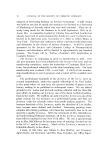
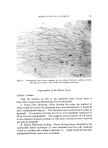
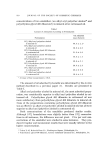
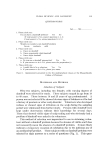
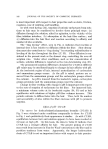
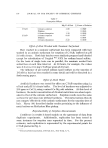
116 JOURNAL OF THE SOCIETY OF COSMETIC CHEMISTS tionnaire was presented to all five undergraduate classes of the Massa- chusetts College of Pharmacy. The meaning of each question was care- fully explained to all participants. When possible those persons who answered, "I have no dandruff" or "I have occasionally slight dandruff" were chosen if they were not in the habit of using an antidandruff prepa- ration. The questionnaire helped to obtain subjects and to substantiate the occurrence of dandruff. Since this was a survey based on personal ob- servations and opinions, the interpretation of these results must be made with that in mind. Collection of Sc•trf Samples Jresampling Period--Before scurf samples were taken, a precise regimen was followed by all volunteers (Fig. 2). It was obvious that INSTRUCTIONS TO VOLUNTEERS This experiment will take two weeks. Directions are simple and not much will be required of you, but it is very important that all instructions be followed faithfully. I cannot do any research without your help. I sincerely thank you for your assistance and cooperation. FIRST WEEK: (Presampling Period) Day One: 1. Shampoo hair THOROUGHLY with « oz. of Breck Normal Shampoo.* 2. Rinse VERY WELL with water. 3. Use ONLY WATER to comb hair and to kecp in place. (Use comb given to you.) Day Two-Day Seven:t 1. Comb hair as usual using ONLY WATER. 2. Please do not: a. Shampoo again b. Use hair tonic c. Swim in chlorinated pools d. Rinse hair under water or shower SECOND WEEK: (Sampling Period) Day One-Day Five: 1. Continue directions for FIRST WEEK, Day Two-Day Seven. 2. Give one sample daily. * This shampoo was chosen because it represented a common nonmedicated shampoo for- mulation. t This regimen would eliminate many foreign factors which effect the nutrients on the scalp and therefore effect the growth of the resident flora. Figure 2. Instructions given to all volunteers

i*LORA OF SCALP AND DANDRUFI• there would be many external conditions which could not be controlled. The entire regimen was conceived so that all subjects would begin with as many controlled external conditions as possible and would maintain these conditions throughout a two-week period. No scurf samples were taken during this period which lasted for one week. During this time the scalp was permitted to reach a "natural state" in which epithelial desquama- tion could proceed "normally" for each individual. Sampling Period--During this period of one week a sample of scurf was collected on five successive days using a technique employed by VanderWyk and Roia (8). The vacuum apparatus was passed over the scalp by each subject for exactly two minutes. A uniform sample of scurf was collected by making several passes over the scalp in a left to right manner from the temple and forehead to the nape of the neck. Sterilization of Collection Apparatus The special disposable filter papers were autoclaved in glass Petri dishes and were allowed to dry. They were tared two days after auto- claving to make sure that they had dried to constant weight. A mixture of ethylene oxide (10%) and carbon dioxide (90%) (Matheson Company, Inc., East Rutherford, N.J.) was found satisfactory for sterilization of the replaceable heads and baskets of the HairVac. Observations on Scurf Samples All scurf samples were weighed and the average weight for five samples was noted. Pityrosporum ovale and P. orbiculare (12) are considered resident organisms, but they are difficult to isolate without the addition of a fatty acid to the culture medium. Their presence was determined by micro- scopic examination of scurf smears (13). In this method fresh scurf from each subject was sprinkled on a slide. The slide was flooded with xylol which was allowed to evaporate. A thin film of lipid material formed over the smear which helped to fix the scurf. The smear was fixed further by passing the slide over a flame several times. The slide was flooded with Loeffier's Methylene Blue stain for two minutes, rinsed with water, dried, and examined microscopically under the oil immersion objective. The prevalence of these two organisms was estimated by counting the number of cells in five representative fields and calculating the average per field,
Purchased for the exclusive use of nofirst nolast (unknown)
From: SCC Media Library & Resource Center (library.scconline.org)