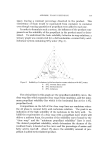
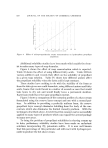
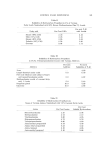
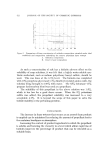
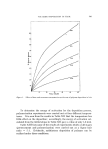
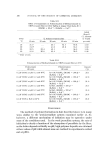
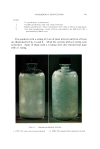
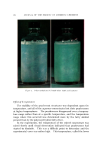
J. Soc. Cosmetic Chemists, 20, 511-523 (Aug. 19, 1969) Technology of Consistent Aerosol Foam Dispensing Without Costly Gadgetry HARRY MACE, B.A., AND CARMELO CARRION, B.S.* Presented September 12-15, 1969, Seminar, Boston, Mass. Synopsis--A characteristic deficiency of aerosol foams, such as shave creams, is the increase in foam wetness as the can empties. This change in foam density can be minimized with solubility and other theoretical considerations. A characteristic extrusion profile for a given formulation can be made by plotting propellant content against per cent product in the can. The per cent of product extruded as a satisfactory foam varies between formulations. To study the problem, a ternary graph showing propellant solubilities in fatty acid-amine com- positions where the water content of the total system is 80% was prepared. A product with a perfectly uniform foam is realized by formulating a soap solution that is clear with propellant included but where the propellant has a limited solubility in the soap. Propellant may then be added above this amount to form a reserve layer which will maintain a constant propellant percentage dissolved in the solution during extrusion. The graph defines compositions of soap solutions that fulfill these requirements. Proper operation of this concept requires the can not be shaken before use. Propellant solubilities were determined with formulations using the newer synthetic detergents with and without salt added. INTRODUCTION In 1966, Richman and Shangraw (1-5) published a very com- prehensive and thorough review on the theory of formation, formulation, and methods of evaluation of aerosol foams. One of the studies dealt with the emptying characteristics of pressurized foams and computer predictions of propellant changes during extrusion. Their work was * Aerosol Techniques Research Center, Inc., 265 Old Gate Lane, Milford, Conn. 06460. 511

512 JOURNAL OF THE SOCIETY OF COSMETIC CHEMISTS designed to measure the loss in propellant concentration with container emptying and the results of their tests showed that the loss in propellant concentration with emptying was indeed dramatic, this fact becoming most obvious after the container is 50% empty. It is a well-known fact that as an aerosol product is discharged from the container, the volume of the liquid phase decreases and the volume of the vapor phase increases correspondingly. In foam products, where the propellant concentration is necessarily small, the change in concen- tration of propellant in the liquid phase as the product is discharged is significant and will cause a noticeable change in foam properties. These alterations in foam properties manifest themselves as changes in the con- sistency, foam viscosity, and foam density. This nonuniformity of foam from the beginning to end of the package has been a source of con- cern to the aerosol chemist through the years. In the case of aerosol shave creams, shampoos, etc., the degree of nonuniformity is mostly noticeable towards the end of the package and the consumer has re- luctantly learned to accept this change in foam consistency as normal for an aerosol package. However, with the growing interest in utilization of foams in pharmaceutical applications, it has become necessary to develop foam systems which will insure a uniform dosage throughout the life of the package. Formulation technology for pressurized foams is well known to the art. Fundamentally, aerosol foams may be developed from three basic systems i.e., water-based emulsions or surfactant-containing solutions, hydroalcoholic, and nonaqueous systems. Spitzer et al. (6) obtained a patent in 1953 covering the use of a range of concentrations of various surface active agents, as well as triethanolamine salts of fatty acids, as emulsifying agents for certain propellants in aqueous media. This work is still used as the basis for most shave lather formulations in the aerosol industry. Sanders (7-12) has published a series of very comprehensive studies on foam formulation technology and his work on hydroalcoholic and non- aqueous foams was the first and most detailed ever offered to the in- dustry. However, formulation technology to date has been directed toward the new foam "forms" such as quick-breaking, long-lasting con- traceptive and other foam innovations rather than toward correction of the basic problem of uniform foam formation. The purpose of this paper is not to show new concepts in aerosol foam formation, but rather to show new techniques by which conventional
Purchased for the exclusive use of nofirst nolast (unknown)
From: SCC Media Library & Resource Center (library.scconline.org)