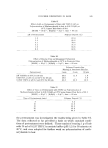
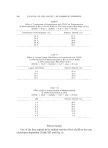
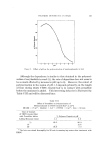
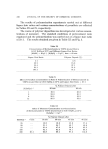
568 JOURNAL OF THE SOCIETY OF COSMETIC CHEMISTS the waxes present did not interfere with this sterol determination. The amount of wax was then approximated by correcting the weight of the combined fraction by the amount of colorimetrically determined cholesterol ester. Triglycerides and Free Sterols--It was not possible to obtain a satis- factory separation of these two lipids with the silicic acid used in this study. Therefore, these two lipids were eluted and collected as a single fraction with hexane-benzene (40:60) as the eluant. As before, the combined fractions were dried and the residue was weighed. The amount of free sterol was estimated colorimetrically (11) and expressed as cholesterol. In this instance it was necessary to isolate the cholesterol by solvent partition aoeter alkaline saponification of the triglycerides as it was not possible to determine cholesterol reliably in their presence. As in the previous fraction, an approximation of the triglycerides was made by correcting the total residue for the amount of sterol, as cholesterol, colorimetrically assayed. "t•olar Material"---•This material was removed from the silicic acid by absolute methyl alcohol and weighed. No further analysis was done on this fraction for the purposes of this study. Its collection served only to monitor the completeness of the elution of the sample placed on the silicic acid. Each of the above fractions was routinely monitored for completeness of separation, within the limits of the procedure, by thin-layer chroma- tography (12). Typically, one could recover in excess of 97% of the sample introduced onto the silicic acid by the elution procedure de- scribed. The fatty acids found in the triglyceride and wax-sterol ester fractions were obtained by solvent partition after alkaline hydrolysis. The hydrolysis was carried out in a sealed tube under an atmosphere of nitrogen at 100 øC for 15 hours. The fatty acids so obtained were con- verted to their methyl esters by BFa-MeOH (9) and subjected to analysis by gas-liquid chromatography. Gas chromatography of the fatty acid methyl esters was carried out on a Perkin-Elmer Model F-11.* Apiezon-L "Golay" capillary col- umns 100 feet long (0.02 inch i.d.) were obtained precoated from Perkin- Elmer and used after appropriate conditioning as recommended by the manufacturer. Approximations of the areas under the major fatty acid * Perkin-Elmer Corp., Norwalk, Conn.

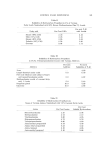
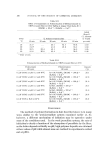
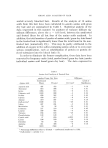
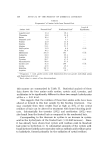
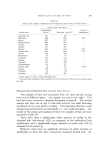
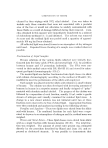
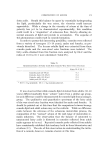
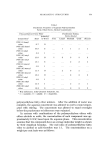
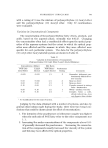
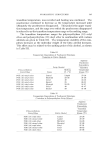
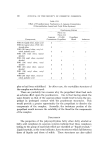
COMPOSITION OF SEBUM 569 peaks were made by triangulation. Relative comparisons were made between fatty acids by computing a ratio of the areas under the respec- tive peaks. Fatty acid peaks of interest were identified by comparison to known samples of fatty acid methyl esters. RESULTS The initial pools of lipid obtained from both facial wipings and comedo extracts were redissolved in hexane prior to removal of any free fatty acids. It was observed that the facial lipids of males before (6-11 years of age) and after (25-40 years of age) puberty were readily resolu- ble in hexane. However, not all of the lipid which had been extracted from the comedos could be dissolved in hexane. Table I summarizes the distribution of lipid found in the facial wipings and comedos based on solubility. Table I Gross Fractionation of Skin Lipid Samples Obtained from Human Males Facial Surface Lipids, % Comedo Lipid, ½• Fraction 6-11 yr 25-40 yr 18-35 yr Protein 0 0 45 Lipid 100 100 55 Hexane-soluble 100 100 64 Hexane-insoluble ...... 36 It can be seen that all of the lipid collected from the facial wipings was totally soluble in hexane with no evidence of protein matter. This is not surprising as the collection and extraction procedures employed would have precluded the possibility of any proteinaceous or highly polar lipid being included in these samples. However, it is generally believed that the prime product of normal sebaceous secretion is almost exclu- sively lipid with only trace amounts of protein present, mostly as cell wall debris (13, 14). In the case of the comedo, only one-third of the total comedo is hexane-soluble lipid, the remainder being composed of protein with some highly polar lipid. TLC of the two apparent lipid fractions from the comedo suggested that the hexane-soluble material was indistinguishable from the facial lipid while the hexane-insoluble lipid contained highly polar substances with only trace amounts of the lipid components normally found in facial wipings. For the purpose of this study only the hexane-soluble portion of the lipids collected was further analyzed. Table II summarizes the compo-
Purchased for the exclusive use of nofirst nolast (unknown)
From: SCC Media Library & Resource Center (library.scconline.org)