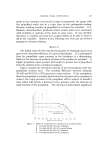
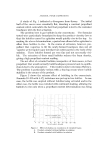
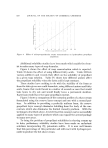
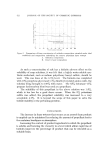
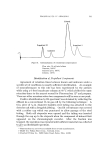
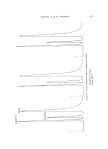
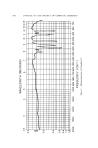
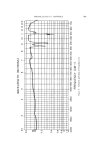
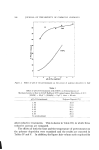
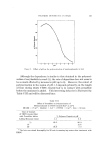
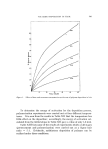
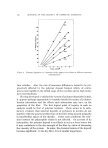
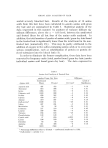
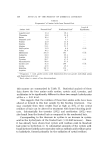
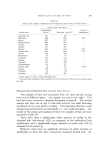
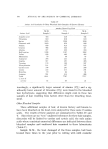
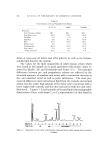
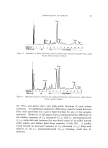
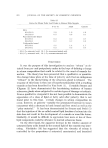
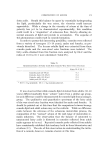
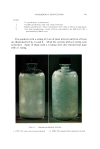
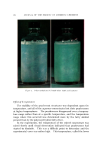
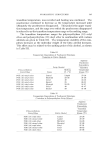
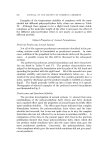
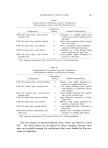
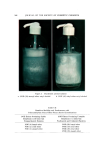
AEROSOL FOAM DISPENSING 517 A study of Fig. 1 indicated a divergence from theory. The initial half of the curves were essentially flat, denoting a constant propellant content which contradicts the fact that propellant is lost to the container headspace with the first actuation. The problem here is gas bubbles in the concentrate. The formulas tested were particularly formulated to keep the product viscosity low so that the bubbles caused by agitation would quickly rise to the top. In making the above determinations, a period was allowed after agitation to allow these bubbles to rise. In the course of extrusion, however, pro- pellant that vaporizes to fill the newly-formed headspace does not all vaporize at the liquid-vapor interface but rather partly in the body of the solution. These bubbles formed are very fine and not necessarily visi- ble. The extrusion of these small bubbles reduces the foam density, giving a high propellant content reading. The net effect of extruded bubbles, irrespective of their source, is that propellant that would normally build headspace pressure back to equilib- rium is lost to the atmosphere. This results in lower extrusion efficiency. The problem is particularly serious with a shaving cream where bubble stability is the essence of the product. Figure 2 shows the extreme effect of bubbling in the concentrate. Formula 33-421 with 4.4% isobutane was put up in two bottles. In one case, the bottle was emptied without bubbles being extruded and in the other case, the bottle was extruded with continued shaking, allowing the bubbles to rise only when a propellant content determination was being M•plmum / fo, r 10 20 30 40 50 60 70 Percent product extruded 80 90 100 Figure 2. Effect of shaking on consistency of extruded foams A. Product extruded without bubbles in solution B. Product extruded with bubbles in solution

JOURNAL OF THE SOCIETY OF COSMETIC CHEMISTS made. It is to be noted that 92% of the product was extruded under proper conditions and only 75% with shaking. It should be mentioned that all of these extrusion determinations were cut off after 90 to 95% extrusion because, even after sitting over- night, the prevalence of bubbles prevented the taking of significant readings. It becomes obvious that, in addition to increasing the soap concen- tration, the solution viscosity must be kept constant or lowered to obtain maximum extrusion efficiency. A proper solution viscosity can be defined as a viscosity sufficiently low so that, at the coolest temperature at which the product is likely to be used, all bubbles formed from a single extrusion will rise to the interface within the normal anticipated period between applications. It is realized that high soap and low viscosity parameters are con- tradictory, but with the abundance of modern surfactants available as viscosity modifiers, the chemist of today can meet the problem. Some brands of shaving creams direct the user to shake only when the can is first purchased. Such a direction would require an extremely effective emulsification system as the solution of the propellant in the oil phase would greatly increase the water phase-oil phase specific gravity difference with the consequent increased tendency toward separation and loss of product uniformity. This laboratory has formulated a high-soap content, low-viscosity shaving cream which will extrude completely with a satisfactory foam if the propellant content is carefully controlled and the agitation before extrusion is accomplished with a swirling motion. The foam, however, is not completely uniform throughout the extrusion. We have also formulated clear shave creams that could carry the "no-shake" instruc- tion without the possibility of product separation. UNIFORM FOAM CONCEPT A foam that would be uniform from the beginning of the container until the end would be possible with a system in which the propellant dissolves in the product to form a clear solution and is only soluble up to the amount required to give the desired foam texture. The uniform foam would be assured by adding propellant above this amount, the excess forming a reserve layer of propellant. The product must be no- shake so a clear soap is desirable to assure the product uniformity (no problem of emulsion separation). As the contents of the can are ex- truded, the propellant from the excess layer vaporizes to fill the head-
Purchased for the exclusive use of nofirst nolast (unknown)
From: SCC Media Library & Resource Center (library.scconline.org)