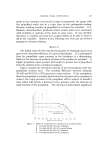
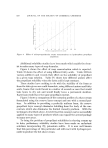
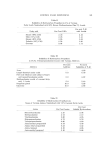
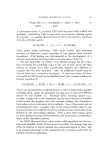
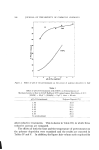
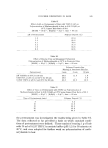
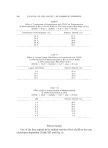
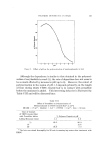
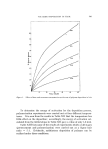
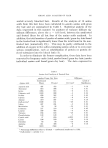
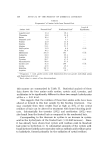
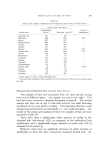
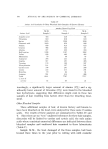
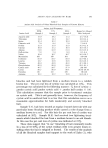
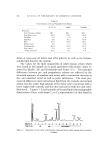
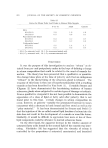
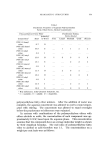
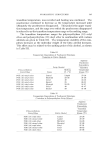
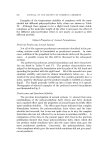
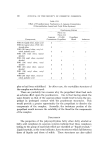
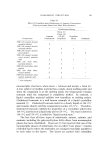
POLYMER DEPOSITION IN HAIR 543 RESULTS As is often the case in work related to the development of new pro- cesses, the experimental procedures which are employed may deviate from strict paths of practicability. An attempt has been made here to restrict the extent of such divergence by directing the main effort to the study of parameters either inherent to the understanding of mechanism of the deposition or useful from the application standpoint. It is well realized that the deposition of polymer in hair--if it is to become a commercial proposition--has to be carried out at ambient temperatures using medically acceptable monomers. The toohomer chosen for this study, methacrylamide (MAM), appears to fulfill the medical require- ments. In most cases, the upper limit of temperature at which the deposition process is carried out does not exceed 25 øC. To keep the time of the deposition under such mild conditions within reasonable limits, a pretreatment aimed at the increase of the accessibility of hair is imperative. It is not surprising to find that THPC performs this func- tion very well indeed. Pretreatment As indicated earlier in this paper, aqueous solutions of THPC effec- tively reduce the disulfide bonds in keratin. The mechanism involves a nucleophilic attack on sulfur-sulfur bond by THP species formed as a result of dissociation of THPC (eq 1). It is evident from this equation that pH is one of the decisive factors determining the concentration of THP and consequently the rate at which disulfide bond breakdown occurs. The latter results in increased accessibility of hair, the extent of which will have a pronounced effect on the rate of polymer formation. The relation between pH of pretreatment and polymer deposition was therefore determined, the appropriate results being shown in Table I and Fig. 1. The hypothesis that the pH affects mainly the concentration of the actual reducing species and not its reaction with disulfide bonds is strongly supported by the results of pretreatment experiments carried out at different pH with THP itself (Table II and Fig. 1). Although the concentration of THP employed was half that of THPC in Table I, much higher depositions were obtained and they varied little over quite a broad range of pH. The time of washing of the hair after pretreatment with THPC does not affect the rate of polymer deposition, in contrast to the situation with

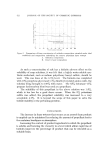
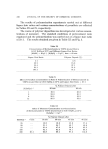
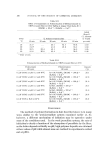
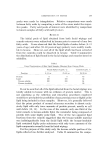
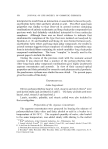
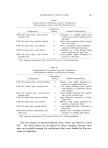
544 JOURNAL OF THE SOCIETY OF COSMETIC CHEMISTS • 50 f• 40 o• 30 • THP PC pH of Pre-treatment Figure 1. Effect of pH of the pretreatment on the extent of polymer deposition in hair Table I Effect of pH of Pretreatment with THPC on Poly•nerization of Methacryla•nide in Hair in 0.01N H2SO4 at 25øC using Liquor:Hair Ratio of 50:1 IMAM] = 50 gl-• [K2S•O8] = 3 gl-• time = 60 rain pH of Pretreatment Poly•ner Deposit (%) 1.05 10.9 2.70 21.8 3.50 30.5 4.05 36.1 4.25 4O.2 5.20 50.3 No pretreatment 8.8 other reductive treatments. This is shown in Table III, in which three reductive systems are compared. The effects of both the time and the temperature of pretreatment on the polymer deposition were examined and the results are reported in Tables IV and V. In addition, the liquor:hair volume ratio employed in
Purchased for the exclusive use of nofirst nolast (unknown)
From: SCC Media Library & Resource Center (library.scconline.org)