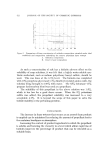
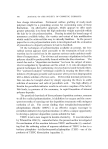
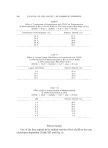
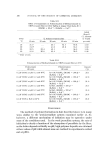
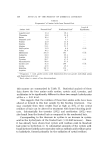
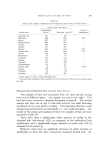
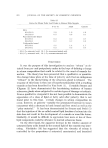
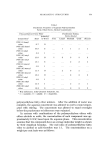
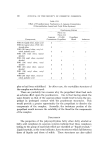
572 JOURNAL OF THE SOCIETY OF COSMETIC CHEMISTS Table III Ratios for Major Fatty Acid Peaks in Human Male Samples 6-11 ¾r Adult Comedo FFA 16:0/16:1 •* 2.9 1.6 2.9 18:0/18:1 b 0.5 0.6 0.7 Wax-sterol ester boun• 16:0/16:1 0.3 0.2 0.7 18:0/18:1 0.2 0.2 0.3 Triglyceride bound 16:0/16:1 2.1 1.4 1.7 18:0/18:1 0.3 0.3 0.4 16:0, C•6 saturated acid' 16:1, C•6 monounsaturated acid. 18:0, C•s saturated acid 18:1, C•s monounsaturated acid. DISCUSSION It was the purpose of this investigation to analyze "sebum" as ob- tained from pre- and postpuberty males in the hope of defining a change in sebum composition that could be related to the onset of comedo for- marion. The theory has been presented that a qualitative or quantita- tive change takes place at the time of puberty such that an endogenous "irritant" to the ductal lining of the sebaceous gland is released. The response of this tissue is then one of hyperkeratinization with a resulting comedo as has been described by Van Scott (1). Certainly Strauss and Kligman (2) have demonstrated the keratinizing tendency of human sebaceous glands when subjected to certain types of damage or irritants. From a qualitative viewpoint it has not been possible to demonstrate the appearance of a class of lipid or fatty acid after puberty that is not found prior to this time. Certain changes in sebum composition do occur, however, at puberty--notably the pronounced increase in waxes concurrent with a decrease in both bound and free sterol as well as the "polar material." It has been demonstrated by Strauss and Pochi (5) that the injection of the so-called neutral lipid fraction of sebum into the skin does not result in the development of a comedo or acne-like lesion. Similarily, it would be difficult to appreciate how more or less of these lipid components could be offensive to normal sebaceous tissue. On the other hand, the apparent increase in the relative amount of saturated fatty acids bound in the neutral lipid of the comedo was inter- esting. Nicolaides (16) has suggested that the viscosity of sebum is controlled by the proportions of saturated, unsaturated, and branched

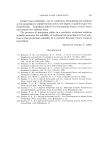
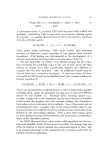
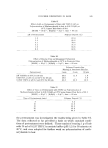
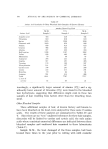
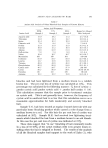
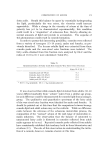
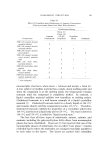
COMPOSITION OF SEBUM 573 fatty acids. Should this balance be upset by essentially hydrogenating the lipid, particularily the wax esters, the viscosity could increase appreciably. While a change in the viscosity of sebum at the time of puberty has yet to be demonstrated experimentally, this condition could result in a "stagnation" of sebaceous flow, thereby allowing ab- normal amounts of lipid and protein to accumulate. The sequelae of this phenomenon could result in comedo formation. In order to pursue this interesting possibility, comedos were collected from a variety of teenagers (15-18 years), males and females, as pre- viously described. The hexane-soluble lipid was extracted from these comedo pools and the wax-sterol ester fractions were isolated. The fatty acids obtained from this fraction were analyzed by GLC and the ratios of 16:0 to 16:1 were calculated (Table IV). Table IV Saturation Ratios of Fatty Acids from Comedo Wax-Sterol Ester Fractions Ratio 16 :{)/16:1 (• Comedo pool (25-40 yr) Comedo, boys (15-18 yr) Comedo, girls (15-18 yr) Adult pool (25-40 yr) 0.7 0.3 0.3 0.2 16:0 = Cx6 saturated 16:1 = C•6 monounsaturated. It was observed that while comedo lipid obtained from adults (2,5--40 years) differed markedly from "sebum" taken from a similar age group, no such difference could be demonstrated for comedo lipid from a younger, group. The qualitative and quantitative spectrums of the fatty acids of the wax-sterol ester fraction were identical for males and females. It should l•e pointed out at this time that the comparison between teenage comedo lipid and adult sebum may not be realistic. While no difference exists between the extremes of the sebaceous maturation process, the composition of the "normal" sebum of the mid-range of maturation re- mains unknown. The observation that the balance of saturated to unsaturated fatty acids is distorted in comedos collected from adult males appears to be real. Repeated comedo pools collected from adults have consistantly exhibited this tendency both in these laboratories and at others (17). The role of this observation in understanding the initia- tion of a comedo, however, remains obscure at this time.
Purchased for the exclusive use of nofirst nolast (unknown)
From: SCC Media Library & Resource Center (library.scconline.org)