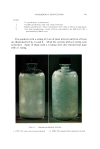
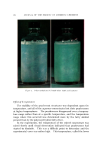
POLYMER DEPOSITION IN HAIR 553 Irrespective of location, the polymer is likely to affect either the kinetics (by simple mechanical hindrance effect) or the equilibrium of the keratin-water interaction. The presence of hydrophilic groups in- the polymer will tend to increase water absorption or water imbibition leading to higher swelling with a corresponding lowering of the modulus the reverse may be true for hydrophobic polymers. In general, any type of polymer deposit will increase the stiffness and bulkiness of hair. This may be recognized by the consumer as an im- provement in body. Depending on the nature of the polymer, the set- holding properties of hair are likely to be affected. It is conceivable that deposits of thermoplastic polymers would result in heat moldability of hair--almost an ultimate in styling. (Received October 25, 1968) (1) (2) (3) (4) (5) (6) (7) (8) (9) (lO) REFERENCES Lipson, M., and Speakman, J. B., The formation of polymers in wool, J. Soc. Dyers Colourists, 65,390 (1949). Madaras, G. W., and Speakman, J. B., The formation of polymers in wool, Ibid., 70, 112 (1954). Wolfram, L. J., and Speakman, J. B., The formation of polymers in wool, Ibid., 77, 477 (1961). Jenkins, A.D., and Wolfram, L. J., Vinyl polymerization in the presence of phosphine compounds as oxygen removers, U.S. Patent 3,248,376 (April 26, 1966). Bajpaj, L. S., Whewell, C. S., and Woodhouse, J. M., Action of tetrakis (hydroxy- methyl) phosphonium chloride (THPC) on wool, Nature, 187, 602 (1960). Jenkins, A.D., and Wolfram, L. J., The chemistry of the reaction between tetrakis (hydroxymethyl) phosphonium chloride and keratin, J. Soc. Dyers Colourists, 79, 55 (1963). Wolfram, L. J., The reaction of tris(hydroxymethyl) phosphine with keratin, III* Congr. Intern. Recherche Textile Lainiere, Paris, 1965, II, p. 505. Wolfram, L. J., and Menkart, J., Wool containing vinyl polymers. Production and some properties, Am. Dyestuff Reptr., 56, 110 (1967). Reuter, M., and Orthrer, L. (Farbwerke Hoechst). Tris(hydroxymethyl) phosphine, German Patent 1035 135 (July 31, 1958). Wolfram, L. J., Ph.D. Thesis, Textile Industries Department, Leeds University, England, 1960.

J. Soc. Cosmetic Chemis/s, 20, 555-564 (Aug. 19, 1969) Amino Acid Analysis of Cosmetically Altered Hair CLARENCE R. ROBBINS, Ph.D., and CHARLES KELLY, B.S.* Synopsis--Bleached and permanent waved hair, treated on the head by consumers, as well as unaltered hair, were hydrolyzed and examined by automatic amino acid analysis. The hydrolyzates of severely bleached hair were found to contain substantially less cystine and smaller quantities of tyrosine and methionine as compared to hydrolyzates from unaltered hair. Relatively large amounts of cysteic acid were also found in the bleached hair hy- drolyzates, the quantities increasing with increased bleaching. The hydrolyzates of per- manent waved hair also contained smaller quantities of cystine than those of unaltered hair with correspondingly larger amounts of cysteic acid. However, the quantities of cysteic acid found in the hydrolyzates from the permanent waved hair did not approach those found in the hydrolyzates of even the very mildly bleached hair. INTRODUCTION Extensive investigations into the chemical nature of bleached wool have been described, while, in contrast, few chemical data on human hair (1) exist in the scientific literature. For the oxidation of wool, the classical work of Harris et al. (2, 3) describes the reaction of hydrogen peroxide and its attack on cystyl and the dibasic amino acid residues, while Inglis and Leaver (4) have described the effects of peroxide oxidation on 19 of the amino acid residues in this same keratin. For human hair, Zahn has investigated the chemical effects of both bleaching (1) and permanent waving (5) and has recently surveyed the literature for the former reaction (1). One common feature of previous amino acid investigations of altered hair is the use of laboratory reacted hair. A somewhat different ap- proach has been taken for this investigation. Our approach has been to study the chemistry of permanent waving and bleaching of human hair by analyzing hair that has been treated on the head by consumers, in contrast to the usual situation of studying laboratory altered hair. * Colgate-Palmolive Research Center, Piscataway, N.J. 08854. 555
Purchased for the exclusive use of nofirst nolast (unknown)
From: SCC Media Library & Resource Center (library.scconline.org)