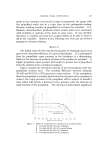
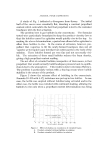
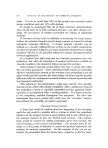
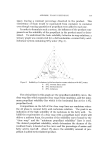
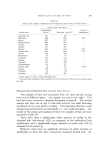
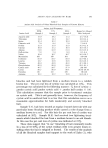
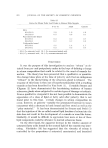
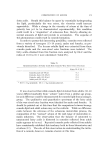
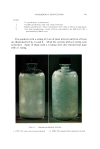
AEROSOL FOAM DISPENSING 513 water-based foams can be made to extrude uniformly throughout the life of the package. Let us consider a standard shave cream formulation consisting of a triethanolamine salt of coconut and stearic acids as the emulsifying sys- tem propelled by isobutane. The foam obtained from this system will vary with the amount of propellant dissolved and/or emulsified in the system. For example, a wet foam results with from 1.4 to 2.5% pro- pellant, a dry foam with more than 4.0ø/0, and an ideal foam when the propellant content is between 3.0 and 3.5ø/0. The problem with this type of system is that in the process of extruding the contents of the can, the foam will gradually change from an acceptable one at the beginning to a very wet foam at the end. In order to understand this phenomenon, it was considered desirable to be able to determine the amounts of propellant dissolved in a product at a given time and not only to know the solubilities of propellants in various solutions but to have an understanding of the factors that control this solubility. The following test methods were chosen as being fast, inexpensive, and well within the required accuracy as will be seen later. METHODS Effective Propellant Solubility The term "effective solubility" is coined to differentiate from absolute propellant solubility which this method does not claim to determine. A measure of the solubility of the propellant in a given solution may be obtained by determining the density of the foam produced by that solu- tion when it is saturated with the propellant. A small layer of the propellant must be present to assure continued saturation with extru- sion. Calculations are based on the gas laws with an attempt made to adjust for the fact that easily liquefiable gases are not perfect gases and the bubble film will exert a contracting effect on the expanded propellant. As this contracting effect will vary with bubble size, film thickness, and surface tension of the solution, the adjustment will be an average. This discrepancy is not considered serious as errors of far greater magnitude will result if even very fine gas bubbles are present in the product. The method has been tested by measuring the initial propellant concentration of samples where the bottles are weighed before and after being pres- surized and found to be accurate within 5ø•c.

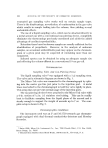
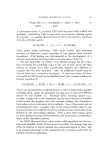
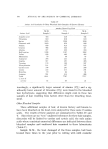
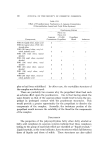
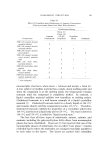
514 JOURNAL OF THE SOCIETY OF COSMETIC CHEMISTS One hundred grams of solution is weighed into a 4-oz plastic-coated aerosol bottle, the headspace in the bottle is purged with small amounts of the propellant to be tested, and a valve is crimped into place. The propellant is then added in 2-g increments, the contents being agitated several times and being allowed to come to equilibrium after each addi- tion. Additions are continued until a thin (1/56 in.) layer of propellant remains. The size of the layer must be controlled to prevent an appreci- able product composition change due to the solubility of one or more of the ingredients of the product in the propellant phase. The foam is then extruded into a weighed container of known volume and the increase in weights recorded. For the sake of convenience, disposable plastic caps which have a volume of 17.5 ml were used as the container. Completely filling the container and accurately leveling off the foam is no problem, particularly when a valve that gives a small degree of post expansion is used. Calculatiol• . weight propcllant (100) -- Ideal gas' per cent propellant = weight of foam - (17.5 -- weight of foam) (molecular weight of gas) (100) (22,400) (weight of foam) For isobutane' per cent propellant = (17.5 - weight of foam) (0.26) weight of foam The value 0.26 is a constant in this equation and substitution of a value of 0.29 compensates for deviations from ideal gas laws with rea- sonable accuracy. Propellant Content To determine the per cent propdlant in a given solution at a given time, an extrusion can be made as above and the same calculations are applied. Extrusion E.•ciency Extrusion efficiency or the per cent of the contents extruded as a suitable foam is the percentage of the total contents that can be extruded without the propellant content dropping bdow a percentage of 1.4 which is equivalent to a foam density of no higher than 0.175 g per ml. To study the extrusion efficiency of a given formulation, the percent- age of propellant is determined initially and at various stages of the emptying of the can. If vapor pressure readings are to be taken at any
Purchased for the exclusive use of nofirst nolast (unknown)
From: SCC Media Library & Resource Center (library.scconline.org)