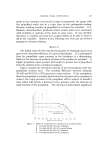
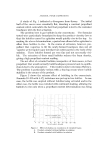
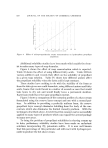
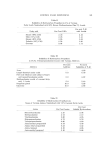
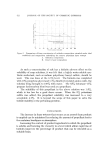
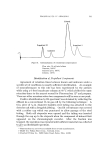
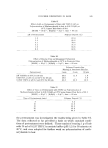
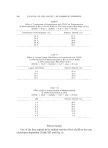
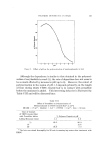
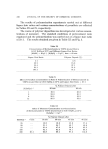
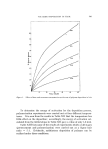
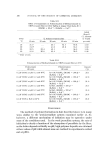
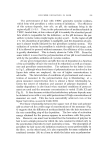
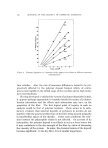
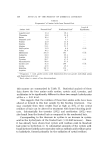
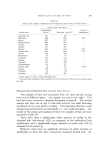
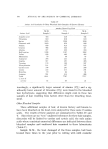
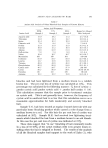
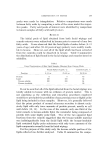
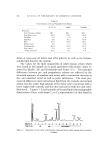
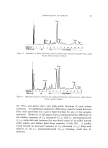
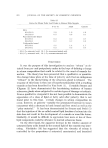
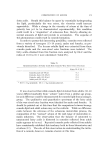
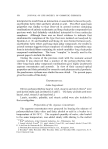
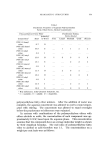
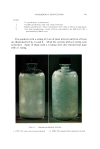
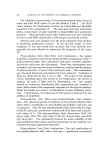
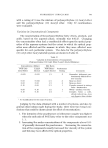
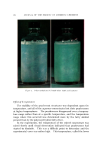
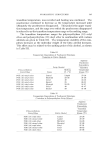
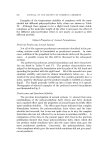
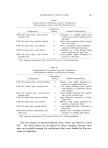
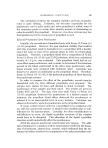
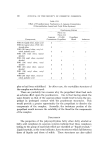
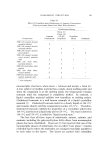
POLYMER DEPOSITION IN HAIR 551 The pretreatment of hair with THPC generates cysteine residues, which form with persulfate a redox system of initiation. The efficiency of this system depends, inter alia, on pH, the optimum being in the region of pH 1.5-3.5. Thus, in the polymerization of methacrylamide in THPC-treated hair, at low values of pH it is mainly the absorbed persul- fate which is responsible for the initiation as the pH increases the per- sulfate/cysteine redox couple begins to play a part. In the region of pH 5--6, the absorption of persulfate is negligible, and the deposition of poly- mer is almost totally initiated by the persulfate/cysteine system. The oxidation of cysteine by persulfate is relatively rapid in this range, and, if it is allowed to proceed without monomer, the efficiency of the system is greatly diminished. This is clearly shown in Table VIII. From the same table it is seen that the polymerization at low pH is not interfered with by the persulfate oxidation of cysteine residues. At any given temperature and pH, the rate of deposition is a function of the accessibility of hair (the extent of its reduction) as well as of mono- mer and persulfate concentrations. The optimum for the latter is close to 3 g/1., although when short times of polymerization are involved or low liquor:hair ratios are employed, the use of higher concentrations is advisable. The interrelation of conditions of pretreatment and concen- tration of monomer in the polymerization step is illuminating at a given monomer concentration there is almost a linear relationship be- tween the extent of reduction and amount of polymer deposited. A similar dependence is also found when standard conditions of pretreat- ment are used and the monomer concentration is varied (Table XI and Fig. 3). It thus becomes evident that satisfactory polymer deposits may be obtained even with a very mild pretreatment if high concentrations of monomer are used. This has been successfully achieved even at low liquor: hair ratios, as seen in Table XIII. The linear relationship between the square root of time and polymer add-on observed for a wide range of concentrations of the monomer (Fig. 4) suggests that the diffusion of methacrylamide into the hair structure is the rate-controlling step of the deposition. The low value of activation energy obtained for the process appears in accordance with this postu- late. However, one must bear in mind that the formation of polymer in hair is not a simple process for which the rate constant is related only to the penetration of keratin by inert molecules or ions. The absorption of persulfate by hair causes the initiation reaction to occur preferentially in the fiber on the other hand, it is also responsible for some oxidation of combined tyrosine (10) to a form in which the latter acts as polymeriza-

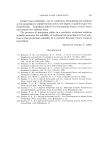
352 JOURNAL OF THE SOCIETY OF COSMETIC CHEMISTS Figure 4. 100 /o 90 [ ß 1•5(• Z5ø/ø 44• 5.0 % 30 2• I 2 3 4 5 6 7 8 Time, (rain) i/2 Polymer deposition as a function of the square root of time at different toohomer concentrations tion retarder. Also, the rate of monomer diffusion is bound to be pro- gressively affected by the polymer deposit formed, which, of course, grows most rapidly in the initial stage of the reaction and at high mono- mer concentrations. Having developed a satisfactory system of polymer deposition in hair, it appears perhaps appropriate to consider briefly the nature of Folymer- keratin interaction and the effects such interaction may have on the properties of the fiber. The first logical point of inquiry in such an analysis would be that of polymer location. There seems to be satis- factory evidence that internal deposits of polymers in keratin do not interfere with the general architecture of the fiber being located primarily in interfibrillar spaces of low density. Under such conditions the cohe- sion between the polypeptide chains is not affected. On account of its isotropicity, the polymer deposit is not likely to act as a force bearer but it may contribute to the dry strength of the fiber by virtue of increasing the viscosity of the system. In water, the chemical nature of the deposit becomes significant in the dry fiber, it is of smaller importance.
Purchased for the exclusive use of nofirst nolast (unknown)
From: SCC Media Library & Resource Center (library.scconline.org)