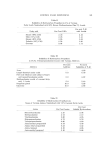
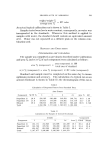
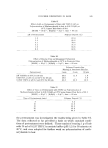
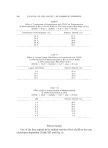
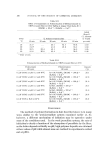
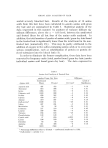
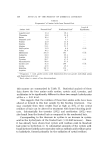
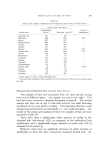
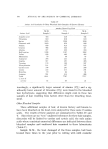
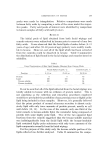
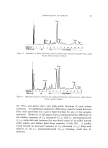
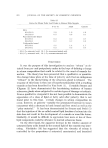
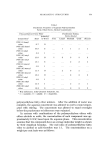
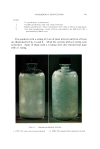
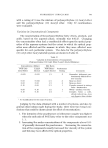
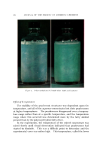
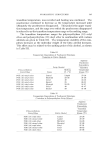
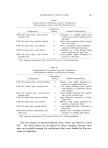
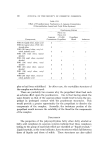
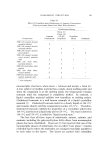
PEARLESCENT STRUCTURES 589 The correlation between the emulsion stability and lack of pearles- cence is quite striking. Evidently, the structure responsible for the pearlescence can be quite stable and, when propellant is added, some of the structures prefer to retain their identity instead of dissociating in order to emulsify the propellant. However, even these systems may lose their pearlescence if the wrong type of propellant is used. Effect of Propellants Upon Pearlescence Initially, the aerosols were formulated only with Freon 12/Freon 114 (15/85) propellant. However, the poor emulsion stability that resulted with this propellant made it desirable to try a propellant with a density about the same as that of the aqueous phase in order to retard phase separation. Therefore, a propellant blend with a composition of 72.2% Freon 12/Freon 114 (15/85) and 27.8% isobutane, which has a calculated density of 1.0 g/co, was evaluated. This propellant blend had an ad- verse effect upon pearlescence, and, in order to determine if the isobutane present in the blend contributed to the effect upon pearlescence, addi- tional aerosols were prepared with isobutane alone. Isobutane was found to be almost as undesirable as the propellant blend. Therefore, Freon 12/Freon 114 (15/85) is the preferred propellant of these three for the pearlescent systems. In order to compare the effect of the propellants, aerosol samples formulated with the three different propellants were prepared. The samples were shaken 20 times and allowed to stand overnight. The pearlescence of the samples was then rated. The results are given in Tables VIII and IX. The data show that while Freon 12/Freon 114 (15/85) propellant destroyed the pearlescence in a limited number of instances, the propellant blend either destroyed the pearlescence or reduced it to an unacceptable level in every instance. Isobutane was almost as destructive upon the pearlescence as the propellant blend. It seems evident that in order for a propellant to be satisfactory for use with the peadescent systems, it should resist emulsification or solu- bilization by the aqueous phase. Certainly, for either emulsification or solubilization to occur, the liquid crystalline structure of the complex would have to be disrupted. This alteration of the liquid crystalline structure would undoubtedly affect the pearlescence. All of the aqueous peadescent concentrates were opaque. The addi- tion of isobutane to a number of these concentrates resulted in the forma- tion of translucent, almost clear, systems, which indicated that the iso- butane had either dissolved the components of the polyoxyethylene com-

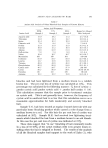
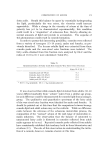
590 JOURNAL OF THE SOCIETY OF COSMETIC CHEMISTS Table Vii i Effect of Propellant upon Pearlescence of Aqueous Concentrates (Polyoxyethylene Lauryl and Cetyl Ether Systems) Pearlescence Rating Freon 12/ Freon 114 Aqueous (15/85) Propellant Components Concentrate Propellant Blend Isobutane POE (4) lauryl ether, laurie acid 3 ... POE (4) lauryl ether, POE (10) stearyl ether 3 ... POE (23) lauryl ether, cetyl al- cohol, palmitic acid 3 3 POE (10) cetyl ether, lauryl alcohol 3 ... POE (10) cetyl ether, myristyl alcohol 3 3 POE (10) cetyl ether, cetyl alcohol 3 3 POE (10) cetyl ether, stearyl alcohol 2 1 POE (20) cetyl ether, cetyl alcohol 3 3 POE (20) cetyl ether, cctyl al- cohol, palmitic acid 3 3 1 1 1 1 plex or had been solubilized. In either case, the crystalline structure of the complex was destroyed. There are probably two reasons why the propellant blend had such an adverse effect upon the pearlescence. One is that having about the same density as that of the aqueous phase would tend to keep the pro- pellant in prolonged contact with the pearlescent structures. This would provide a greater opportunity for the propellant to dissolve the components of the complex. Secondly, the isobutane portion of the propellant would increase the solubility of the blend for the components of the complex. DISCUSSION The properties of the polyoxyethylene fatty ether-fatty alcohol or fatty acid complexes in aqueous systems indicate that these complexes belong to the group of materials which are classified as "liquid crystals." Liquid crystals, as the term indicates, have structures which fall between those of liquids and those of solids. These structures are also called
Purchased for the exclusive use of nofirst nolast (unknown)
From: SCC Media Library & Resource Center (library.scconline.org)