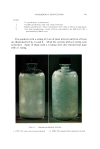
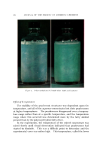
556 JOURNAL OF THE SOCIETY OF COSMETIC CHEMISTS Although this approach has certain drawbacks it has the advantage of providing some insight into the chemistry of human hair that has been altered under uncontrived conditions. EXPERIMENTAL Preparation of Hair Samples Samples of hair were purchased from individuals capable of furnish- ing a detailed account of the chemical products (permanent waves, bleaches, dyes, shampoos, conditioners, etc.) used as far back as two years prior to cutting. Portions of these samples were cut into 1-inch sections, randomized by hand, and extracted in a Soxhlet apparatus for 15 hours with alcohol. The hair was then thoroughly rinsed with de- ionized water, dried at 55% RH, 24øC, randomized by hand again, and stored in glass prior to use. Per cent volatiles was determined for each sample by drying 1 g of hair to a constant weight of 110øC. Amino Acid Analysis Replicate samples of hair weighing approximatdy 100 mg were heated to reflux for 44 hours with 50 ml of 6N HC1. After removal of the acid on a rotary evaporator at 50øC, and dilution with 0.2N (sodium concentration) citrate buffer (pH = 2.2), the hydrolyzates were analyzed on a Beckman Spinco amino acid analyzer, Model 120-C* (6). Ilydrolytic Decomposition of Amino Acids Correction factors for decomposition of amino acids during hydrolysis were estimated by subjecting the Beckman Standard Calibration Mix- ture of amino acids to the conditions of hydrolysis used in this work. Correction factors obtained from a triplicate determination are for cystinc, 0.891 serine, 0.76 threonine, 0.876 and tyrosine, 0.925. RESULTS AND ]DISCUSSION Bleached Hair Frosted Hair A sample of frosted hair was analyzed via amino acid analysis after separation into bleached and unbleached fibers. The bleached fibers of this sample had been stripped, from a dark brown shade, and repre- * Beckman Instruments Inc., Spinco Division, Palo Alto, Calif. 94303.

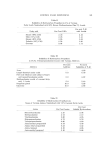
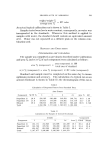
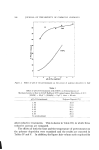
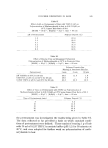
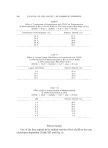
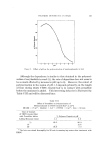
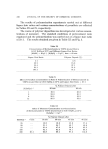
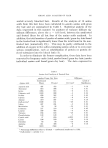
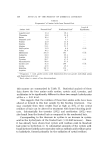
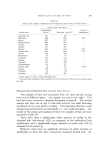
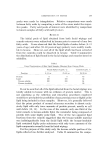
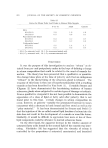
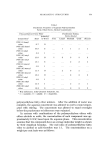
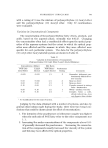
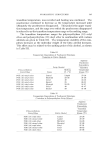
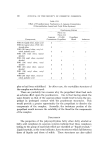
AMINO ACID ANALYSIS OF HAIR 5,57 sented severely bleached hair. Results of the analysis of 18 amino acids from this hair have been calculated to /•moles amino acid/gram dry hair and are summarized in Table I. Statistical analysis of the data (expressed in this manner) by analyses of variance indicate sig- nificant differences, above the a = 0.05 level, between the nonfrosted and frosted fibers for all but four of the amino acids analyzed. In addition, the total number of umoles of amino acids/gram dry hair found in the frosted hair is significantly lower than the total found in the non- frosted hair (numerically 6%). This may be partly attributed to the addition of oxygen to the sulfur-containing amino acids or to even more serious complications, such as solubilization of protein or protein de- rived substances into the bleach bath (4). In order to eliminate the former complication, these data have been converted to frequency units (total/•moles found/gram dry hair//•moles individual amino acid found/gram dry hair). The data expressed in Table I Amino Acid Analysis of Frosted Hair /•moles/Gram Dry Hair Difference Nonfrosted Level of Amino Acid Fibers Frosted Per Cent • Significance Aspartic acid 437 432 -- 1 0.10 Threonine 616 ,588 -- 5 0.01 Serine 1085 973 - 8 0.01 Glutamic acid 1030 999 - 3 0.05 Proline 639 582 - 9 0.05 Glycine 450 415 -- 8 0.01 Alanine 370 357 -- 4 0.10 Half- cystine b 1509 731 -- 50 0.01 Valin e 487 464 -- 5 0.05 Methionine 50 38 -- 24 0.01 Isoleucine 227 220 -- 3 0.05 Leucine 509 485 -- 5 0.01 Tyrosine 183 146 -- 20 0.01 Phenylalanine 139 129 -- 7 0.05 Cysteic acid 27 655 4-2322 0.01 Lysine 198 180 -- 10 0.10 Histidine 65 55 -- 15 0.05 Arginine 511 486 -- 6 0.10 Total 8020 7,543 -- 6 Percentage difference refers to (frosted -- nonfrosted/nonfrosted X 100). Half-cystine = cystinc X 2.
Purchased for the exclusive use of nofirst nolast (unknown)
From: SCC Media Library & Resource Center (library.scconline.org)