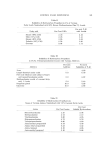
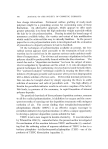
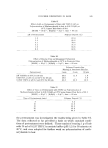
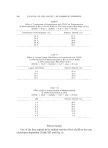
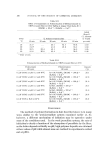
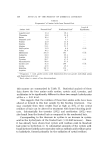
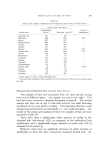
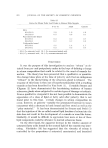
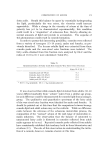
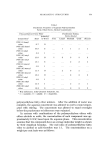
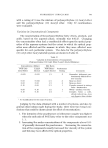
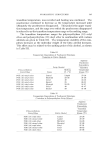
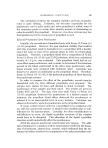
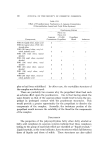
PEARLESCENT STRUCTURES ,585 transition temperature, was recorded and heating was continued. The pearlescence continued to decrease as the temperature increased until ultimately the pearlescence disappeared. This point is the upper transi- tion temperature, and the range over which the pearlescence disappeared is referred to as the transition temperature range or the melting range. The transition temperature ranges for polyoxyethylene (10) cetyl ether and polyoxyethylene (20) oleyl ether in combination with various alcohols are given in Table ttt. The temperature stability of the com- plexes increases as the molecular weight of the fatty alcohol increases. This effect may be related to the melting point of the alcohol, as shown in Table lit. Table III Temperature Dependence of Pearlescent Structures (Variation in Fatty Alcohols) Fatty Alcohol Polyoxyethylen½ Melting Fatty Ether Name Pt. (øC) POE (t0) cetyl ether Lauryl Liquid POE (t0) cetyl ether Myristyl 33-35 POE (10) cetyl ether Cetyl 49 POE (10) cetyl ether Stearyl 58 POE (20) oleyl ether Myristyl 33-35 POE (20) oleyl cther Cetyl 49 POE (20) oleyl ether Stearyl 58 Aqueous Pearlescent Concentrate Transition Temperature Range (øC) 25-28 34-38 35-46 38-52 32-37 41-47 51-56 Table IV Temperature Dependence of Pearlescent Structures (Variation in Polyoxyethylene Fatty Ethers) Polyoxyethylene Fatty Ether Fatty Alcohol Aqueous Pearleseent Concentrate Transition Temperature Range (øC) POE (10) cetyl ether Lauryl 25-28 POE (10) stearyl ether Lauryl 26-29 POE (10) eetyl ether Myristyl 34-38 POE (10) stearyl ether Myristyl 37-39 POE (20) eetyl ether Cetyl 37-51 POE (20) stearyl ether Cetyl 38-52 POE (20) oleyl ether Cetyl 51-56

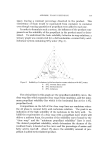
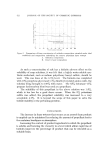
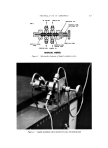
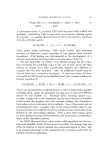
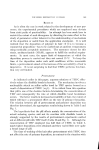
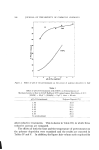
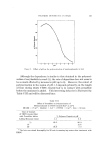
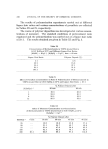
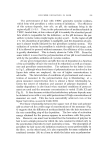
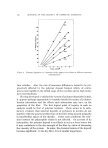
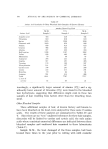
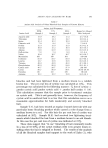
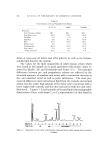
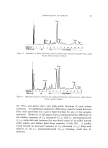
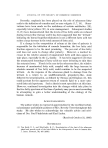
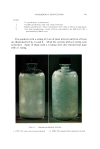
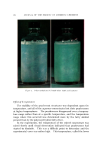
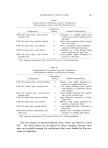
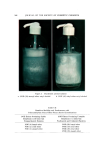
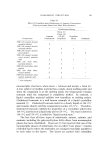
586 JOURNAL OF THE SOCIETY OF COSMETIC CHEMISTS Examples of the temperature stability of complexes with the same alcohol but different polyoxyethylene fatty ethers are shown in Table IV. Although there appears to be a slight trend towards more stable complexes as the molecular weight of the ether is increased, the effect of the different polyoxyethylene ethers is not nearly as marked as with different alcohols. Optical Properties of Aerosol Formulations Preferred Pearlescent Aerosol Systems Not all of the aqueous peadescent concentrates described in the pre- ceding sections could be formulated as peadescent aerosols. In some cases, addition of the propellant to the concentrate destroyed the pearles- cence. A possible reason for this will be discussed in the subsequent sections. The preferred peadescent aerosol formulations and their characteris- tics are listed in Tables V and VI. The product characteristics were judged by discharging the formulation into the palm of the left hand and spreading the product with the right hand. All of the aerosols have poor emulsion stability and must be shaken immediately before use. As a result of the poor dispersion of propellant, the systems generally have a noisy, sputtery discharge and the product usually is emitted as a foamy liquid. The liquid generally builds up into a foam when it is spread. Photographs of selected examples of the preferred aerosol formulations are illustrated in Fig. 3. Pearlexcence and Emulsion St:tbility The previous investigation of aerosol systems (1) showed that some combinations of the polyoxyethylene fatty ethers and fatty alcohols had a marked effect upon the properties of aerosol foams but little effect upon emulsion stability. The effect upon foams indicated that complex formulation between the polyoxyethylene fatty ethers and the fatty alcohols had occurred, but it was not quite clear as to why the complex formation also was not reflected by an increase in emulsion stability. A comparison of the data in the present paper with that in the previous publication showed that those polyoxyethylene fatty ethers which did not produce stable emulsions were also the same ethers that gave the most peadescent products. Conversely, the polyoxyethylene fatty ether complexes which gave the most stable emulsions did not give pearl- escent products.
Purchased for the exclusive use of nofirst nolast (unknown)
From: SCC Media Library & Resource Center (library.scconline.org)