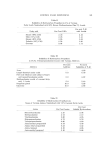
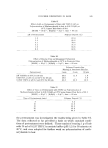
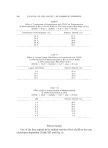
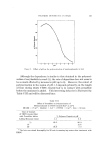
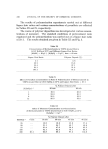
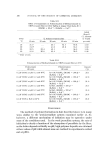
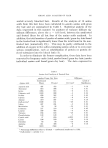
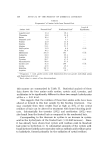
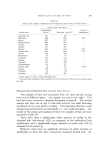
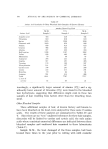
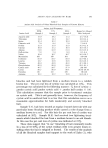
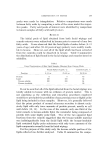
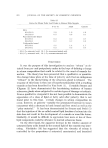
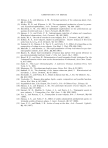
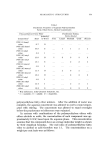
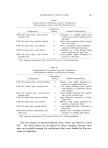
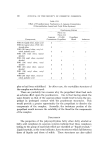
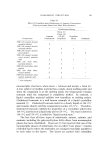
PEARLESCENT STRUCTURES 591 Table IX Effect of Propellant upon Pearlescence of Aqueous Concentrates (Polyoxyethylene Stearyl and Oleyl Ether Systems) Pearlescence Rating Freon 12/ Freon 114 Aqueous (15/85) Propellant Components Concentrate Propellant Blend Isobutane POE (10) stearyl alcohol, myristyl alcohol 3 ......... POE (20) stearyl alcohol, myristyl alcohol 3 3 1 ... POE (20) stearyl alcohol, cetyl alcohol 3 3 1 3 POE (20) stearyl alcohol, cetyl alcohol, palmitie acid 3 3 1 a POE (20) oleyl ether, myristyl alcohol 3 2 ... a POE (20) oleyl ether, eetyl alcohol 3 3 1 • POE (20) oleyl ether, stearyl alcohol 3 3 ... • POE (20) oleyl ether, cetyl alcohol, palmitic acid 3 2 ... a Not evaluated. mesomorphic structures, where meso = between and morph = form (6). A true solid or crystalline material has a single, sharp melting point and when the compound is at the melting point, the temperature remains constant until the compound is completely melted. In contrast, a liquid crystalline material exhibits two transition or melting points. Cholesteryl benzoate is a well known example of a liquid crystalline material (7). Cholesteryl benzoate melts to a cloudy liquid at 148-9øC and remains cloudy until the temperature reaches 175-9øC. Therefore, cholesteryl benzoate exhibits the properties of a crystalline solid below 148-9øC and those of a liquid only above 178-9øC. The state in between 148-9øC and 178-9øC is called the "liquid crystal state." The fact that all three types of surfactants, anionic, cationic, and nonionic, including the polyoxyethylene fatty ethers, form mesomorphic phases has been established. Roseyear (6) has reported that one of the mesomorphic phases of surfactants, the so-called "neat phase," consists of flexible layers where the molecules are arranged essentially parallel to to each other in the layers. The layers are packed with crystalline

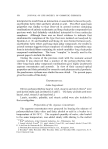
592 JOURNAL OF THE SOCIETY OF COSMETIC CHEMISTS regularity according to X-ray studies, but the lateral arrangement is random. In the presence of water, the layers are separated by the water molecules with the polar heads of the surfactant oriented towards the aqueous phase. X-ray studies of the fatty alcohols have also shown that these compounds exist in a number of different solid phases (8). There- fore, it is not surprising that the molecular complexes formed from the polyoxyethylene fatty ethers and alcohols and acids from mesomorphic phases. The pearliness in creams formulated with an excess of stearic acid in sodium or potassium stearate systems has been recognized for a long time and originally was assumed to be due to laminae of crystalline stearic acid. However, additional data indicated that the pearliness was due to the molecular complex formed between free stearic acid and sodium stearate (9). Subsequent work has shown that these complexes can exist in different solid forms and the 1: 1 complex of sodium palmirate and palmitic acid is reported to have a crystal pattern which is similar to that of the paraffins. In aqueous systems, these phases contain water and are usually liquid-crystalline in nature (10). The pearlescence and iridescence of the polyoxyethylene fatty ether complexes in aqueous systems undoubtedly are a consequence of the liquid crystal structure of the complexes. The colors are due to inter- ference phenomena resulting from the reflection of light from different planes or layers in the liquid crystal structure. This effect is similar to that observed with soap bubbles, where the light is reflected from two film surfaces, or from wet pavements, where colors result from the re- flection of light from thin films of oil. The disappearance of pearlescence and iridescence over a specific temperature range at higher temperatures evidently results from the gradual degradation or "melting" of the liquid crystalline structures responsible for the pearlescence. Thus, the behavior of these poly- oxyethylene fatty ether systems with their two transition temperatures or "melting" points is similar to that of a typical liquid crystalline ma- terial. SUMMARY Aqueous concentrates and aerosols exhibiting a high degree of pearlescence were obtained with certain specific combinations of polyoxyethylene fatty ethers and fatty alcohols. The peadescent aerosols generally discharged as foamy liquids which subsequently ex- panded into foams. The foams were not peadescent.
Purchased for the exclusive use of nofirst nolast (unknown)
From: SCC Media Library & Resource Center (library.scconline.org)