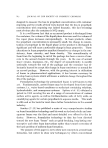
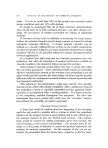
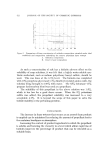
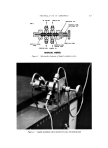
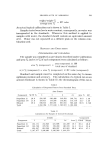
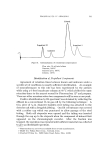
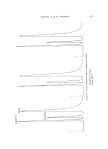
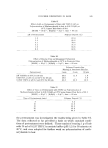
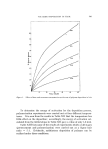
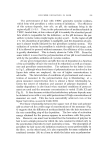
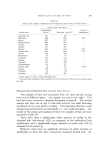
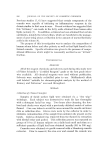
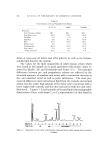
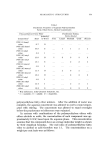
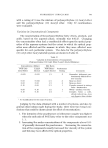
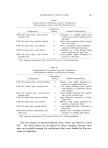
PROPELLANTS IN AEROSOLS 531 Figure Propellanf 12 • Isobufane Ethano Chromatogram of commercial antiperspirant Flow rate, 24 ml/min helium Detector, 160øC Injection port, 185øC Column, 110øC Identification of Propellant Components Agreement of retention times between known and unknown under a specific set of conditions is usually sufficient identification. An example of nonconformance to this rule has been experienced by the authors while using a 6-foot hexadecane column at 40øC which yielded the same retention times to the nearest second for Fluorocarbon 12' and propane. There are other occasions when two components will be seen as one peak. Positive identification by IR spectrum $ was obtained by collecting the effluent in a conventional 10-cm gas cell by the following technique: A 6-in. piece of •/i-in. diameter stainless steel tubing was attached to the detector exit with a Swagelokl: fitting. One IR cell entrance was covered with a rubber cap which was punctured to allow passage of the steel tubing. Both cell stopcocks were opened and the tubing was inserted through the cap up to the stopcock when the component of interest first appeared on the chromatograph recorder. After the fraction was trapped, the operation was repeated until sufficient material was collected to give an identifiable spectrum. * Fluorocarbons 12 and 114 are available from several manufacturers. $ Model 421, Perkin-Elmer Corp., Norwalk, Conn. $ Crawford Fitting Co., 29500 Solon Road, Solon, Ohio, 44139.

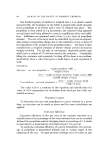
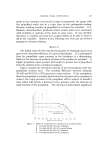
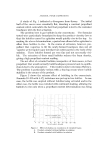
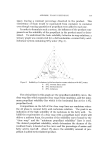
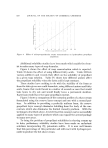
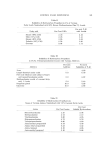
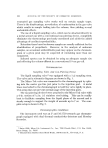
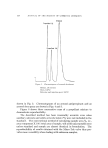
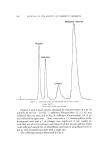
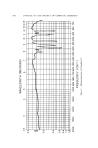
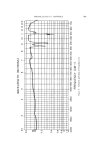
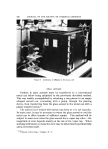
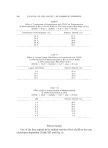
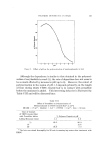
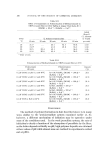
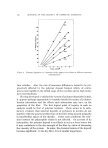
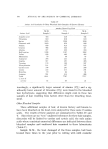
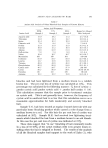
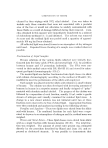
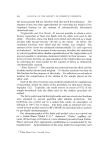
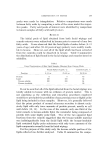
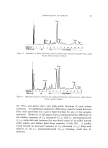
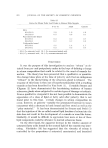
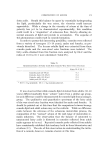
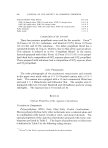
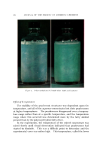
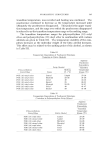
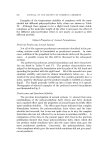
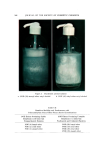
532 JOURNAL OF THE SOCIETY OF COSMETIC CHEMISTS Propane I I Isobutane I I I I I I I I I I I Figure 5. Ethanol Methylene Chloride ,i Chromatogram of commercial aerosol shoe spray Oven, 130øC Flow rate, 24 ml/min helium Figures 7 and 8 show spectra obtained by this procedure on a mixture of 12/114. In Fig. 7, sufficient Fluorocarbon 12 (1.5 •1) was collected with six runs and in Fig. 8, sufficient Fluorocarbon 114 (2 •1) was collected in eight runs. Since there was a 1:1 stream splitter in the instrument used and a 1-•1 plunger was employed, it can readily be seen that use of a 10-•1 plunger and removal of the stream splitter would yield sufficient sample for an identifiable spectrum at propellant levels as low as 10% in finished aerosols with a single run. The collection setup is illustrated in Fig. 9.
Purchased for the exclusive use of nofirst nolast (unknown)
From: SCC Media Library & Resource Center (library.scconline.org)