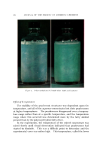
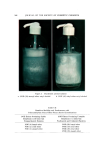
J. •%•oc. Cos•uetic Che•m'sts, 20, 577 ,593 (Aug. 19, 1969) Molecular Interactions in Aerosol Emulsion Systems. III. Pearlescent Structures PAUL A. SANDERS, Ph.D.* Presented September 12-13, 11½6'8, Seminar, Boston, Mass. Synopsis--Specific combinations of the polyoxyethylene fatty ethers and fatty alcohols or acids exhibit considerable pearlescence or iridescence in aqueous or aqueous aerosol systems. As a result of the high aesthetic appeal of these systems, they should be useful for the for- mulation of cosmetic and pharmaceutical products. The pearlescence that is produced depends upon the particular polyoxyethylene fatty ethers, fatty alcohols, and fatty acids that are present, and also upon their concentrations and ratios to each other. The pearlescence is sensitive to temperature, and all of the products ultinmtely lose their pearlescence at higher temperatures. The loss of pearlescence occurs over a temperature range rather than at a specific temperature. This behavior in conjunc- tion with the optical properties of these systems, indicates that they belong to the class of substances having mesomorphic or liquid crystalline structures. Acrosols prepared from the aqueous concentrates generally discharge as foamy liquids which subsequently expand into foams. The propellant can affect the pearlescence of the aqueous concentrates, particularly if the molecular complex has some affinity for the pro- pellant. INTRODUCTION Previous investigations in aqueous aerosol systems indicated that an interaction occurred between certain nonionic surfactants and long- chain polar compounds. For example, the addition of fatty alcohols or fatty acids to aerosol systems formulated with polyoxyethylene fatty ethers often had a marked effect upon foam properties (1). This was * Freon Products Laboratory, E. I. du Pont de Nemours & Co., Inc., Wilmington, Del. 19898. 577

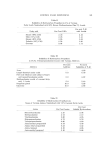
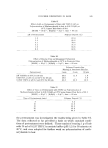
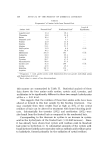
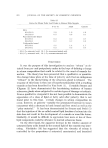
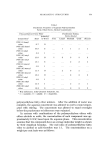
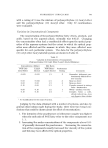
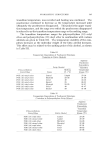
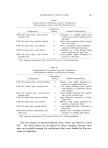
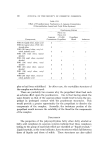
578 JOURNAL OF THE SOCIETY OF COSMETIC CHEMISTS interpreted to result from an interaction or association between the poly- oxyethylene fatty ether and fatty alcohol or acid. The effect upon foam properties was similar to that observed in aerosol systems containing combinations of anionic surfactants and long-chain polar compounds that previous work had definitely established interacted to form molecular complexes. Although there was no direct evidence to indicate that stoichiometric complexes of the type that were isolated and analyzed by Epstein et al. (2) and Goddard and Kung (3) were formed between poly- oxyethylene fatty ethers and long-chain polar compounds, the results in aerosol systems suggested that complexes of indefinite composition may form in interfacial films containing the mixed emulsifier-long-chain polar compound combinations. The term "complex" is broadly used in the present paper to inc}ude the latter. During the course of the previous work with the nonionic aerosol systems it was observed that a number of the polyoxyethylene fatty ether-long-chain polar compound combinations gave highly pearlescent aqueous concentrates and aerosols. In view of their unusual optical properties and their potential for cosmetics and pharmaceutical products, the pearlescence systems were studied in more detail. The present paper gives the results of this study. EXPERIMENTAL Active Ingredients Eleven polyoxyethylene lauryl, cetyl, stearyl, and oleyl ethers* were used in this study and are listed in Table I. The fatty alcohols used were lauryl, cetyl, stearyl, t and myristyl. • Lauric, myristic, palmitic, and stearic acidsõ were also included in the investigation. Preparation of the Aqueous Concentrates The aqueous concentrates were prepared by heating the mixture of polyoxyethylene fatty ether and fatty alcohol or acid in a beaker to a temperature of 60-70øC. The required quantity of water, also heated to the same temperature, was added slowly with stirring to the melted * Brij © surfactants, Atlas Chemical Industries, Inc., Wilmington, Del. t Lauryl alcohol (Lorol © 11), cetyl alcohol (Lorol 24), and stearyl alcohol (Lorol 28), E. I. du Pont de Nemours & Co., Wilmington, Del. • Obtained from Eastman Chemical Products, Inc., Kingsport, Tenn. õ Wecoline © 1295, Wecoline 1495, Wccoline 1695, and Wecoline 1892, respectively, E. F. Drew Chemical Corp.
Purchased for the exclusive use of nofirst nolast (unknown)
From: SCC Media Library & Resource Center (library.scconline.org)