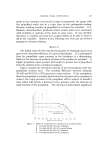
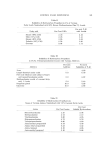
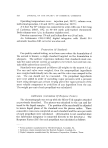
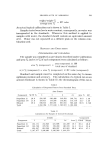
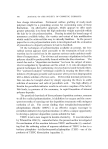
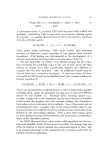
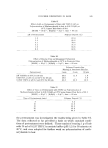
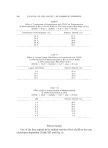
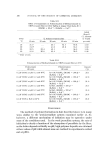
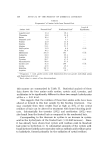
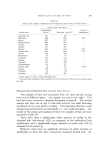
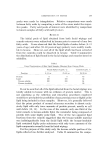
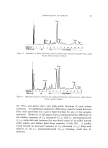
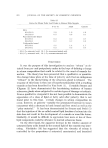
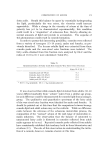
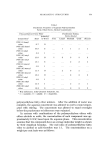
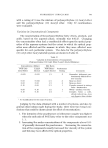
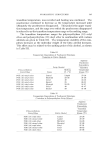
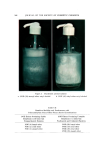
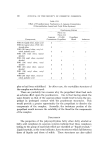
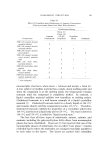
PROPELLANTS IN AEROSOLS 529 weight/weight % = RF value average area % An actual typical calibration run is shown in Table I. Samples tested were low in water content consequently, no water was incorporated in the standards. Whenever this method is applied to samples with water, the standard should contain an equivalent amount of it. Water was not separated as a definite peak on the column com- bination used. RESULTS AND DtSCUSS•ON Determination and Calculation The sample was completed as previously described under Calibration and area % and w/w % of each component were calculated as follows: area % (component) = area component X 100 total area of standard w/w % (component) = area % (componen[) X RF value (component) Standard and sample must be completed on the same day to insure optimum precision and accuracy. The calculation of a typical run on an aerosol deodorant is shown in Table II the chromatogram of this run is Table I Calculation of Response Factors from Standard Data Area Counts Component W/W % 1 2 3 Av Area % RF Propellant 12 28.9 254,235 248,488 246,503 249,742 19.5 1.48 Propellant 114 21.8 179,417 174,554 173,362 175,778 13.7 1.59 Ethanol 49.3 848,401 854,001 861,062 854,448 66.8 0. 738 Total 1,282,053 1,277,043 1,280,927 1,280,008 Table ii Calculations for Sample of Aerosol Deodorant Counts Component 1 2 3 Av _ Component Area % Calcd Actual Propellant 12 252,172 252,830 251,896 252,299 19.7 29.1 28.6 PropcHant 114 181,758 179,761 179,290 180,270 14.1 22.4 21.6 Ethanol 814,047 812,300 809,357 811,901 63.4 46.8 47.1 Total 1,247,977 1,244,891 1,240,543 1,244,470

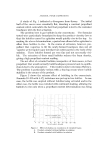
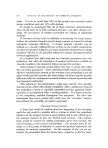
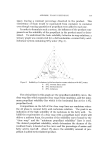
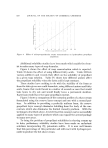
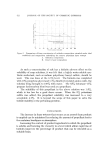
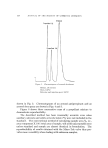
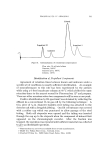
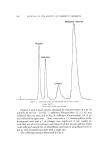
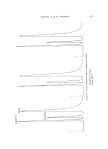
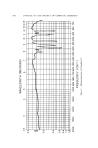
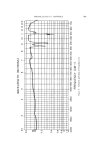
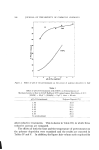
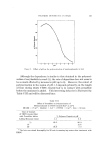
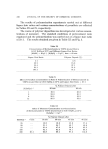
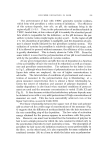
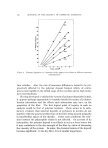
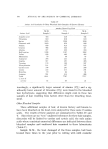
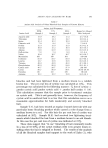
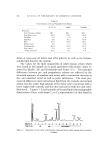
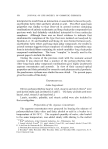
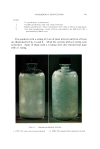
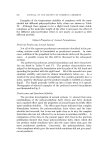
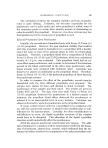
•30 JOURXAL OF THE SOCIETY OF COSMETIC CHEMISTS Ethanol Propellant 12 ! II II II ]1 II I II tl 11 Propellant 114 II II I I I I ! [ I Figure $. Chromatogram of aerosol deodorant Helium, 20 ml/min Oven, 130øC Detector and injection port, 200øC shown in Fig. 3. Chromatograms of an aerosol antiperspirant and an aerosol shoe spray are shown in Figs. 4 and 5. Figure 6 shows three consecutive runs of a propellant mixture to demonstrate reproducibility. The described method has been reasonably accurate even when auxiliary solvents and solids at levels below 7% were not included in the standard. The conventional method of calculating sample area %, i.e., area component X 100/total area of sample, will yield unacceptable error unless standard and sample are almost identical in formulation. The reproducibility of results obtained with the Micro-Tek valve thus pro- vides more versatility when dealing with unknown samples.
Purchased for the exclusive use of nofirst nolast (unknown)
From: SCC Media Library & Resource Center (library.scconline.org)