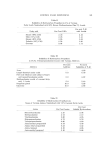
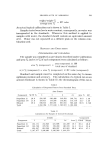
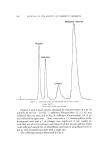
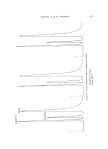
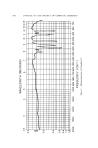
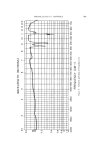
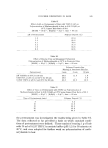
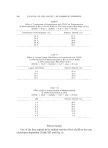
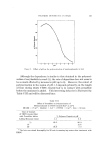
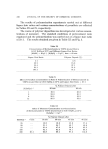
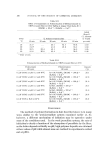
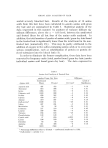
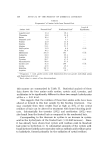
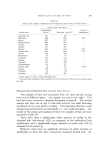
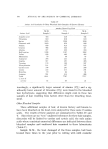
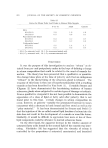
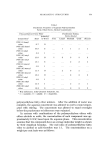
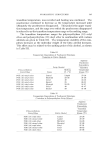
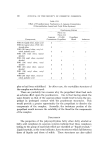
562 JOURNAL OF THE SOCIETY OF COSMETIC CHEMISTS has suggested that the content of cysteic acid determined in the hydroly- zate of bleached wool or hair is an indication of the oxidative change. Permanent Waved Hair Laboratory permanent waved hair was initially examined and com- pared with unwaved control hair. The waved hair was obtained by reducing for 30 minutes with 6% ammonium thioglycolate at pH 9.2, using a 33/1 solution-to-hair ratio, and oxidizing for 5 minutes with 1.4% sodium perborate, using a 40/1 solution-to-hair ratio. The amino acid analysis of this hair as compared to control hair indicated cysteic acid to be significantly higher in the permanent waved hair at the a = 0.05 level (49 vs. 25 umoles/g of hair). However, there were no significant differences in the other 17 amino acids. Table VI Cysteic Acid in Permanent Waved Hair Cysteic Acid Content, Source umoles/Gram Unaltered hair Laboratory permanent waved (IX) Known history waved (2X) Known history waved (4X) Up to 40 49 84 94 Two samples of hair known to have been permanent waved on the head were then analyzed. The data describing the results from perma- nent waved hair are summarized in Table VI. No substantial numerical differences between unaltered hair and permanent waved hair were noted for any of the amino acids except for a cysteic acid increase (5) and a corresponding half-cystine decrease (from 1407 and 1512/•moles/g to 1311 and 1372/•moles/g). In actuality there are no real unaltered references for these hair samples, although the above comparison is re- vealing. In addition to these differences, the chromatograms of the permanent waved hair of known history contained a small peak cor- responding to methionine sulfone. The amount of this material was estimated to be approximatdy 50 /•moles/g hair. In four of the un- altered samples there was too little of this material to calculate and in the fifth there was less than one-half of the amount found in the perma- nent waved hair. Presumably, the methionine sulfone in the permanent waved hair was formed during the reaction of the neutralizer with the

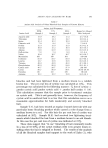
AMINO ACID ANALYSIS OF HAIR 563 reduced hair during the waving process. The differences shown be- tween the laboratory waved hair and the hair waved on the head by consumers may be attributed to such experimental variants as the number of wavings and for the laboratory waved hair the unrealistically high solution-to-hair ratio in both the reduction and neutralization steps as well as the use of unstressed hair. SUMMARY Bleached and permanent waved hair, treated on the head by con- sumers, as well as unaltered hair, were hydrolyzed and examined by automatic amino acid analysis. The hydrolyzates of severely bleached hair were found to contain substantially less cystinc and smaller quanti- ties of tyrosine and methionine as compared to unaltered hair. Rda- tively large amounts of cysteie acid were also found in the bleached hair hydrolyzates, the quantities increasing with increased bleaching. These results suggest that severely bleached hair contains less eystyl, tyrosyl, and meth ionyl residues than unaltered hair with relatively large amounts of cysteic acid residues. The hydrolyzates of permanent waved hair also contained smaller quantities of cystinc than those of unaltered hair with correspondingly larger amounts of cysteic acid. However, the quantities of eysteie acid found in the hydrolyzates from the permanent waved hair did not approach those found in the hydrolyzates of even the very mildly bleached hair. These results suggest that the disulfide functional group of eystyl residues remains changed in human hair after permanent wav- ing but not to the same extent that exists after bleaching. ACKNOWLEDGMENT The authors acknowledge Dr. J. D. Barnhurst for carefully reading this manuscript and for helpful suggestions. (Received October 29, 1968) REFERENCES (1) Zahn, H., Chemical processes in the bleaching of wool and human hair with hydrogen peroxide and peroxy acids, J. Soc. Cosmetic Chemists, 17, 687-701 (1966). (2) Smith, A. L., and Harris, M., Oxidation of wool: Effect of hydrogen peroxide on wool, J. Res. Natl. Bur. Std., 16, 301-7 (1936). (3) Rutherford, H. A., and Harris, M., Reaction of wool and hydrogen peroxide, Ibid., 20,
Purchased for the exclusive use of nofirst nolast (unknown)
From: SCC Media Library & Resource Center (library.scconline.org)