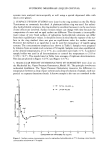
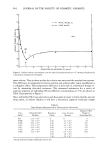
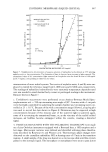
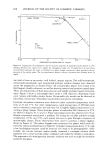
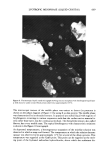
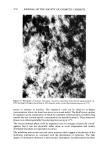
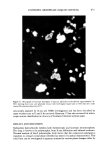
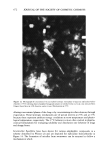
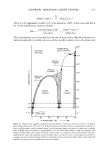
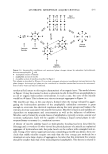
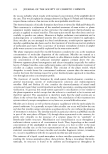
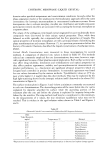
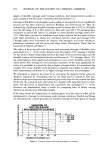
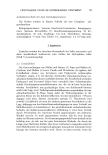
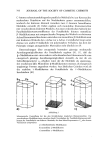
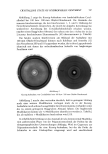
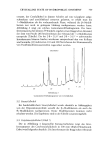
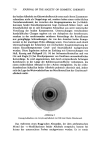
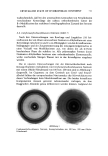
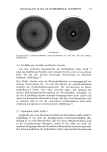
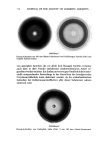
LYOTROPIC MESOPHASE (LIQUID CRYSTAL) 669 i Figure 9. Thermotropic liquid crystal micrograph showing smectic mesophase with birefringent liquid layer at 10X objective under crossed Nicol prisms observed at approximately 183øC. The microscopic texture of the middle phase was easiest to detect (its presence is shown on the phase diagram of Figure 13 by using X as data points). The middle phase was characterized by its threaded texture. It appeared as a turbid liquid with regions of birefringence occurring in various sequences such that the surface-active material it- self, rather than water, was the continuous medium. The thread-like texture, also called fibrous, has a very mobile state. The typical birefringence with characteristic striations is shown in the Figure 10 micrograph. At depressed temperatures, a heterogeneous separation of the miceliar solution was observed in which a soap curd formed. The temperature at which the solution became opaque was observed to be approximately 12øC for several of the dilute systems. This temperature was regarded as the Krafft point. This point can be regarded as the melt- ing point of the hydrated nafoxidine hydrochloride, above which the surfactant dis-

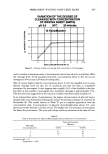
670 JOURNAL OF THE SOCIETY OF COSMETIC CHEMISTS Figure 10. Micrograph of lyotropic mesophase of aqueous nafoxidine hydrochloride (approximately 10- 30%) showing birefringent liquid layer at 43X objective under crossed Nicol prisms observed at 25øC. perses in solution as micelies. This transition could not be observed at higher concentrations where the liquid was more viscous and turbid. The Krafft point can also be explained as the temperature at which the solubility of the hydrated crystalline drug reaches the cmc (critical micelie concentration) for micelie formation. These transition phases were indistinguishable by polarizing microscopy at 12øC. The viscous isotropic phase could be separated from its conjugate solutions by centrif- ugation, but it was not physically stable alone at room temperature and usually developed neat phase as evaporation occurred. The polarizing microscope can only show textures which suggest a distribution of the molecular orientation, as contrasted with the distribution of molecules. The high degree of orientation observed in the lyotropic mesophases described above has been
Purchased for the exclusive use of nofirst nolast (unknown)
From: SCC Media Library & Resource Center (library.scconline.org)