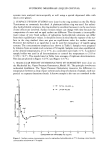
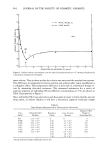
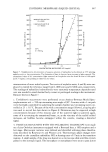
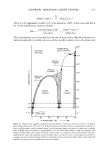
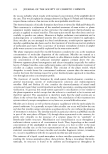
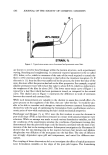
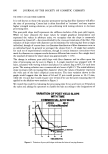
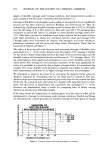
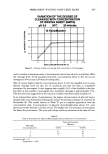
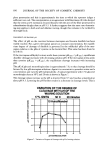
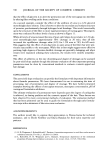
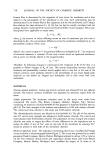
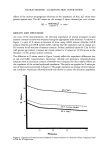
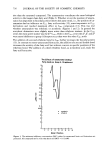
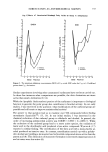
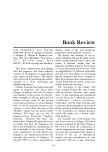
692 JOURNAL OF THE SOCIETY OF COSMETIC CHEMISTS degree of disulfide cleavage under waving conditions. Such measurements usually re- quire a separate and often time-consuming chemical analysis (12). Cleavage of disulfide by nu•cleophiles such as sulfite or mercaptide ion is an equilibrium process and has been treated in detail by Wolfram and Underwood (9). They de- termined the equilibrium disulfide cleavage values for human hair at 35øC in 1M sulfite over the pH range of 0-9. The solution to fiber ratio was 100:1. By repeating these conditions at various pH values it is possible to obtain disulfide cleavage values of 8- 51%. Hair fibers can then be withdrawn from these solutions and the values of post- yield slope determined to obtain the correlation between slope and cleavage level. Cleavage values were determined by titration wiih salyrganic acid under varying ex- perimental conditions and the post-yield slope values determined. These data are presented in Table II and Figure 5. The values of the post-yield slope decrease with increasing cleavage of disulfide, and a good linear fit (r = -0.94) can be obtained over the range 0-50% cleavage. Crewther (4) has shown a linear relationship between the slope of the post-yield region and the disulfide content of S-methylated Lincoln wool between 0-75 % cleavage. Above 75% the slope begins to drop rapidly and extrapolates to zero at zero disulfide content. For values above 40% cleavage by our technique, estimation of the slope graphically be- comes too unreliable to extend the data to higher cleavage values. It is postulated that roughly 45% of the disulfide in the hair fiber is relatively inaccessible to sulfite under these experimental conditions (9), so higher cleavage levels were not investigated. We attempted to improve the linear fit by correcting the measured slope values for diameter variations by normalizing them to the slope prior to treatment. The stan- dardized slope thus represents the measured post-yield slope for the treated hair fiber divided by the measured post-yield slope for a length of the same fiber prior to treat- ment. For this series of experiments, the correlation was unchanged (r = -0.94). However the standardized slope is useful for comparing hairs of widely varying diameter as discussed in a following example. If the slope values are independent of cleaving agent, then the data for sulfite can be extrapolated to cleavage by mercaptans under waving conditions. Haefele and Broge (6) determined the cysteine generated by disulfide cleavage with mercaptans of varying VARIATION OF POST YIELD SLOPE 1.0 0.0 0.1 0.2 0.3 0.4 0.5 DEGREE OF CLEAVAGE (•) WIT H' ff•'l• I•' • •-F'•::-L-•A•/A G E '•,.• 0 O D• 0 o• SLOPE = mo•- +b rn = -- 0.83_+0.09 b = 0.57_+0.03 r = -- 0.94_+0.05 r2 = 0.88 Figure 5. Variation of post-yield slope with degree of cleavage.

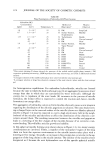
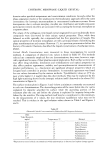
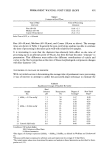
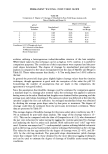
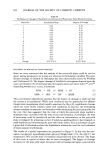
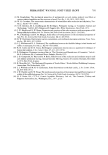
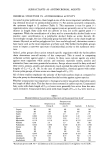
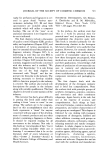
PERMANENT WAVING: POST-YIELD SLOPE 693 TabIe III Comparison of Degree of Cleavage of Disulfide by Post-Yield Slope Analysis with Data of Haefele and Broge (6) pH of Mercaptan Standardized Solution Slope Degree of Cleavage Slope Haefele and Broge 1. 2.0 0.89 0.03 0.03 2. 5.0 0.63 0.22 0.10 3. 6.5 0.65 0.20 0.14 4. 8.0 0.46 0.34 0.31 5. 9.8 0.27 0.48 0.42 Conditions: 0.55 N Thioglycolic Acid 30:1 Solution to Hair Ratio 10 Minutes Immersion Room Temperature acidities utilizing a heterogeneous iodine/thiosulfate titration of the hair samples. While blank values by this technique can be as high as 3.0% cysteine, it is useful for comparison purposes. The conditions of their experiment were repeated and the post- yield slopes determined. The degree of cleavage by standardized post-yield slope analysis is compared to the values extrapolated from the data of Haefele and Broge in Table Ill. These values assume that (kssk)0 = 0.79m mol/g based on 5.05% sulfur in the hair. In general the post-yield slope gives slightly higher cleavage values than the titration technique, though agreement is good with the exception of the value for pH 5.0. Considering the number of assumptions that are made in this comparison, the agreement is very good indeed. Since the assumption that disulfide cleavage could be estimated by comparison against a standard slope vs. cleavage plot seemed valid, the technique was applied to patrons having waves in the salon. Random hair lengths were obtained before perming, and the average post-yield slope determined. The same procedure was followed at the time the operator judged the test curl sufficient. An averaged standardized slope was obtained by dividing the average perm slope value by that prior to treatment. The degree of cleavage could then be estimated from the previously determined correlation. These data are presented in Table IV. The average degree ofdisulfide cleavage for this wave under salon conditions was 28 m 9% as estimated by post-yield slope analysis. The range of the cleavage values is 13- 41%. This can be compared with the data of Gumprecht et al. (12), who determined the per cent reduction for salon waving by tagging the cysteine generated by cleavage and analyzing the hair by amino acid analysis. Both radioactive and "cold" tags were used. Cysteine was assayed as C•4mcarboxymethyl cysteine utilizing labeled iodoacetic acid as the hot tag, and as S-aminoethyl-cysteine utilizing ethyleneimine as the cold tag. The values by the hot tag method for the degree of cleavage were 22-45%, and 20- 36% by the cold tag methods. The post-yield slope determination yields cleavage values that compare well to those obtained by the more laborious tagging techniques and can be used to estimate the degree of cleavage of disulfide under actual waving conditions.
Purchased for the exclusive use of nofirst nolast (unknown)
From: SCC Media Library & Resource Center (library.scconline.org)