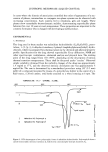
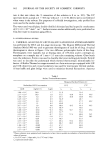
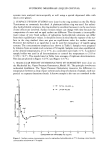
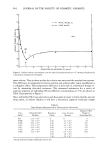
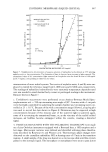
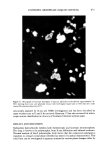
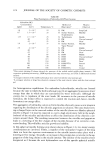
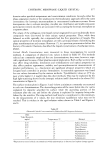
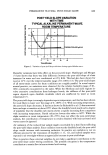
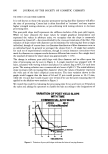
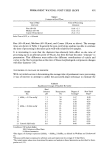
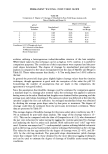
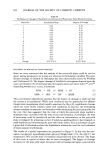
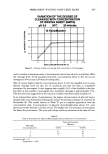
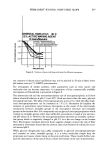
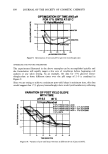
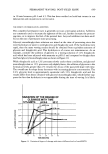
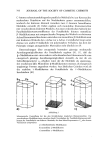
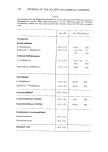
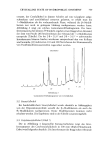
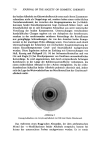
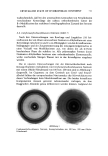
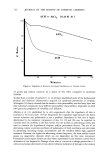
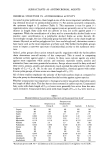
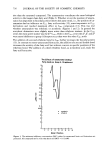
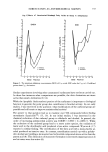
LYOTROPIC MESOPHASE (LIQUID CRYSTAL) 677 domain under specified temperature and concentration conditions. As such, either the phase-separation model or the small-system thermodynamic approach offers the same convenience for lyotropic mesomorphism in concentrated surfactant systems. Fewer discrepancies due to solvent interplay, miceIlar size distribution and multicomponent participation (mixed micelies) are associated with accepting the lyotropic mesophase as a separate phase. The origin of the ambiguous term liquid crystal originated because traditionally these compounds were discovered by their unique optical properties. Thus, while they behaved as solids optically, the compounds had the flow properties of liquids. The optical properties of lyotropic mesophases are still a principal means of identifying the phase transformations and texture. Roseyear (7), in a previous presentation before the Society of Cosmetic Chemists, described the liquid-crystal texture of surfactant meso- phases. Critical Micelle Concentrations were measured in these investigations by several methods. A comparison of observed cmc values is listed in Table IV. The methods selected are commonly employed for cmc determinations they were, however, espe- cially significant because of their pharmaceutical implication. Both surface activity (as it may affect drug solubility, dissolution and solubilization) and optical properties (as they affect product appearance, stability and spectrophotometric measurements of product performance, i.e., dissolution) are significant physical properties which are designed and controlled in product formulation. A reasonable agreement was found for cmc values determined by the various methods. Tyndallmetric values at 25øC ap- pear a little higher (1.2 mg/ml) than the other methods. This may be explained by the high light-scattering shown by the isotropic solution itself (observed to be about 95% transmission in Figure 6). The surface tension plots in Figures 3 and 4 show a minimum commonly encountered in such cmc determinations. The descending portion of the curve below the cmc can be explained by impurity adsorbed by surface while the ascending portion of the minimum after the cmc and before the plateau is explained by impurity being solu- bilized by the micelies. The ring method itself may be a contributor to this minimum. In the measurement of y values, the true minimum equilibrium value may not be reached. This is evident in the aged-solution values shown in Table I and Figures 3 and 4. Table IV Observed Critical Concentrations for Nafoxidine HC1 Aqueous Solutions CMC Value Measured, mg/ml Temperature, øC Method 0.70 25 Surface Tension 0.83 37 Surface Tension 0.92 37 Vapor Pressure 1.2 25 Ty ndallmetric 0.75 25 Nephelometric A 0.68 25 Nephelometric B 0.7 25 Turbidimetric 1.35 • 25 Turbidimetric Represents a second critical concentration in which anisotropicity is observed and a phase change appears.

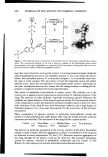
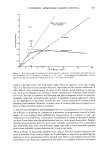
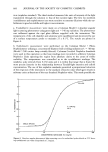
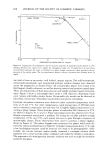
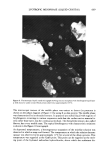
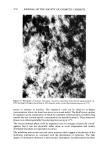
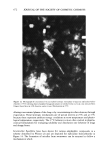
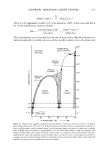
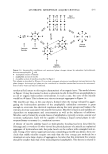
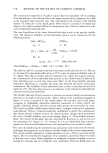
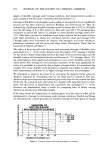
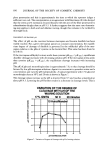
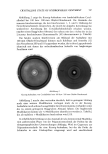
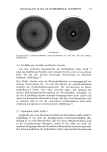
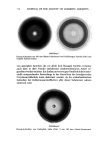
678 JOURNAL OF THE SOCIETY OF COSMETIC CHEMISTS The temperature dependence of surface tension has been described (10) as resulting from the influence of two factors. One is the vapor pressure of the substance the 3' falls as the saturated vapor pressure rises. The other factor is the increase in the thermal motion of molecules in the liquid phase which leads to increased intermolecular distance the surface tension falls as the temperature rises. This was observed in solu- tions of nafoxidine hydrochloride. The Ionic Equilibrium of the Amine Hydrochloride plays a role in the miceliar equilib- rium. The observed solubility of total nafoxidine species can be represented by the following scheme. [Naf' HC1]•ond [C1-] + [Naf' H +] Km •I In Naf' H +] [Naf]sond Ks. •__Ka, [Naf]•s• + [Ha•)] [HOH] ==• [Mixed Micelie] where [Naf]tota• = [Naf]baso + [Naf' H +] + [n Naf' H +] The observed pH of a saturated solution of nafoxidine hydrochloride was 4.6. This can be calculated for appropriate pKa values at 25øC to give an apparent solubility value of 0.7 mg/ml. This value coincides with the measured cmc values. For a given molarity, the concentration of free nafoxidine base present in the solution may be affected by back hydrolysis and as such may exert some effect on the drug solubility (miceliar properties). Buffering to a suitable pH range may diminish the extent of free-base contribution. The solubility of free nafoxidine base in water is calculated to be 0.011 mg/ml at 25øC. The free base may act as an impurity in the nafoxidine hydrochloride solutions (miceliar and otherwise). The Miceilar Molecular Weight was seen to increase at a second critical concentration as observed in the light scattering studies. This is shown in the equilibrium diagram in Figure 14 as the conversion to the middle phase. The miceliar units of the phase, consisting of amphiphilic nafoxidine molecules associated in a fluid, reform into parallel cylindrical threads with the external polar groups (W) surrounded by water. This liquid crystalline middle phase formed many conjugate solutions for nafoxidine hydrochloride. Winsor (2) has discussed this equilibrium in detail. The turbidimetric data shown plotted in Figure 8 show tl•e observed phase change which represented the onset of visible turbidity, seen in micrograph, Figure 11, of the middle (nematic) phase. The texture of this phase has been described by Rosevear (3) and its structure was determined by Luzzati (1). It is formed by a set of indefinitely long cylinders, regular, two dimensional hexagonal array, and separated from one another by water. The onset of turbidity may be interpreted as a cloud point (not in the terms of nonionic surfactants that experience an increase in miceliar weight with increased temperature). This can be justified inasmuch as a phase separation occurs to form a coacervate in this region. This was described by Langmuir (11) as unipo!ar coacervation when two kinds of micelies were mixed. Phase separation in surfactant solutions normally occurs on heating for nonionic and on cooling for ionic surfactants. Thus the Krafft point ob-
Purchased for the exclusive use of nofirst nolast (unknown)
From: SCC Media Library & Resource Center (library.scconline.org)