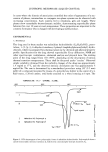
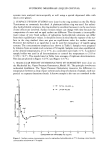
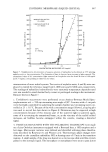
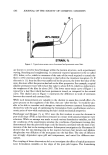
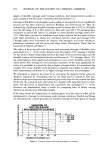
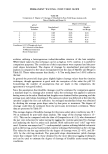
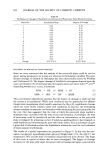
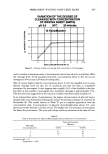
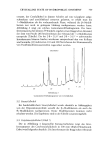
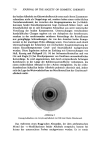
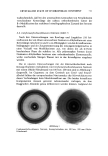
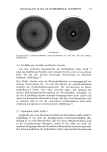
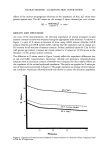
LYOTROPIC MESOPHASE (LIQUID CRYSTAL) 665 1.6 1.4 1.2 0.4 0.2 •7 ø C CMC / / / / / / / / / / / / / ! /// "•DEAL ELECTROLYTE // 2xM SUCROSE / •llßl I K• I I I I I I I I 2 4 8 8 IO 15 xlO -3 MOLES LITER-I NAFOXIDINE HCl o I I 0 20 25 Figure 5. Molecular weight determination by thermoelectric osmometry of nafoxidine hydrochloride and sucrose standard at 37øC, showing a cmc value at 4 x l0 -a mol 1 -• for the apparent levelling effect. Adjust- ing for ionic dissociation, the cmc range is then near 2 x 10 -• tool or 0.92 mg/ml. equal to one-half of the true molecular weight. Thus the apparent molecular weight value as a function of concentration will vary, depending on the activity coefficient. If other effects, such as dissociation of cation to free amine, decomposition, or associa- tion such as micellization are involved, further variation and departure from ideality will occur. Sucrose is relatively well behaved and gives a response which is typical for singularly dispersed, monomolecular species. Completely ionized substances, which are not aggregated or associated, should also give a linear response of resistance with changing concentration. However, in many cases of ionizing substances in aqueous so- lutions, departure from ideality is common. 4. LIGHT SCATTERING MEASUREMENTS were all performed at 25øC because of the difficulty in adapting the commercial instruments to temperature control at other ranges. It is recognized that turbidimetric measurement of a solution at only one temperature is not sufficient to determine a solubilization end point (because turbidity can arise from either miceliar solubilization limits or cloud point depression). Nephe- lometric measurements, however, were more carefully controlled at 25øC, providing a data obtainable span with a much broader range especially at lower monomer popula- tions where turbidity by spectrophotometry is quite inaccurate. Three methods of measuring turbidity were utilized. The first method measured the ratio of intensity of the scattered light, the Tyndall light, to that of the incident light by absolute or direct measurement of the Tyndall ratio. The second method measured the same effect as the first, but compared the intensities to a standard of known concentra-

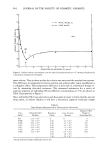
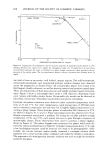
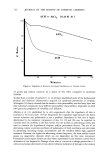
666 JOURNAL OF THE SOCIETY OF COSMETIC CHEMISTS tion (nephelos standard). The third method measured the ratio of intensity of the light transmitted through the solution to that of the incident light. The first two methods (tyndallmeter and nephelometer) are more sensitive to extreme dilutions while the tur- bidimeter is good at middle and higher concentrations. a. Tyndallmetric measurements were made on a Coleman Model 14 absolute angular light scattering photometer using green light at ?, = 546 n• radiation. The photometer was calibrated against the opal glass diffusor supplied with the instrument. The temperature of the cell chamber and solutions were equilibrated and monitored by use of a surface temperature probe to maintain 25 -+ 0.1øC. The results are plotted in Figure 6. b. Nephelometric measurements were performed on the Coleman Model 7 Photo Nephelometer utilizing a concentrated-filament bulb yielding radiation at ?, -- 700 rn/x (Model 7-500 exciter lamp suitably filtered). Coleman Certified Nephelos Standards were used in this operation so that haze readings were recorded in arbitrary Coleman Nephelos Units spanning the region from absolute clarity to the zones of visible turbidity. The temperature was controlled as in the tyndallmeter readings. The nephelos scale extends from 0-! 30 units and it is within that range that is found the most precise linearity in the relationship between Tyndall-light intensity and colloid concentration. The use of the nephelos standards permitted a proportional reduction of the response of the instrument to the standard of known value which gave results in arbitrary units as fractions of the true Standard Nephelos value. This made possible the COLLOID 15-- 50-- z o • 45- z 75-- 90 - S,NGLE S.EC,ES / II I I 0.1 1.0 10.0 I• CONCENTRATION NAFOXIDINE HCI (mg/ml) Figure 6. Absolute angular photometric light-scattering curve for n•oxidine hydrochloride at 25øC show- ing tyndallmetric cmc value extrapolated at 1.2 mg/ml.
Purchased for the exclusive use of nofirst nolast (unknown)
From: SCC Media Library & Resource Center (library.scconline.org)