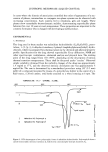
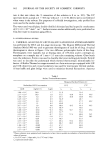
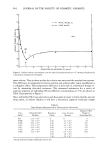
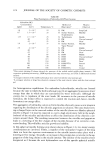
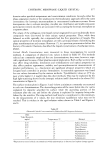
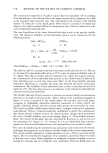
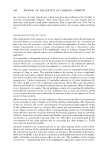
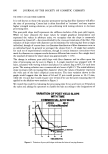
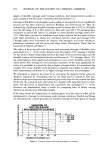
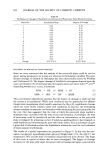
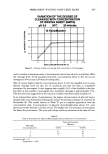
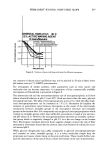
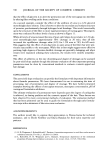
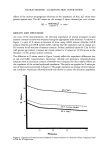
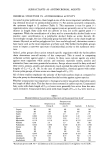
694 JOURNAL OF THE SOCIETY OF COSMETIC CHEMISTS Table IV The Degree of Cleavage of Disulfide by a Commercial Acid Wave Under Salon Waving Conditions Patron No. Standardized Slope Degree of Cleavage 1 O.54 O.28 2 O.39 O.39 3 O.4O O.38 4 0.54 0.28 5 O.53 O.29 6 0.39 0.39 7 0.64 0.21 8 0.60 0.24 9 0.75 0.13 10 0.69 0.17 11 0.50 0.31 12 0.41 0.38 13 0.37 0.41 14 0.59 0.25 15 0.75 0.13 16 0.64 0.21 Average 0.55 -+ 0.13 0.28 + 0,09 THE EFFECT OF MERCAPTAN CONCENTRATION Since we were convinced that the analysis of the post-yield slope could be used to assess waving parameters, we turned our attention to formulation variables. The equi- librium cleavage of disulfide by mercaptan has been theoretically treated by Wolfram and Underwood (9). The degree cleavage of disulfide by mercaptans depends upon the total concentration (C) of mercatan plus mercaptide anion and varies with C •/2 or C 2/a depending whether eq 1 or eq 2 is dominant. kSSk + RS- --' kSSR + kS- (1) kSSk + 2RS- .• 2kS- + RSSR (2) This concentration dependence assumes that the degree of cleavage is small and that the system is at equilibrium. While such conditions may be approached for alkaline thioglycolate preparations which rapidly penetrate the fiber (8), equilibrium cleavage values are more slowly attained under acid conditions. In practice, the formulating chemist attempts to maximize curl formation while minimizing the processing time and the cost. Our data suggested that the time at which the post-yield slope reached a minimum value correlated with the time of test curl formation. Accordingly, the time of processing could be preselected and the effect of concentration on the post-yield slope investigated by preparing a series of solutions, applying them to hair wrapped on small mandrels and determining the post-yield slope values. Such a technique can give a great deal of information about the formulation without the need for curl evaluation of many separate trial formulas. The results of a typical experiment are presented in Figure 6. In this case the mer- captan was glyceryl monothioglycolate (glyceryl thioglycolate) (16), the pH 6.5, the temperature 50øC and the time of treatment was preselected to be 20 min. The shape of this curve is typical of others that we have investigated. The degree of cleavage increases (or the post-yield slope decreases) with increasing mercaptan concentration

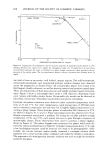
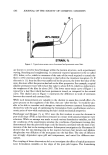
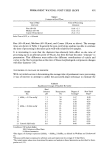
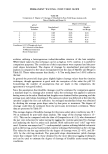
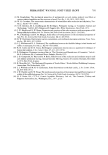
PERMANENT WAVING: POST-YIELD SLOPE 695 VARIATION OF THE DEGREE OF CLEAVAGE WITH CONCENTRATION OF WAVING AGENT (GMTG) pH 6.5 5ffC 20 minutes 1.0 0•4 ! I I lO HairslMandrel I I 0.8 0.6 0.2 2 4 6 8 10 12 14 17 18 GMTG CONCENTRATION 0NT.%) Figure 6. Variation of degree of cleavage with concentration of waving agent. until it reaches a maximum value. Concentrations above this value do not further affect the cleavage level. In the example presented, concentrations above 6-8% are not ad- vantageous if we accept a 20-min processing time. This of course implies that for concentrations above 6-8% the disulfide is at its equi- librium cleavage level for this set of conditions and that the fiber is completely penetrated by mercaptan. It also suggests that roughly 45% of the disulfide in the ker- atin fiber is inaccessible to mercaptan since maximum cleavage is approximately 55%. This has also been suggested for the reaction of sulfite with the keratin disulfide (9). In an independent series of experiments, the degree of penetration of glyceryl mono- thioglycolate was determined utilizing the iodine decoloring technique as reported by Herrmann (8). The results (shown in Table V) are in complete agreement with the concentration data. Concentrations of glyceryl monothioglycolate above 6% com- pletely penetrate the hair in 20 min or less. The higher the concentration of mercaptan, the faster the penetration. The post-yield slope reaches a minimum at the time ofcom- Table V Time of Penetration of Glyceryl Monothioglycolate as a Function of Concentration Time of Penetration Mercaptan (Minutes) Concentration (%) T 50% T 100% 2 19 50 6 11.5 20 12 7 12 Conditions: pH = 6.5 Temperature = 50øC
Purchased for the exclusive use of nofirst nolast (unknown)
From: SCC Media Library & Resource Center (library.scconline.org)