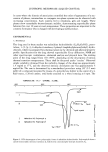
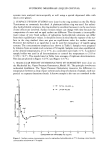
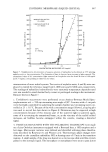
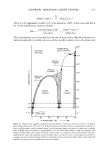
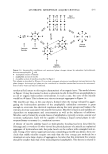
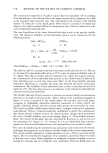
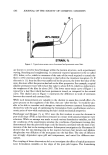
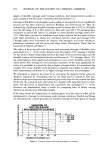
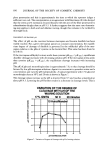
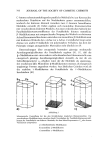
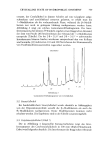
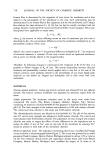
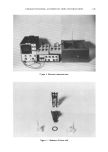
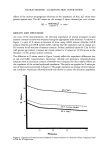
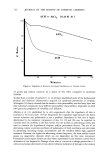
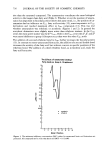
LYOTROPIC MESOPHASE (LIQUID CRYSTAL) 673 Km n[Naf+] +m[C1-] • [NafnClm]n-m where n is the aggregation number (CI) is the gegenion, (Naf +) is the cation and Km is the cicellar equilibrium constant such that [cations]n[gegenion] TM (aNaf+)n(aC1-) TM [micelies] (aNafn Clm) Thus micellization can be described by the law of mass action. Micelie formation is a thermodynamically reversible process and the miceliar solution obeys the phase rule I SOTROPI C SOLUTION THERMOTROPIC LIQUID CRYSTAL CRYSTAL PHASES -200 o 175 ø 150 ø MICELLAR PHASE VISCOUS ISOTROPIC MIDDLE NEAT (Nematic) ( S mectic ) 125 ø I00 ø .75 ø .50 ø 37 ø' 25 ø K. Pt. SOAP CURD 12ø 0 20 40 60 80 100 % NAFOXIDINE HCl • Figure 13. Binary phase diagram of nafoxidine hydrochloride in water as a function of mol % of drug in water. Phases observed at 25øC and 37øC isotherms (shown as dotted tie lines) are, sequentially: isotropic so- lution, miceIlar phase, middle (nematic) phase, viscous isotropic phase, neat (smectic) phase and crystalline solid. A Krafft point is estimated at approximately 12øC for dilute phases where a soap curd appears. The shaded micellar phase and shaded hydrated crystal phase are estimated from both thermal and spec- trophotometric data. The speckled viscous isotropic phase is observed only in heterogeneous systems of conjugate solutions involving either middle or neat phases with an isotropic gel phase. Data points marked X represent the presence of the middle phase with other phases.

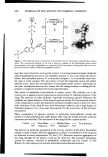
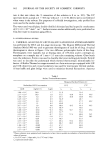
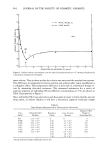
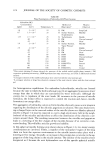
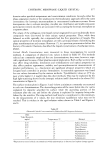
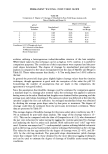
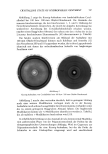
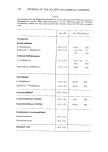
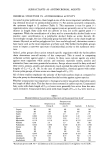
674 JOURNAL OF THE SOCIETY OF COSMETIC CHEMISTS Table III Phase Examinations of Nafoxidine HCl/Water Systems Nafoxidine HCI Concentration Method of Phase(s) mg/ml tool % Temperature, øC Observation • Observed 1.0 2 x 10 -a 12 X PM Soap Curd 0.7 1.5 x 10 -a 25 O Surface Tension, MiceIlar Nephelometry 1.35 2.7 x 10 -a 25 X Turbidimetry Middle 60 25 O PM Viscous Isotropic b 65 25 O PM Neat" 1.0 2 x 10 -a 37 O Surface Tension, Miceliar Vapor Pressure 2.0 4 x 10 -• 37 X PM Middle 60 37 O PM Viscous Isotropic b 65 37 O PM Neat c 18 85 X HSM Middle 60 88 X HSM Viscous Isotropic b 40 113 X HSM Middle 70 134 O HSM Neat c 100 176 O HSM, DTA Smectic 90 178 O HSM Neat 100 186 O HSM, DTA Crystal •Data points showing X always showed the presence of the mobile turbid middle phase (nematic). PM represents polarizing microscopy, HSM represents hot stage microscopy, and DTA is differential thermal analysis. 2, Conjugate solutions of the middle turbid phase were observed with the clear isotropic gel. "A conjugate solution or lyogel was observed composed of the neat (smectic) phase with the clear isotropic gel. for heterogeneous equilibrium. For nafoxidine hydrochloride, micelies are formed because the state in which the hydrocarbon groups (•) are aggregated possesses a lower energy than that in which they are surrounded by water molecules. Although the energy due to repulsion of the ionic heads (W) increases in the process of micelle formation, the former effect is expected to control the reaction and, hence, micelle formation is an energy effect. The aggregation of nafoxidine cations to form micelles obviously causes a new situation regarding the distribution of the chloride gegenions in solution. The ionic heads form- ing a charged layer on the external surface of the micelle (shown as a Hartley spherical micelie in Figure 14) may be expected to exert a high electrostatic field in the neigh- borhood of the micelles and therefore to effect the distribution of the chloride coun- terions around them. The resulting interaction between the micelles and gegenions leads to a lowering of the free charges of the micelles because of an extensive coun- terion binding. This will affect micellar growth and stability. In this spherical micelle forming step (shown above in Figure 14), two major energy considerations are involved. Firstly, a transfer of the non-polar ¾ region of the long chain ion from the aqueous environment to the micelle interior takes place with a lowering in free energy. Secondly, an increase in free energy also occurs due to the ag- gregation of the long chains in the micelle interior. The interior of the micelle is here designated as • because the new hydrocarbon core of this specific spherical micelle
Purchased for the exclusive use of nofirst nolast (unknown)
From: SCC Media Library & Resource Center (library.scconline.org)