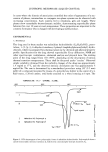
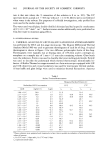
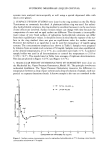
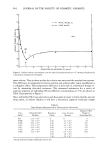
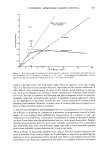
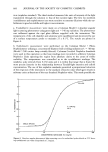
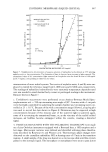
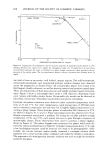
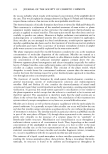
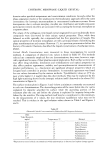
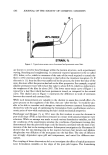
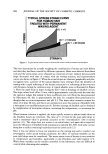
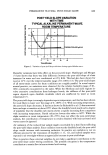
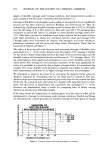
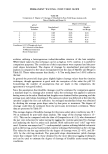
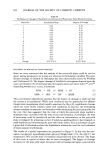
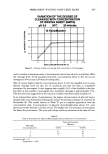
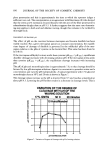
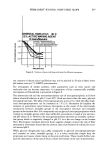
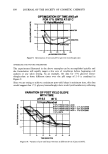
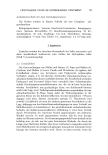
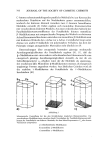
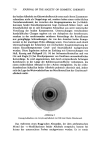
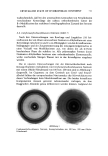
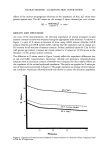
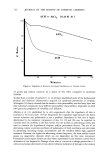
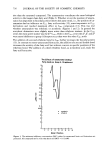
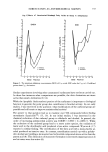
688 JOURNAL OF THE SOCIETY OF COSMETIC CHEMISTS TYPICAL STRESS STRAIN CURVE FOR HUMAN HAIR TREATED WITH PERMANENT WAVING AGENT (1) t =0 f = 5 minutes (3) •- = 20 minutes STRAIN% Figure 2. Typical stress-strain curves for human hair treated with permanent waving agent. This was determined by actually weighing the combination of tresses and rods before and after they had been treated by different operators. Hairs were selected from these rods and the stress-strain curve obtained as a function of time. Indeed, the post-yield slope decreased with time of contact with the waving solution, and representative curves are shown in Figure 2. When the actual slopes are obtained graphically and plot- ted against time, a picture of the typical alkaline wave emerges from the initiation of waving with a rapid softening of the keratin structure to a reforming of the structure with bromate during the oxidation step. A typical alkaline wave is illustrated in Figure 3. Note the rapid drop in slope during the first 5 min as breakage of disulfide occurs. The slope values level off at 15 min, which approximately coincides with the time that the operator judges this sample to have a sufficient test curl. From the data presented by Herrmann (8), this is approximately the time for complete fiber penetration by thioglycolate at room temperature and pH 9.2. The slope value remains constant for times of at least 40 min, and this is not unexpected, since the reaction of disulfide with a mercaptan is an equilibrium process (9). Further cleavage of disulfide can be obtained by reapplication of mercaptan solution, increasing the temperature, or increasing the pH. When bromate solution is applied, the slope rapidly returns to almost initial values as the disulfide bonds are reformed. The time of 5-10 min for the post-yield slope to reach a maximum value is generally accepted as the "neutralization" time in actual practice (11). The slope does not return to its initial value, and again this is expected since the efficiency of disulfide bond restoration is typically 80-90% with some cystine being lost to sulfur containing by-products such as cysteic acid (12). Since it was our desire to focus our attention on the waving step and to conduct our investigation under actual waving conditions, the effect of external variables on the post-yield slope must be considered. The stress-strain curve of keratin is very sensitive to temperature and humidity, particularly in the Hookean and yield regions (13). While these variables can be readily controlled in the laboratory, they are difficult to control while obtaining salon samples.

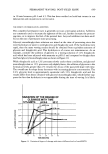
PERMANENT WAVING: POST-YIELD SLOPE 689 POST YIELD SLOPE VARIATION WITH TIME TYPICAL ALKALINE PERMANENT WAVE. ROOM TEMPERATURE . }• •/• ,o o i i i i i •, BROMATE pH 6.5 O ch THIOGLYCOLATE pH 9.2 uJ 0.2 o 10 2o 3o 4o • , • , I , I , I 0 10 20 30 40 Time (Minutes) Figure 3. Variation of post-yield slope with time during typical alkaline wave. Humidity variations have little effect on the post-yield slope. Hamburger and Morgan (7) have shown that there was little difference between the post-yield slope of a hair immersed in water and one conditioned at 65% R.H. This had also been shown for wool at 22øC over the relative humidity range of 0-100% (13). The post-yield slopes of all stress-strain curves for these conditions are roughly parallel. In actual experi- mental practice, no variations were observed for the relative humidity range of 40- 60% commonly encountered in the salon. While the Hookean and yield regions in- volve extensive contributions from hydrogen bonds, the stiffness of the post-yield region depends upon disulfide crosslinks which are unaffected by water at room temperature (7). The post-yield slope is strongly dependent upon temperature, and this has been shown for wool fibers in water over the range of 0-100øC (13). With increasing temperature, the post-yield slope decreases. It has been shown by Rebenfeld et al. (2) that untreated hairs undergo a transition at about 85øC where the disulfide bonds reach such a degree of instability that the disulfide-rich matrix shows a rapidly increasing flow component with increasing temperature. Partial reduction lowers this value to 66øC. While the slight variation in room temperature (20-25øC) does not affect the post-yield slope analysis, the contribution of temperature to results obtained with heat activated acid waves cannot be ignored. Air oxidation of the reduced hair sample might conceivably be a third factor affecting the post-yield slope analysis. Since oxidation restores the disulfide bond, the post-yield slope would increase with increasing oxidation. In practice air oxidation is not an efficient process for the restoration of disulfide (7, 11, 12), and indeed samples were exposed to air overnight without an appreciable increase in post-yield slope. Thus in practice these external variables do not make a significant contribution to the post-yield slope under waving conditions. The possible exception is the temperature contribution to matrix flow in heat activated acid waving.
Purchased for the exclusive use of nofirst nolast (unknown)
From: SCC Media Library & Resource Center (library.scconline.org)