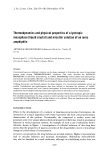
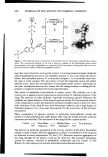
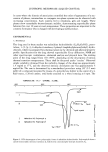
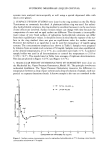
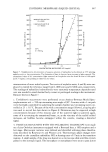
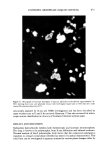
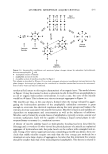
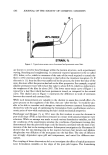
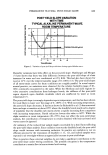
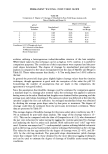
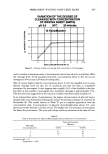
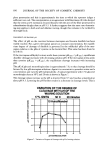
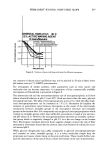
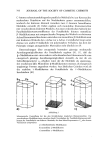
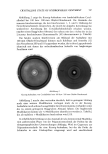
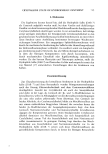
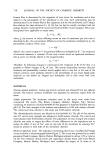
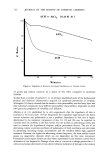
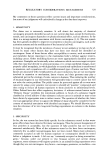
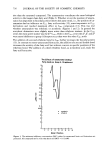
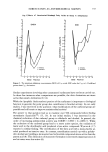
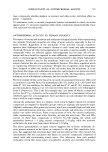
LYOTROPIC MESOPHASE (LIQUID CRYSTAL) 663 systems were analyzed microscopically as well using a special depressed slide with micro cover glasses. 2. SURFACE TENSION STUDIES were done by the ring method on the Du Noiiy Tensiometer as commonly described. A platinum-iridium ring was used. For nafoxi- dine hydrochloride solutions, the ring method is excellent because it can be used even if time effects are involved. Surface tension values can change with time because the composition of a new and an aged surface are different. Thus dynamic 3' (nonequilib- rium) values of very fresh surfaces of nafoxidine hydrochloride solutions can differ from their equilibrium 3' values. It should be borne in mind that the rupture of the sur- face in the ring method does not give an equilibrium value for surface tension. However the method is so rapid that it can be used for measuring 3' of rapidly aging systems. The concentrations employed are shown in Table I. Samples were prepared by dilution from an initial stock solution of 50 mg/ml. Samples were also equilibrated at the desired temperatures, 25 or 37øC, in a controlled water bath ---IøC. A jacketed sample holder was used in all determinations to control the temperature to 25.0 or 37.0øC (+0.5ø). The results listed in Table I are averages of triplicate determinations. The data are plotted in Figure 3 (25øC) and Figure 4 (37øC). 3. MOLECULAR WEIGHT DETERMINATIONS BY OSMOMETRY were done on the Mechrolab Inc. Vapor Pressure Osmometer, Model 301. The principle involves an isothermal distillation. The Vapor Pressure Osmometer measures the difference in temperature between a drop of pure solvent and a drop of solution of sample, each sus- pended on separate thermistor beads. A known sample is also run as a standard in the 75- E 65 z c• 60 I z o_ z • 55 m 50 45 4O 0 o ---• INITIAL VALUES, t o ß ---• LATER VALUES 25oc I I I I I I I 3 4 5 6 7 8 9 I0 CONCENTRATION NAFOXIDINE HCI (mg/ml) Figure 3. Surface tension-concentration curve for nafoxidine hydrochloride at 25øC showing critical micelie concentration minimum at 0.70 mg/ml.

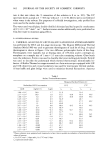
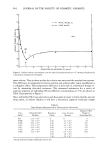
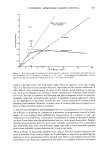
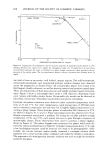
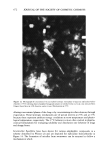
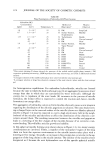
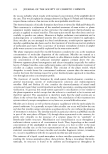
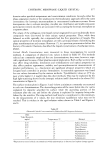
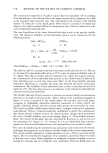
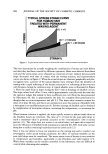
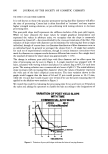
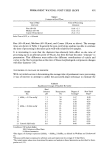
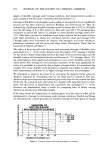
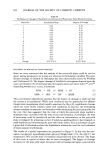
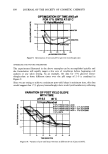
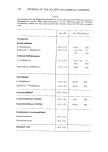
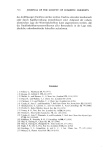
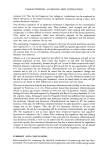
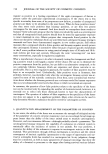
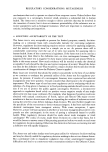
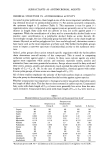
664 JOURNAL OF THE SOCIETY OF COSMETIC CHEMISTS 75 70 6• 60 ,50 45 CMC l, , i 2 o --,.- INITIAL VALUES, t o © • LATER VALUES 37 ø C 40 I I I I I I 0 3 4 5 6 7 8 9 I0 CONCENTRATION NAFOXIDINE HCl (mg/ml) Figure 4. Surface tension-concentration curve for nafoxidine hydrochloride at 37øC showing critical micelle concentration minimum at 0.83 mg/ml. same solvent. Thus in these studies the solvent was water and the standard was sucrose. The difference in temperature between solvent and solution after vapor equilibrium is a colligative effect. This temperature difference is detected on a thermistor bridge cir- cuit by measuring electrical resistance. The measured resistances for a series of aqueous solutions of nafoxidine HC1 at different concentrations at 37øC are shown in Table II and plotted in Figure 5. Since nafoxidine HCI is an electrolyte and dissociates in water to form chloride ion and drug cation, at infinite dilution it will have a theoretical apparent molecular weight Table II Vapor Pressure Measurements by Thermoelectric Osmometry Apparent a Mol Conc. Nafoxidine HC1 Resistance Conc. Sucrose Weight of mg/ml Molarity Ohms Molarity Nafoxidine HC1 0.01 2.16 x 10 -s 0 0 0 0.088 1.91 X 10 -4 0.10 1.5 X 10 -a 59 0.460 9.94 X 10 -4 0.10 1.5 X 10 -a 307 1.012 2.19 X 10 -a 0.30 4.3 X 10 -a 235 2.012 4.54 X 10 -a 0.50 7.3 X 10 -a 276 4.959 1.07 X 10 -2 0.55 8 X 10 -a 621 9.984 2.16 X 10 -2 0.45 6.5 X 10 -a 1536 0.70 1.0 X 10 -2 1.40 2.0 X 10 -= Actual molecular weight of nafoxidine HC1 is 462.
Purchased for the exclusive use of nofirst nolast (unknown)
From: SCC Media Library & Resource Center (library.scconline.org)