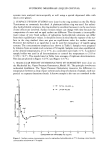
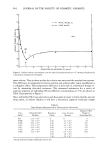
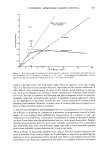
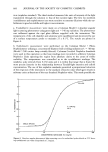
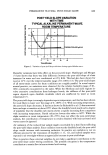
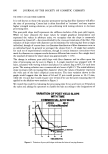
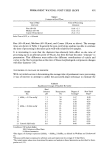
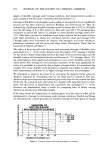
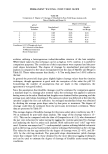
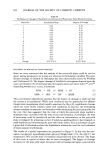
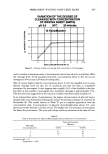
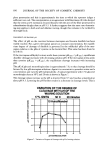
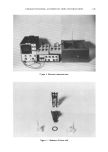
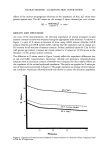
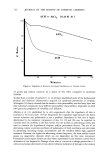
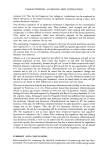
CHARACTERIZING ALUMINUM SKIN INTERACTION 723 corneum (14). Thus the low frequency, low voltage ac conductance can be employed to follow alterations in the barrier function of epidermal membranes during contact with various aluminum solutions. The observed impedance of an epidermal membrane is dependent on the concentration and nature of the current-carrying ions. Thus molarity, ionic strength and pH are important variables in these measurements. Unfortunately when dealing with aluminum compounds, it is often difficult to achieve constant values for all of the above parameters. Thus, within an experiment, values were selectively assigned. In the experiments conducted, each membrane was balanced or stabilized for impedance and this measure- ment was used as a reference for the test. The relationship of impedance values obtained to the type of excised membrane used has been reported (6, 11, 14, 29, 30). Tregear (6), using rabbit and guinea pig stratum comeurn reported values of 10-20 kilaohms. In the studies reported here, our ohmic values varied on the controls from 12.6 to 31.9 kilaohms. Thus good correlation with those reported in the literature was observed. Allenby et al. (13) extensively looked at the effects of both temperature and pH on the electrical impedance of skin. They found that between 25 and 60øC the impedance changes very little. Additionally, between the pH's of 5.0 and 8.0 little variation was noted. However dramatic reductions were noted at pH 2.0 and 10.0. In our experiments, a pH of 4.71 was maintained for the aluminum chlorohydroxide and the aluminum chloride solution was at pH 3.41. It should be noted that the major impedance change was observed with the aluminum chlorohydroxide at a pH value which is not as critical as the pH value of aluminum chloride in regard to impedance. Thus the differences observed in the role of these salts in altering skin impedance cannot be based merely on their self pH values but are based on their differences in their interaction with the tissue. The rates of aluminum chloride and aluminum chlorohydroxide binding to skin has been reported by Putterman et al. (31). These authors found that aluminum chlorohydroxide bound to guinea pig stratum corneum at twice the rate of aluminum chloride. Similar findings for these salts were reported by Fitzgerald and Rand (32) using Sephadex G-25 as the sorption media. Subsequent work by Fitzgerald (33,34) has reaffirmed that aluminum chlorohydroxide binds more quickly than aluminum chloride. Recalling that the Z values for aluminum chloride and aluminum chlorohydroxide are based on R 2, the resistive function of the plot, the differences observed between the salts should be a square of the change due to the sorption. Thus the AZ for aluminum chloride at 30 min was approximately 5% and the corresponding AZ for aluminum chlorohydroxide was roughly 25%. The magnitude is not an exact square since reciprocal frequency and capacitive functions are reflected in the Z values. From analyzing the impedance data and relating this data to recently established sorption times and rates for aluminum chlorohydroxide and aluminum chloride, it now can be stated that the aluminum chlorohydroxide does sorb more quickly than aluminum chloride and that this is shown directly by impedance changes. It now becomes apparent that the onset of antiperspirant activity can be related to the parameter of sorption which can be measured by the impedance change. SUMMARY AND CONCLUSIONS Instrumentation for measuring the electrical conductance of guinea pig skin has been developed. The results were reproducible and in agreement with other studies using similar

724 JOURNAL OF THE SOCIETY OF COSMETIC CHEMISTS tissues and common buffer systems. Sweat inhibition by aluminum can be related to some degree to tissue sorption and that relative sorption can now be measured as a function of impedance change on excised stratum corneum. Aluminum chlorohydroxide sorbs to skin more quickly than aluminum chloride and this is reflected in a five-fold greater effect on impedance. The skin impedance data for aluminum chloride and aluminum chlorohydrox- ide correlate well with dextran and guinea pig stratum corneum binding data as determined by gel filtration chromatography and morin fluorescence analysis. The electrometric technique discussed in this report can be used as a laboratory method for estimating the sorption and/or antiperspirant potential of ionic salts. REFERENCES (1) E. S. Bretschneider, A.M. Rubino and J. j. Margres, Antiperspirant efficacy, Presented at 9th Congress, International Federation of Societies of Cosmetic Chemists, Boston, June 7, 1976. (2) Author's personal communication. (3) M. Ainsworth, Methods for measuring percutaneous absorption, J. Soc. Cosmet. Chem., 11, 69 (1960). (4) I. H. Blank, Percutaneous absorption, J. Occup. Med., 2, 5 (1960). (5) I. H. Blank, Cutaneous barriers, J. Invest. Dermatol., 45, 249 (1965). (6) R. T. Tregear, "Physical Functions of Skin," Academic Press, New York, 1966, pp 6-13. (7) R.J. Scheuplein and I. H. Blank, Permeability of the skin, Physiol. Rev., 51, 702 (1971). (8) A.M. Kligman, The biology of the stratum comeurn, in W. Montagna and W. Lobitz, "The Epidermis," Academic Press, New York, 1964, Chapter XX. (9) F. N. Marzulli, Barriers to skin penetration, J. Invest. Dermatol., 39, 387 (1962). (10) C. A. Squier and R. M. Hopps, A study of the permeability barrier in epidermis and oral epithelium using horseraddish peroxidase as tracer in vitro, Brit. J. Dermatol., 95, 123 (1976). (11) R. T. Tregear, Interpretation of skin impedance measurements, Nature, 205, 600 (Feb. 1965). (! 2) J. D. Montagu and E. M. Coles, Mechanism and measurement of the galvanic skin response, ?sychol. Bull., 65, 261 (196). (13) A. C. Allenby, J. Fletcher, C. Schock and T. F. S. Tees, The effect of heat, pH and organic solvents on the electrical impedance and permeability of excised human skin, Brit. J. Dermatol., 81 (Suppl. 4), 31 (1969). (14) P. H. Duggard and R.J. Scheuplein, Effects of ionic surfactants on the permeability of human epidermis: an electrometric study, J. Invest. Dermatol., 60, 263 (1973). (15) K. E. Malten and F. A.J. Thiele, Evaluation of skin damage II, Brit. J. Dermatol., 89, 565 (1973). (16) F. A.J. Thiele and K. E. Malten, Evaluation of skin damage, Brit. J. Dermatol., 89, 373 (1973). (17) H. Kramer and P. Meares, Correlation of electrical and permeability properties of ion-selected membranes, BiophysicalJourn., 9, 1006 (1969). (18) R. Edelberg, "Biophysical Properties of the Skin," Wiley-Interscience, New York, 1971. (19) O. Kadem and A. Leaf, The relation between salt and ionic transport, J. Gen. ?hysiol., 49, 655 (1966). (20) N. Lakshminarayanaiah, Transport phenomena in artificial membranes, Chem. Rev., 65, 491 (1965). (21) M.J. Bartek, J. A. LaBudde and H. I. Maibach, Skin permeability in vivo: comparison in rat, rabbit, pig and man, J. Invest. Dermatol., 58, 114 (1972). (22) R.J. Scheuplein, Mechanism of percutaneous adsorption, J. Invest. Dermatol., 45, 334 (1965). (23) R.J. Scheuplein and L. W. Ross, Mechanism of percutaneous absorption, J. Invest. Dermatol., 62, 353 (1974). (24) I. H. Blank and R.J. Scheuplein, The relationship of the structure of the epidermis to percutaneous absorption, Brit. J. Dermatol., 89(Suppl. 4), 4 (1969). (25) S. Riegelman, Pharmacokinetic factors affecting epidermal penetration and percutaneous absorption, Pharmacokinetics, 16, 873 (1975). (26) R.J. Scheuplein, I. H. Blank, G.J. Brauner and D.J. MacFarlane, Percutaneous absorption of steroids, J. Invest. Dermatol., 52, 63 (1969). (27) R. B. Stoughton, Percutaneous absorption: a personal view, J. Invest. Dermatol., 63, 305 (1974). (28) P. Grasso and A. B. G. Lansdown, Methods of measuring and factors affecting percutaneous absorption, J. Soc. Cosmet. Chem., 23, 481 (1972).
Purchased for the exclusive use of nofirst nolast (unknown)
From: SCC Media Library & Resource Center (library.scconline.org)