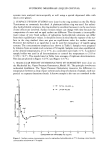
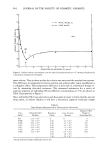
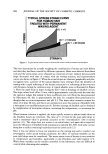
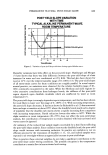
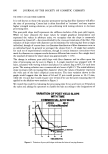
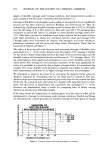
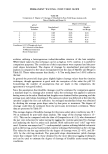
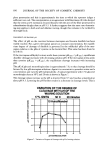
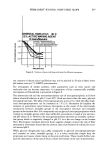
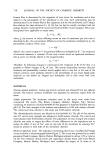
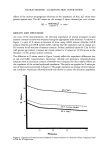
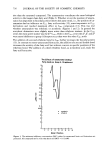
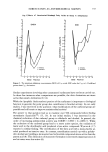
736 JOURNAL OF THE SOCIETY OF COSMETIC CHEMISTS tive than the saturated compound. The unsaturation contributes the most biological activity to the longer chain fatty acid (Table I). Whether or not the position of unsatu- ration was important to biocidal activity follows this same trend, i.e., the position ofun- saturation had no influence on Cn: • fatty acids activity (12), some importance to Cm derivatives and reached maximum effect in C•8:• compounds (13). This was true whether unsaturation was ethylenic or acetylenic (Figures 1 and 2). In general the acetylenic derivatives were slightly more active than ethylenic isomers. In the series the most active isomer was the A •ø Cm •, while in the C•8: • series the A2, A7 and A8 were more inhibitory to group A Streptococcus than were the other C•8: • acids. The addition of a second ethylenic bond to C•8:• further increases the biocidal activity (13). In contrast to mono-unsaturated fatty acids, the addition of a second double bond increases the activity of the fatty acid but without concern to specific positions of the ethylenic bond. The addition of a third ethylenic bond, as in linolenic acid, made the fatty acid less active. 0.8 0.6 0.. • 0.2 O. 0.08 6 2 The Effects of Unsaturated Dodecyl Fatty Acids on Group A Sfrep/ococci ocetylenic ethylenic I I I I I I I I I I 2 4 6 8 I0 12 14 16 18 Bond Position Figure 1. The minimum inhibitory concentration (MIC) values for unsaturated lauric acid derivatives are presented. All compounds are less toxic than lauric acid (MIC = 0.12 mM).

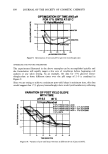
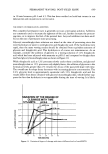
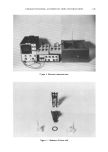
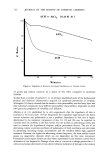
SURFACTANTS AS ANTIMICROBIAL AGENTS 737 The Effects of Unsoturoted Octodecyl Forty Acids on Group A Streptococci i 0.4 0.3 0.2 0.08 EVEN o ocetylenic '• 0.8 E 0.4 .õ ß "- 0.2 0 0.08 ODD ß ethylemc o ocetyleni½ I I I I i I I I I J I I I I I I I I I 2 4 6 e •o •2 •4 •6 m 2 4 6 e •o •2 •4 •6 •e Bond Position Bond Position Figure 2. The minimum inhibitory concentration (MIC) of Czs:z acids. MIC value for C zs:0 is 3.52 mM and greater than C •8: • derivatives. Similar experiments involving other unsaturated surfactants have not been carried out. In those few instances wher comparisons are possible, the oleic derivatives are more active than stearic derivatives (9, 14). While the lipophilic (hydrocarbon) portion of the surfactant is important to biological function in general, the polar group also contributes to biocidal activity. In our early studies, I was interested in the question: what modifications of the carboxyl group are possible and still retain or improve antimicrobial activity? The answer to that question lead us to examine over 500 compounds before finding monolaurin (Lauricidin TM) (15, 16). In our initial studies, I was interested in the chemical reduction of the carboxyl group to aidehyde and alcohol. In general, the order of increasing antimicrobial activity was COOH CHO C•OH (7). While the reduction of the carboxyl group lead to a more active species, the oxidation of lauric acid to the dicarboxylic acid produced a less active compound. Wyss et al. (17) reported a similar finding. The esterification of the fatty acid with a mono-hydric al- cohol produced an inactive ester. In contrast, esterification carried out with a polyhy- dric alcohol and yielding a monoester lead to biocidal compounds more active than the parent acid (8). This distinction ofmonoester formation is extremely important since di and tri esters were less active (8).
Purchased for the exclusive use of nofirst nolast (unknown)
From: SCC Media Library & Resource Center (library.scconline.org)