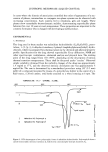
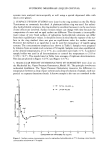
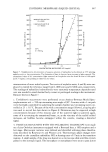
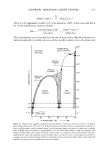
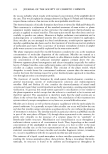
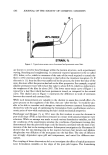
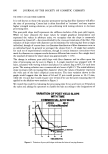
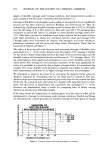
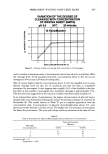
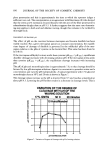
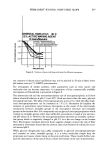
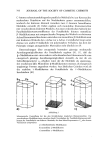
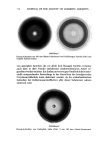
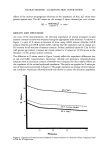
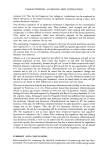
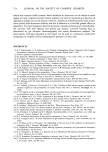
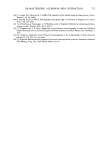
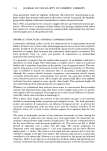
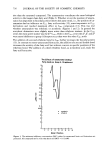
690 JOURNAL OF THE SOCIETY OF COSMETIC CHEMISTS THE EFFECT OF HAIR FIBER DIAMETER It is well known to those who practice permanent waving that fiber diameter will affect the time of processing. Coarse hair is often described as "resistant" and may require higher strength waving solutions, or pre-softening with waving solution to decrease processing time. The post-yield slope itself represents the stiffness modules of the post-yield region. While we have obtained the slope values by simple graphical interpolation and expressed the values in arbitrary units, we recognize that the slope is commonly expressed in dynes/cm 2--the stress divided by the cross-sectional area of the fiber. The variation of slope values with diameter can be minimized by selecting hair from a single individual, though of course there is a Gaussian distribution of fiber diameters even on an individual head. In general we averaged the slopes from 5-10 single hair samples for each set of experimental conditions, though in certain instances corrections were made for diameter to compare results between different hair sources. For a single head, the standard deviation for slope values was approximately - 10%. The change in arbitrary post-yield slope with fiber diameter and its effect upon the time of processing can be seen in Figure 4. A single mandrel was wrapped with l0 hairs, saturated with waving solution and placed in a plastic bag at 46øC for each time point. The waving solution was a commercial acid wave of pH 6.5. The initial arbitrary slope increases with increasing fiber diameter where the values of diameter represent the wide axis of the hair's elliptical cross-section. The time variation shown in this graph would suggest that the hairs of 64 and 95/am would process in 10-15 min, while the 112/am hair would require over 20 min if we use the same reasoning that we applied to the alkaline wave analysis in Figure 3. We tested this result by evaluating the processing time for an acid wave on 49 heads in the salon and asking the operators to classify the hair according to the designations of VARIATION OF POST YIELD SLOPE WITH TIME COMMERCIAL ACID WAVE pH 6.5 10 HairslMa • 64• diame Irel • 0.8 • 0.6 UJ •.4 o m diameter 0.2 ! 95,• diameter 10 20 30 40 TIME (MINUTES) Figure 4. Variation of post-yield slope with time for hairs of varying diameter.

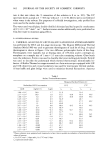
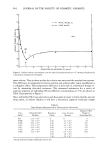
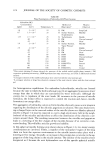
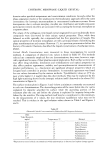
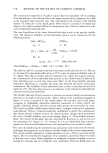
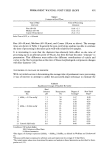
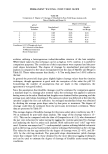
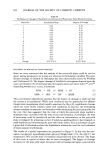
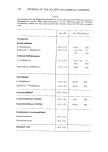
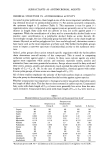
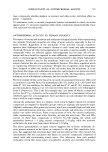
PERMANENT WAVING: POST-YIELD SLOPE 691 Table I Commercial Acid Wave Type of Hair Time of Processing (microns) (minutes) Fine (40-60) 18.0 -+ 2.7 Medium (60-90) 16.6 _-_ 3.6 Coarse (90 and above) 23.6 + 5.6 Salon Test at 50øC, n = 49 heads Fine (40-60/zm), Medium (60-90/zm), and Coarse (90/zm or above). The average times are shown in Table I. In general the post-yield slope analysis was able to estimate the time of processing in the salon quite well with relatively few samples. It is interesting to note that the diameter has relatively little effect on the time of processing up to an arbitrary point of 90/zm, but then the hair becomes "resistant" to penetration. This difference must reflect the different contributions of cuticle and cortex to the fiber's properties as the ratio of these morphological components changes with fiber diameter (14). THE DEGREE OF CLEAVAGE OF DISULFIDE With our initial success in determining the average time of permanent wave processing, it was of interest to attempt to utilize the post-yield-slope technique to estimate the Table II Equilibrium Cleavage of Disulfide By Sulfite Final Sample Solution Temperature Degree of Post-Yield No. pH (øC) Cleavage a Slope b 5, 6. 7. 8. 9. 10. 11. 12. 13. kSSko = 0.57m mol/g e 7.1 50 0.37 0.28 7.1 50 0.37 0.32 7.9 50 0.20 0.39 8.5 50 0.10 0.48 kSSko = 0.60m mol/g • 0.! 35 0.02 0.57 2.0 35 0.31 0.27 2.8 35 0.39 0.30 3.6 35 0.44 0.26 4.1 35 0.38 0.18 4.7 35 0.42 0.17 7.1 35 0.23 0.30 9.2 35 0.07 0.50 Control (H20 only) 6.0 35 0.00 0.60 Conditions: 1M Sodium Sulfite 100:1 Solution to Fiber Ratio 24 Hours Immersion a The degree of cleavage represents [(kSSk)o - (kSSk)eq.]/(kSSk)o as defined by Wolfram and Underwood (9). b The post-yield slope is expressed in arbitrary units and represents the average of 10 hair fibers. e The initial cystine values were determined by amino acid analysis in these laboratories as described by Gum~ precht et al. (12).
Purchased for the exclusive use of nofirst nolast (unknown)
From: SCC Media Library & Resource Center (library.scconline.org)