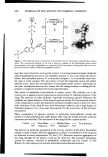
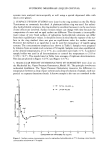
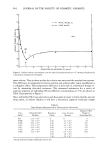
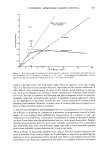
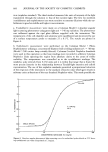
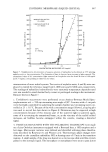
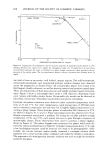
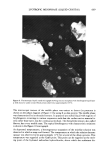
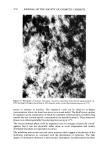
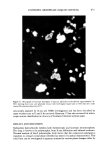
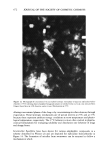
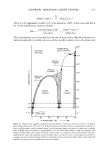
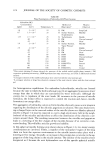
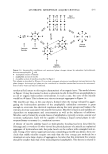
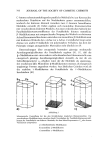
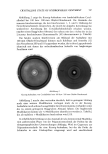
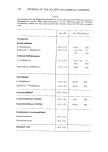
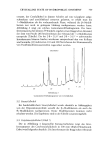
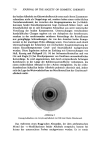
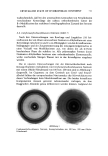
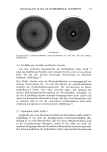
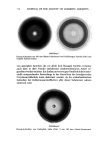
LYOTROPIC MESOPHASE (LIQUID CRYSTAL) 679 served for nafoxidine hydrochloride corresponds to the classical case for ionic amphi- philes. Light scattering studies for cationic micelles that form coacervates have pre- viously been reported (12) for systems with both zero and low electrolyte added. The Neat (Smectic) Phase of nafoxidine hydrochloride is observed only in very high concentrations of drug. The kinetics of formation of this phase are such that it was not easily observed in systems in which the crystalline drug was only partially hydrated. This phase could be produced by concentrating the viscous isotropic gel phase by evaporation or by cooling a supersaturated isotropic solution of drug. Micrographs in Figures 12 and 13 showed the texture of phases prepared by cooling to 25øC. Due to the kinetics of phase formation of the neat phase, there is some uncertainty associated with the phase boundaries for this phase, shown in Figure 9. This phase could not be produced in the concentration range below 65 mol % by the cooling method. Similarly, the stepwise aggregation of micelies in the evaporation method did not produce a neat phase that stayed anisotropic above 125øC. For this reason the ki- netics of phase formation complicates the phase diagram, and is reflected in the multiple equilibria scheme in Figure 14 by showing various possible phase transforma- tions between the three lyotropic mesophases observed, The Viscous Isotropic Mesophase for nafoxidine hydrochloride always appeared with the presence of either the middle or neat phases. If centrifuged, the neat phase always set- tled down as the dense pearlescent bottom layer. A scheme for lyotropic paracrystalline phases different from the scheme in Figure 14 has been proposed by Small and Bourges (13), in which they describe the transition to a cubic liquid-crystal phase as the viscous isotropic phase. This phase is described as a face-centered cubic structure with three-dimensional long-range ordering. It was observed in the stepwise hydration of the crystalline solid as intermediate between the neat and middle phases. Small and Bourges report that under the polarizing microscope this phase appears isotropic, but, if bubbles are trapped within it, they are angularly deformed and do not become spherical with time. This was not observed for the viscous isotropic phase of nafoxidine hydrochloride. APPLICATIONS TO FORMULATION s•:v, tsc•:tm^L coss•r)•R^• •oss Having established that nafoxidine hydrochloride is an association colloid when in aqueous solution, the pronounced surface activity and miceliar aggregation observed are not entirely surprising when the structure of the molecule is considered. The cmc ranges observed are typical for ionic surfactants. The effects of chemical structure or miceliar and liquid crystal behavior have been reviewed by Usoltseva and Chistyakov (14). These authors give a detailed description of the effect of aromatic moieties, espe- cially those joined in thepara-position and the tendency for form mesophases. The cosmetic chemist should be aware that factors other than impurity can lead to de- partures for the usual, well defined solid-isotropic liquid transition or solubility- turbidity phenomena. Sometimes supposedly impure pharmaceutical or cosmetic in- gredients are apt to be discarded as inseparable mixtures simply because they exhibit lyotropic or thermotropic mesomorphism with which the formulators are not familiar. The reformulation of components based upon results of stability studies often dictates

680 JOURNAL OF THE SOCIETY OF COSMETIC CHEMISTS the selection of costly ingredients, which may have been influenced by miceIlar or lyotropic mesomorphic behavior. Thus drug, flavor, odor or color changes may be associated with liquid-crystal phase transitions. This is especially true if we rely on optical methods for routine analysis (spectrophotometric, microscopic, light-scattering, etc.) FACTORS AFFECTING THE CMC VALUES The implications of the existence of a cmc range for nafoxidine hydrochloride aqueous solutions allows us to predict many physical-chemical properties. At concentrations above the cmc the solution is non-ideal. It should be emphasized, however, that the critical concentration is not a unique concentration value but a concentration range within which the constitution of the amphipathic solute in solution changes from the molecular (or ionic) disperse state to an equilibrium between molecules (or ions) and aggregates. It is important to distinguish between (a) those factors which influence the cmc ofnafoxi- dine hydrochloride solutions and (b) those properties of nafoxidine hydrochloride so- lutions which are a consequence of micellar behavior in the subsequent physical, chemical and/or biological systems investigated, i.e., properties affected by the cmc. The cmc ranges determined in the studies described were for essentially simple binary systems of drug in water. The micellar behavior for ternary or more complicated systems becomes quite complex. Mention is only made here of the most common fac- tors which can affect cmc values, namely, (a) the presence of additives such as (1) salts (gegenions), (2) polar compounds, (3) insoluble materials or (4) other surfactants (b) the effect of pH and (c) the temperature dependency. These effects are discussed by Shinoda and Sjoblom (15) in greater detail however, the qualitative effect of these fac- tors is important to recognize. Special emphasis is made in recognizing that nafoxidine hydrochloride solutions involve an ionic surfactant, and, as such, one must be careful not to assume that the typical behaviors of nonionic surface-active agents can be ex- pected in these systems. Salts lower the cmc values of ionic surfactants. However the salt effect is not governed by the principle of ionic strength or the Debye-Hiickel relationships. The depression of the cmc depends only on the concentration of ions bearing a charge opposite of that of the surface-active ions (i.e., anions). The nature and concentration of ions of the same charge (cations) are without effect. Correspondingly smaller cmc's for nafoxidine hydrochloride solutions would be observed for bivalent gegenions than for univalent additives. Long-chain alcohols, amines and similar compounds containing a polar group can produce a considerable lowering of the cmc. The effect is increased both by the concentration of the polar additive and by increasing the chain length (i.e., C4OH lower the cmc more than C2OH). Insoluble materials such as hydrocarbons or any other material which can be solubi- lized in the interior of the nafoxidine hydrochloride micelle can cause an increase in the micellar size and thus lower the critical concentration. The interplay of the hydro- philic and oleophilic (may be here considered as hydrophobic) portions of the amphi- pathic nafoxidine ion have a great effect on the cmc. The solubility of the ion-pair (counterion + charged polar head of the amphipathic nafoxidine cation) in the surface
Purchased for the exclusive use of nofirst nolast (unknown)
From: SCC Media Library & Resource Center (library.scconline.org)