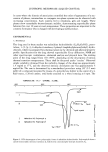
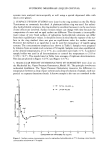
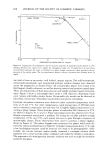
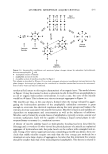
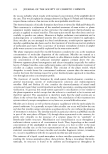
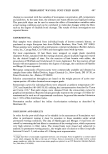
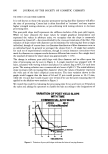
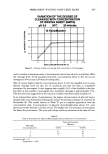
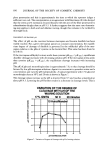
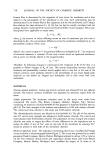
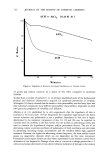
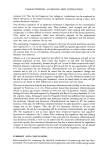
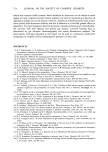
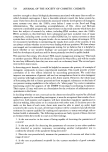
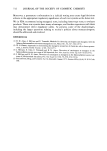
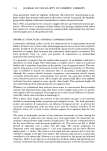
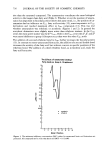
696 JOURNAL OF THE SOCIETY OF COSMETIC CHEMISTS plete penetration and this is approximately the time at which the operator judges a sufficient test curl. This interpretation is in agreement with Herrmann (8) who showed that the stress at 2% extension decayed linearly with the area of the fiber penetrated by ethanolamine thioglycolate at pH 9.3. It further suggests that the same rate-determin- ing step applies to both acid and alkaline waving, though this remains to be verified by thorough study. THE EFFECT OF WAVING pH The effect of pH on the reaction between mercaptan and keratin disulfide has been widely studied. For a given mercaptan species at constant concentration, the equilib- rium degree of cleavage of disulfide is governed by the sulfhydryl pKa of the mer- captan relative to the pKa of cysteine in the keratin fiber. This value has been found to be 9.8 (9). If the mercaptan sulfhydryl is more acidic than cysteine (pK Rsu pK usu ), equilibrium disulfide cleavage increases with decreasing solution pH. If the mercaptan is less acidic than cysteine (pKvau pK ksu), the equilibrium cleavage increases with increasing pH. The pK of glyceryl monothioglycolate is approximately 7.8, so that cleavage should be favored by low pH mercaptan solutions. Again it is convenient to preselect a time and a concentration and vary the pH independently. A typical experiment with 17% glyceryl monothioglycolate at 50øC and 20 min is shown in Figure 7. The cleavage values increase as the pH is lowered from 9.5 and reaches a maximum at about pH 4.5. Lowering the pH further results in a decrease in cleavage levels. This is VARIATION OF THE DEGREE OF CLEAVAGE WITH pH OF THE WAVING SOLUTION 17% GMTG 50 ø C 20 minutes 1.0' i i i 10 HairslMandrel 0.• / 0.2 8 t0 t2 1 pH WAVING SOLUTION Figure 7. ¾ariation ooedcgr½½ ooedcav•g½ w•h pH o•w•v•n•

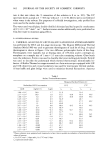
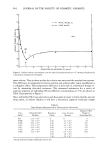
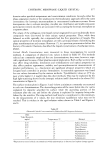
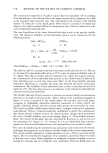
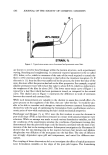
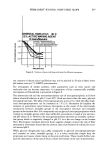
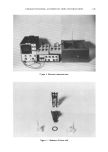
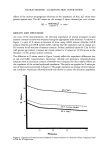
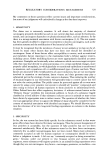
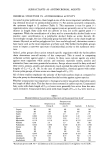
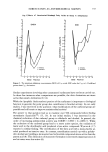
PERMANENT WAVING: POST-YIELD SLOPE 697 0.800 • 0.60• I-- 0.400 o,. 0.200 o ORIENTAL HAIR pH 6.5 46 øC 12% ACTIVE WAVING AGENT 10 HairslMandrel =(1) NH 4 + MERCAI•TOPROPiC m(2) MEA + MERCAPTOPROPH (3) GLYCERYL MERCAPTOPR ..... (4) GLYCERYL MONOTHIOGL i ! i 'IONATE tOPIONATE .•LYCOLATE 10 20 30 40 50 TIME (MINUTES) Figure 8. Variation of post-yield slope with time for different mercaptans. not contrary to theory since equilibrium may not be attained in 20 min at these lower pH values, even at 17% GMTG concentration. For mercaptans of similar acidities, other parameters such as ionic nature and molecular size can become important. A comparison of four commercially available mercaptans on Oriental hair is presented in Figure 8. The ammonium salt and the monoethanolamine salt of mercaptopropionic acid show almost identical behavior at pH 6.5 and 46øC. Both are slower than the ester, glyceryl mercaptopropionate. The pKa of mercaptopropionic acid is 10.2, while the pKa ofgly- ceryl mercaptopropionate can be estimated at 7.8 (15). Herrmann (8) explains the variation in penetration rates between mercaptans as the result of the electrostatic interactions between ionizable groups in the mercaptan's structure and ionizable groups in the keratin fiber. For compounds such as glyceryl mercaptopropionate which contain no ionizable groups other than sulfhydryl, penetration is rapid at low and neu- tral pH values (6.5). However the mercaptopropionate salts have an ionizable carboxy- late group which is negatively charged at pH 6.5 as is the net charge on the keratin fiber. Electrostatic repulsion between these negative charges reduces the rate of fiber penetration. Herrmann found that the slowest rates of penetration for thioacids occur- red around pH 6. While glyceryl thioglycolate has a pKa comparable to glyceryl mercaptopriopionate and contains no other ionizable groups, it is a lower molecular weight than the propionate and causes a faster decay in the post-yield slope. These results further sup- port the dependence of the rate of decay of post-yield slope on the rate of penetration.
Purchased for the exclusive use of nofirst nolast (unknown)
From: SCC Media Library & Resource Center (library.scconline.org)