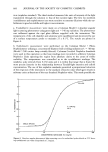
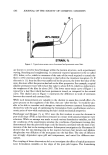
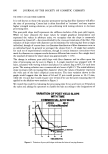
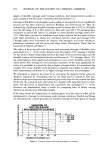
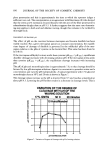
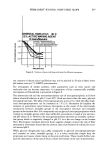
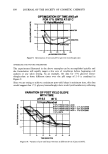
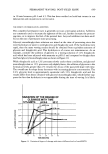
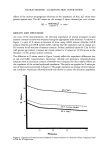
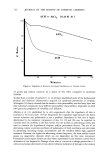
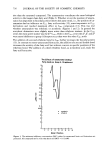
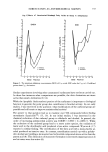
700 JOURNAL OF THE SOCIETY OF COSMETIC CHEMISTS that the effect of glycerin is to alter the pentration rate of the mercaptan into the fiber by altering fiber swelling under these conditions. As a second example, consider the effect of the addition of urea to a 12% glycerol monothioglycolate soluton. Urea is known to alter the secondary and tertiary structure of proteins, predominantly through hydrogen bond breakage. This would conceivably open the structure of the fiber to more rapid penetration of waving agent. This experi- ment was conducted for three levels of urea as shown in Figure 11. While all levels of urea increased the rate of post-yield slope decay relative to 12 % gly- ceryl monothioglycolate (approximately 50% cleavage in 20 min), they all also increased the equilibrium cleavage value (62% for 1.5M urea to 78% for 6M urea). This suggests that the effect of urea has been to open areas of the fiber that were pre- viously inaccessible to the mercaptan. While this at first might suggest more effective perming, high degrees of keratin disulfide cleavage are generally damaging and when tresses were examined utilizing these solutions, the results were entirely unsatisfac- tory. The effect of additives on the rate of perming and degree of cleavage can be assessed by post-yield slope analysis though the ultimate evaluation of other important perming parameters must be done by conventional methods to evaluate cosmetic appeal and hair damage. CONCLUSIONS The post-yield slope evaluation can provide the formulator with important information about formula parameters. We have demonstrated its use in estimating the time of processing, rate of penetration and degree of cleavage. We have further presented examples showing the effects of mercaptan structure, mercaptan concentration, pH of waving and formulation additives. The ultimate evaluation of a permanent wave depends upon the degree of curling that is achieved, its lasting qualities and the cosmetic appeal of the hair. These factors are best observed by more conventional methods of evaluation. The evaluation method that has been presented can be used to guide the formulation through early formula- tion steps with a minimum of laborious tress evaluation. ACKNOWLEDGMENTS The authors would like to express their appreciation to Donna Garza for technical assistance, and to Dodie Keithley and Dayna Banakas for their salon expertise and patience. REFERENCES (1) H. D. Weigmann, L. Rubenfeld and C. Dansizer, A transition temperature in wool fibers under stress in relation to structure, Text. Res. J., 35,604-611 (1965). (2) L. Rubenfeld, H. D. Weigmann and C. Dansizer, Temperature dependence of the mechanical properties of human hair in relation to structure, J. Soc. Cosmet. Chem., 17, 525-538 (1966).

PERMANENT WAVING: POST-YIELD SLOPE 701 (3) (4) (5) (6) (7) (8) (9) (10) (11) (12) (13) (14) (15) (16) M. Feughelman, The mechanical properties of permanently set and cystine reduced wool fibers at various relative humidities and the structure of wool, Text. Res. J., 33, 1013-1022 ( 1963). W. G. Crewther, The stress-strain characteristics of animal fibers after reduction and alkylation, Text. Res. J, 35,867-877 (1965). S. D. Gershon, M. A. Goldberg and M. M. Rieger, Permanent waving, in "Cosmetics: Science and Technology," 2nd Ed., M. S. Balsam and E. Sagarin, Eds., Wiley Interscience, New York, 1972. J. W. Haefele and R. W. Broge, Properties and reactions of hair after treatment with mercaptans of dif- fering sulfhydryl acidities, Proc. Sci. Section of the Toilet Good Association, 36, 31-39 (1961). W.J. Hamburger and H. M. Morgan, Some effects of waving lotions on the mechanical properties of hair, Proc. Sci. Section of the Toilet Goods Association, 18, 41-48 (1952). K. W. Herrmann, Hair keratin reaction, penetration, and swelling in mercaptan solutions, Trans. Fara- daySoc., 59, 1663-1671 (1963). L. J. Wolfram and D. L. Undersood, The equilibrium between the disulfide linkage in hair keratin and sulfite or mercaptan, Text. Res. J, 36, 947-953 (1966). R. K. Curtis and D. R. Tyson, Birefringence: polarization microscopy as a quantitative technique of human hair analysis, J. Soc. Cosmet. Chem., 27, 411-431 (1976). R. Helingotter, Permanent waving of hair, in "The Chemistry and Manufacture of Cosmetics," 2nd ed., M. G. deNavarre, Ed., Continental Press, Orlando, Florida, 1975. J. G. Gumprecht, K. Patel and R. P. Bono, Effectiveness of the reduction and oxidation steps in acid and alkaline permanent waving, Annual Scientific Meeting, Society of Cosmetic Chemists, December 6, 1976, New York, In press. R. Meredith, Ed., "The Mechanical Properties of Textile Fibers," North-Holland Publishing Company, Amsterdam, The Netherlands, 1956. L. J. Wolfram and M. K. O. Lindemann, Some observations on the hair cuticle, J. $oc. Cosmet. Chem., 22,839-850 (1971). J. W. Haefele and R. W. Broge, The synthesis and properties ofmercaptans having different degrees of acidity of the sulfhydryl group, Proc. Sci. Section of the Toilet Goods Association, 32, 52-59 (1959). N. F. Estrin, Ed., C.T.F.A. Cosmetic Ingredient Dictionary, 2nd ed., The Cosmetic, Toiletry and Fragrance Association, Inc., Washington, D.C., 1977, p 125.
Purchased for the exclusive use of nofirst nolast (unknown)
From: SCC Media Library & Resource Center (library.scconline.org)