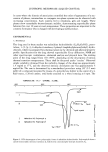
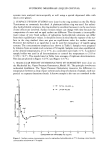
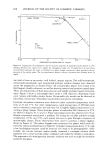
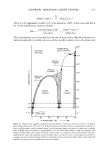
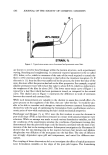
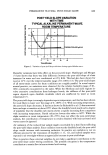
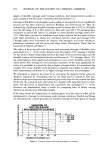
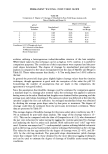
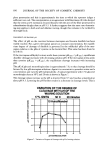
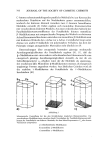
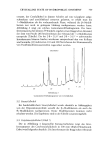
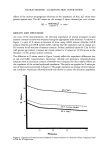
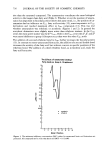
LYOTROPIC MESOPHASE (LIQUID CRYSTAL) 661 In cases where the kinetics of association controlled the order of appearance of a suc- cession of phases, intermediate or conjugate two-phase systems can be observed with increasing concentration. Such systems led to emulsions, gels and lyogels. These phases show remarkable thermodynamic stability, demonstrating reproducible phase behavior for over l0 years at room temperature. These properties are important to the cosmetic formulator who is charged with developing a stable product. EXPERIMENTAL A. MATERIALS The drug used in these studies was nafoxidine hydrochloride (C29H3202NCl), pyrro- lidine, 1 -{ 2-[p-( 3,4-dihydro-6-methoxy-2-phenyl-l-naphthyl)phenoxy]ethyl}-hydro- chloride, which was prepared for pharmaceutical use by chemical and physical property profile. Specifications for the drug showed reproducible X-ray diffraction, NMR and other spectroscopic confirmation, elemental analysis and physical data. The melting point of the drug ranged from 169-189øC, depending on the description of various thermal transition temperatures. These shall be discussed under "results." Observed simple solubility (obtained from the turbidity change) of the drug was approximately 1.4 mg/ml at 37øC, and the observed intrinsic dissolution rate was approximately 4 mg/cm2/hr. The rate is determined by a standardized procedure using 3/8" (9.5 mm) pellet of a compound mounted by means of a polyethylene holder in the center of a 4- fluid-ounce, (120-ml) amber, oval bottle attached to a wheel rotating at 6 rpm. The TEMPERATURE (øC) - CHROMEL: ALUMEL 12_0 ø 150 ø 180 ø T soil _ i 186.•iq 3• solid ! •'• liquid crystal ]' Nafoxidine HCI Polymorph c• 13 Nafoxidine HCI Polymorph /• Tm = 176.6 ø Figure 2. DTA thermogram of two polymorphic forms of nafoxidine hydrochloride. Polymorph fl shows a crystal-mesomorphic (smectic) transition, T•c followed by a mesomorphic-isotropic transition, Tm.

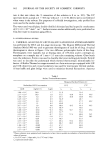
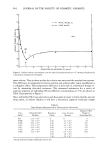
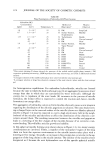
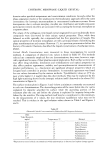
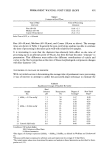
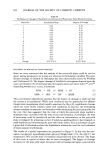
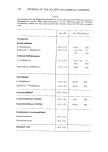
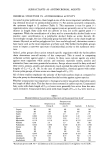
662 JOURNAL OF THE SOCIETY OF COSMETIC CHEMISTS rate is that rate where the % saturation of the solution is 0 to ca. 10%. The UV spectrum shows a peak ate. = 303 m/x with anE = 17,150. Beer's law is not followed when water is the solvent. For purposes of colloidal investigations, only profiled lots were used in the studies reported. The water used was all-glass, double-distilled deionized and had a specific conductance of 0.5-1.0 x 10 -6 ohm -• cm -•. Surface tension studies additionally were performed on CO,•-free water to minimize aging effects. B. INVESTIGATIONAL STUDIES 1. THERMAL ANALYSIS OF CRYSTALLINE NAFOXIDINE HYDROCHLORIDE was performed by DTA and hot-stage microscopy. The Dupont Differential Thermal Analyzer Model 900 was used to generate thermograms of each lot of drug. A typical thermogram is shown in' Figure 2 for two different polymorphic forms of the drug. Thermograms were typically run at heating rates of 10øC/min under a nitrogen at- mosphere on a sample size of 1 mm x 3.5 mm tube-containing volume. Glass beads were the reference. Form • was used to describe the lower melting polymorph. Form/• was used to describe the polymorph which showed thermotropic mesomorphic be- havior. A Kofler-Thomas hot stage mounted on a Leitz microscope equipped with 43X and 10X objectives and crossed polarizers was used for microscopic thermal analysis. A heat baffle and glass bridge were used to minimize thermal fluctuations. Aqueous Table I Surface Tension Measurements Nafoxidine HC1 Concentration Measured Surface Tension (3') 25øC 37øC mol/l mg/ml = C Log C to tx to tx 1.08 x 10 -• 50.0 1.7 53.3 a 51.6 2.17 x 10 -= 10.0 1.0 51.6 49.8 49.4 1.08 x 10 -2 5.0 0.7 49.5 49.8 49.8 6.49 x 10 a 3.0 0.5 50.4 a 48.7 4.33 x 10 -a 2.0 0.3 49.9 47.5 3.25 x 10 -a 1.5 0.2 49.8 a 47.3 2•17 x 10 -a 1.0 0.0 48.8 49.2 44.4 1.62 x 10 -a 0.75 -0.1 48.5 a 46.6 1.08 x 10 -a 0.50 -0.3 50.0 50.7 50.1 6.49 x 10 4 0.30 -0.5 53.7 •' 52.0 4.33 x 10 -4 0.20 --0.7 52.9 57.4 60.8 2.17 X 10 --4 0.10 --1.0 57.2 59.6 1.08 X 10 --4 0.05 -- 1.3 58.9 61.9 4.33 X 10 --5 0.02 --1.7 60.4 59.2 64.0 2.17 X 10 --.5 0.01 --2.0 68.2 68.3 67.0 1.08 X 10 --5 0.005 --2.3 67.2 66.8 4.33 X 10 --6 0.002 --2.7 68.5 69.0 2.17 X 10 --6 0.001 --3.0 69.3 49.6 49.3 46.2 44.3 49.4 54.5 58.5 • These solutions were prepared and measured at a later time to permit an evaluation of several intermediate values of interest. tx for 25øC was 1-3 days and tx for 37øC was 19 days. to represents initial values.
Purchased for the exclusive use of nofirst nolast (unknown)
From: SCC Media Library & Resource Center (library.scconline.org)