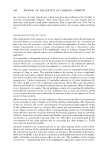
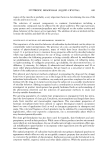
LYOTROPIC MESOPHASE (LIQUID CRYSTAL) 681 region of the micelle is probably a very important factor in determining the size of the micelie and hence its cmc. The selection of aerosol components in cosmetic formulations including a mesomorphic compound may be affected by the above additives. The vapor pressure, spray pattern and concentrate/propellant ratio will depend on the surface activity and phase behavior of the major active ingredient. The addition of salts or alcohols will de- termine the stability and shelf-life of the product. SIGNIFICANCE OF MICELLAR AND MESOMORPHIC PROPERTIES The importance of the miceliar behavior of nafoxidine hydrochloride can be subject to considerably varied interpretation. The presence of a cmc can manifest itself in a wide variety of physiochemical properties, many of which have been described in this report. It is pertinent here to mention those properties affected by miceliar behavior which may significantly influence the use of drug, cosmetic or toiletry products. Shi- noda describes the following properties as being critically affected by micellization: (a) solubilization, (b) surface tension, (c) partial molal volume, (d) refractive index, (e) light scattering, (f) colligative properties, (g) solubility, (h) electromotive force, (i) diffusion, (j) viscosity, (k) dialysis, (1) ultraviolet and infrared absorption and 10 or more other physicochemical phenomena. All are based on a non-ideal or varied be- havior of the surfactant at concentrations above the cmc. The physical and chemical methods employed in preparing the drug and the dosage form were of particular interest to us in the design of the most effective formulation of nafoxidine hydrochloride. In addition, any analytical procedure employed to aid us in dealing with the drug in its varied systems must be subjected to a possible involvement of miceIlar behavior. Having recognized such a contribution in several of the systems investigated in product development has greatly facilitated both an understanding of the phenomena observed and the selection of appropriate methods to study and develop suitable formulations. The growing popularity of cosmetic hair preparations in transparent form has stimu- lated the development of clear gels. Emulsions, microemulsions and lyogels have been made from miceliar and mesomorphic ingredients. The viscoelastic properties of lyotropic mesophases have been utilized to capture rheological cosmetic acceptance based on ease of application (feel) as well as detergent properties in shampoos and soaps. The color and fragrance of such products may be stabilized by concentrating the ingredient(s), often very expensive components, into a mesomorphic phase which is very thermodynamically stable. The clear gel formulation has also been used for lipsticks, skin fresheners and anti- perspirants, as well as hair products. While most of these products involve microemul- sions which are not mesophases, the use of surfactants in high concentration offers spe- cial solubilization opportunities to incorporate other ingredients into the gel formula- tion (especially perfuming). The optical properties of nafoxidine hydrochloride mesophases displayed pearlescent appearances which offer not only an acceptable cosmetic property but can also be used to overcome the problem of discoloration. Surfactant systems can be formulated to in- corporate vanillin, eugenol, indole and other labile additives. While the pearlescent ef-

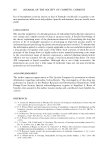
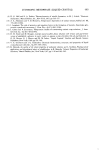
682 JOURNAL OF THE SOCIETY OF COSMETIC CHEMISTS fect of mesophases is not as intense as that of bismuth oxychloride or guanine (com- mon pearlescent additives in nail polishes, lipsticks and mascara), they are usually more stable. CONCLUSIONS The micellar properties of colloidal solutions of nafoxidine hydrochloride represent a very unique and complex system of drug in aqueous media. A detailed knowledge of the theory explaining some of the phenomena observed in formulating the drug has proven to be of invaluable assistance in developing an improved product and/or in understanding and predicting the physicochemical properties involved. To assume that the information gained is entirely or partly applicable to the successful development of a drug product recognizes only a part of the effort. Such a system, in which the active principle of the dosage form is a highly surface-active material possessing a cmc range in the concentration range of interest, represents a selected pharmaceutical product which is not too common. On the average, it has been assumed that about 1 in every 200 compounds is liquid crystalline. Although this is not a high occurrence, the phenomena can occur over a wide range of molecular types and can pose several op- portunities as well as problems. ACKNOWLEDGEMENT The author expresses appreciation to The Upjohn Company for permission to release information regarding nafoxidine hydrochloride. The investigation of this drug was performed at Upjohn in the Product Research and Development Department, Solid Dosage Form Section. Special acknowledgement is given to Engelbert L. Rowe of Upjohn, who assisted in the surface tension studies and contributed much helpful dis- cussion. REFERENCES (1) V. Luzzati, H. Mustacchi and A. Skoulios, The structure of the liquid-crystal phases of some soap and water systems, D/scussions Faraday Sot., 25, 42- 50 ( 1958) (2) P. A. Winsor, Binary and multicomponent solutions of amphiphilic compounds. Solubilization and the formation, structure, and theoretical significance of liquid crystalline solutions, Chem. Rev., 68, No. 1, 1-40 (1968). (3) F. B. Roseyear, The microscopy of the liquid crystalline neat and middle phases of soaps and synthetic detergents, J. Amer. O//Chem. Sot., 31, No. 12,628-639 (1954). (4) P. A. Winsor, The structure ofviscoelastic solutions of colloidal electrolytes, J. Co//oidSci., 10, 88-100 (1955). (5) J. S. Clunie, J. M. Corkill and J. F. Goodman, The structure of lyotropic mesomorphic phases, Proc. Roy. Soc. (London), Ser. A. 285,520-533 (1965). (6) C. A. Gilchrist, J. Rogers, G. Steel, E.G. Vaal and P. A. Winsor, The constitution of aqueous liquid crystalline solutions of amphiphiles, J. Colloid Inter/}tc. SoL, 25,409-420 (1967). (7) F. B. Roseyear, Liquid crystals: the mesomorphic phases of surfactant compositions, J. Soc. Cosmet. Chem. 19, 581-594 (1968). (8) D.C. Poland and H. A. Scheraga, Hydrophobic bonding and micelie stability, J. Phys. Chem., 69, 2341-2442 (1965).
Purchased for the exclusive use of nofirst nolast (unknown)
From: SCC Media Library & Resource Center (library.scconline.org)