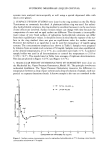
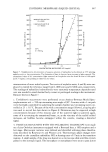
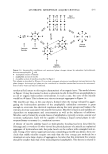
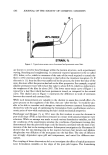
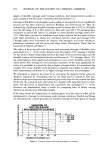
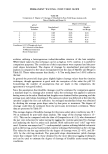
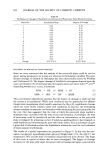
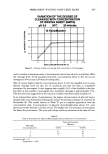
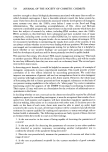
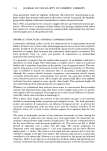
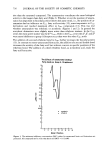
738 JOURNAL OF THE SOCIETY OF COSMETIC CHEMISTS Other modifications of the carboxyl group were studied. The formation of a hydroxamic acid derivative lead to an inactive specie, while amide and substituted amide species retained or increased their biological activity (10). Aminimides, a hybrid between amides and amines, represent a new class of surfactants (18). These com- pounds were particularly effective against yeast and fungi while possessing weak an- tibacterial activity. Of special note was the fact that aminimides, R•C--NN--R2 •CHa are effective when R• or R2 was C•4--C• in length (10, 11). This again emphasizes the importance of chain length over polar structure. The final change in surfactant struc- ture studied was the structure-function activity of amine compounds. Amines possess wide spectrum activity and are particularly active against gram (-) organisms (Figure 3). From this figure two observations can readily be made and reinforce previous con- clusions. Where agents are tested against the gram (-) genera, lower chain (C•0--C•a) derivatives are active. Alkyl amines with chain length between C •z--C •8 were more ac- tive against gram (+) organisms. From these and other studies I have concluded that all KE S O K E SO KE SO K E SO KE SO K E S O K E S O K E S O K E S O K E SO K E SO 8 9 10 I1 12 13 14 15 16 18 20 CHAIN LENGTH Figure 3. Effect of chain lengthening on amine activity tested against Klebsiella-Enterobacter sp. (K), E. coli (E), S. aureus (S) and S. pyogenes group A (O).

SURFACTANTS AS ANTIMICROBIAL AGENTS 739 basic compounds, whether aliphatic or aromatic and when active, will show effect on gram (-) organisms. To summarize, acidic or neutral compounds (amides, aminimides or esters) are active against gram (+) and yeast organisms while amine compounds characteristically enjoy wide spectrum biocidal activity. ANTIMICROBIAL ACTIVITY VS. HUMAN TOXICITY The aspect of toxicity and irritation and surfactant biological activity while representing two separate functional properties are today of great concern, especially to the cos- metic chemist. Regardless of the practicality of the zero-risk concept, regulatory agencies have challenged the cosmetic chemist to seek better and safer alternative chemicals. Because all cells (microorganisms) are not alike, it may be possible to design compounds which are effective against microorganisms but not man. All cells are unique and they should be expected to react differently, quantitatively if not qualita- tively, to chemical agents. This uniqueness resides primarily in the cellular walls and/or membranes. Indeed it may be the membrane (wall) that not only gives the cell its unique character but also controls its metabolic function. The above argument needs no supporting references for acceptance. Despite this recognition, most drugs have been designed to affect the interior of the cell rather than the membrane. It is my hypothesis that drugs, and surfactants in particular, can be made to act more selectively if their action is directed to certain cells or classes of cells. This hypothesis, conceived during my work with aliphatic surfactants, has now reached fruition. The best example of this can be found in our study of unsaturated fatty acids. Oleic acid is considered a growth factor for mammalian cells (19). Jenkin et al. (20) found that while Aa 18:1 was inhibitory for kidney cells and the A 2, A7 and A8 18:1 isomers were growth stimulators, Kabara et al. (! 3) reported these latter isomers to be lethal against group A Streptococcus. This is the first example that ! am aware of where a compound such as the A2 C•8: • derivative can be a growth stimulator for a mammalian cell and an inhibitory agent for a microorganism. Such specificity can only stimulate• the imagina- tion to look for other examples. Among the surfactants there is a distinct trend towards higher toxicity for aromatic compounds as compared to lipophilic groups, which are aliphatic and natural in origin. Aliphatic surfactants offer germicidal activity which are reasonably high and safe since their biotransformation products--water, carbon dioxide and ammonia or trimethyl amine--are rather innocuous. From a toxicity point of view, the cationic surfactants, while representing the most active biocides, are also the most toxic. The oral LD•0 toxicity of these basic compounds is between 50-500 mg/kg, the amide and aminimides between 1-3 g/kg, anionic compounds 2-8 g/kg, while the nonionic surfactants, the least toxic, have values between 5-50 g/kg. The above generalization on agent toxicity suggests that nonionic surfactants de- serve greater attention in the future as compared to the past. Past experience, how- ever, has suggested that nonionics have little antimicrobial activity. Our research has demonstrated that this conclusion was based on nonionic compounds composed of mixed acids and representing mixed esters. Our laboratory data with purified surfactants reveal that mono-esters of polyhydric alcohols and esterified with lauric
Purchased for the exclusive use of nofirst nolast (unknown)
From: SCC Media Library & Resource Center (library.scconline.org)