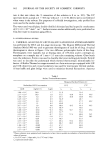
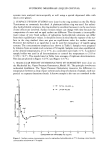
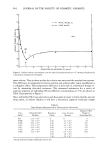
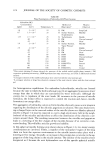
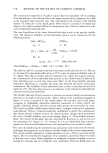
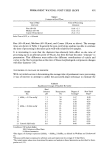
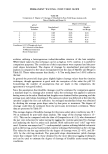
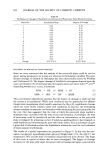
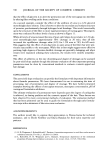
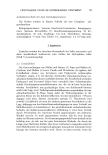
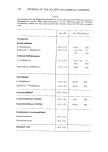
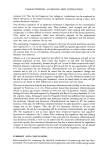
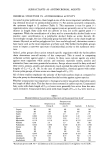
PERMANENT WAVING: POST-YIELD SLOPE 691 Table I Commercial Acid Wave Type of Hair Time of Processing (microns) (minutes) Fine (40-60) 18.0 -+ 2.7 Medium (60-90) 16.6 _-_ 3.6 Coarse (90 and above) 23.6 + 5.6 Salon Test at 50øC, n = 49 heads Fine (40-60/zm), Medium (60-90/zm), and Coarse (90/zm or above). The average times are shown in Table I. In general the post-yield slope analysis was able to estimate the time of processing in the salon quite well with relatively few samples. It is interesting to note that the diameter has relatively little effect on the time of processing up to an arbitrary point of 90/zm, but then the hair becomes "resistant" to penetration. This difference must reflect the different contributions of cuticle and cortex to the fiber's properties as the ratio of these morphological components changes with fiber diameter (14). THE DEGREE OF CLEAVAGE OF DISULFIDE With our initial success in determining the average time of permanent wave processing, it was of interest to attempt to utilize the post-yield-slope technique to estimate the Table II Equilibrium Cleavage of Disulfide By Sulfite Final Sample Solution Temperature Degree of Post-Yield No. pH (øC) Cleavage a Slope b 5, 6. 7. 8. 9. 10. 11. 12. 13. kSSko = 0.57m mol/g e 7.1 50 0.37 0.28 7.1 50 0.37 0.32 7.9 50 0.20 0.39 8.5 50 0.10 0.48 kSSko = 0.60m mol/g • 0.! 35 0.02 0.57 2.0 35 0.31 0.27 2.8 35 0.39 0.30 3.6 35 0.44 0.26 4.1 35 0.38 0.18 4.7 35 0.42 0.17 7.1 35 0.23 0.30 9.2 35 0.07 0.50 Control (H20 only) 6.0 35 0.00 0.60 Conditions: 1M Sodium Sulfite 100:1 Solution to Fiber Ratio 24 Hours Immersion a The degree of cleavage represents [(kSSk)o - (kSSk)eq.]/(kSSk)o as defined by Wolfram and Underwood (9). b The post-yield slope is expressed in arbitrary units and represents the average of 10 hair fibers. e The initial cystine values were determined by amino acid analysis in these laboratories as described by Gum~ precht et al. (12).

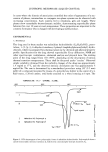
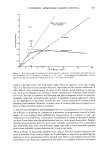
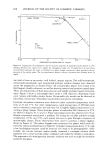
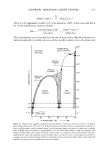
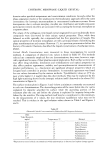
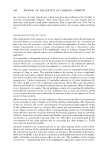
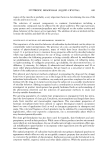
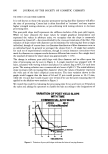
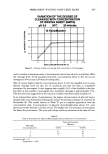
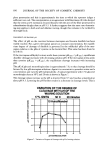
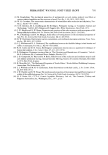
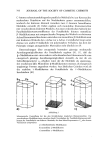
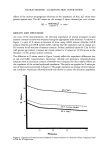
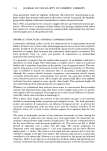
692 JOURNAL OF THE SOCIETY OF COSMETIC CHEMISTS degree of disulfide cleavage under waving conditions. Such measurements usually re- quire a separate and often time-consuming chemical analysis (12). Cleavage of disulfide by nu•cleophiles such as sulfite or mercaptide ion is an equilibrium process and has been treated in detail by Wolfram and Underwood (9). They de- termined the equilibrium disulfide cleavage values for human hair at 35øC in 1M sulfite over the pH range of 0-9. The solution to fiber ratio was 100:1. By repeating these conditions at various pH values it is possible to obtain disulfide cleavage values of 8- 51%. Hair fibers can then be withdrawn from these solutions and the values of post- yield slope determined to obtain the correlation between slope and cleavage level. Cleavage values were determined by titration wiih salyrganic acid under varying ex- perimental conditions and the post-yield slope values determined. These data are presented in Table II and Figure 5. The values of the post-yield slope decrease with increasing cleavage of disulfide, and a good linear fit (r = -0.94) can be obtained over the range 0-50% cleavage. Crewther (4) has shown a linear relationship between the slope of the post-yield region and the disulfide content of S-methylated Lincoln wool between 0-75 % cleavage. Above 75% the slope begins to drop rapidly and extrapolates to zero at zero disulfide content. For values above 40% cleavage by our technique, estimation of the slope graphically be- comes too unreliable to extend the data to higher cleavage values. It is postulated that roughly 45% of the disulfide in the hair fiber is relatively inaccessible to sulfite under these experimental conditions (9), so higher cleavage levels were not investigated. We attempted to improve the linear fit by correcting the measured slope values for diameter variations by normalizing them to the slope prior to treatment. The stan- dardized slope thus represents the measured post-yield slope for the treated hair fiber divided by the measured post-yield slope for a length of the same fiber prior to treat- ment. For this series of experiments, the correlation was unchanged (r = -0.94). However the standardized slope is useful for comparing hairs of widely varying diameter as discussed in a following example. If the slope values are independent of cleaving agent, then the data for sulfite can be extrapolated to cleavage by mercaptans under waving conditions. Haefele and Broge (6) determined the cysteine generated by disulfide cleavage with mercaptans of varying VARIATION OF POST YIELD SLOPE 1.0 0.0 0.1 0.2 0.3 0.4 0.5 DEGREE OF CLEAVAGE (•) WIT H' ff•'l• I•' • •-F'•::-L-•A•/A G E '•,.• 0 O D• 0 o• SLOPE = mo•- +b rn = -- 0.83_+0.09 b = 0.57_+0.03 r = -- 0.94_+0.05 r2 = 0.88 Figure 5. Variation of post-yield slope with degree of cleavage.
Purchased for the exclusive use of nofirst nolast (unknown)
From: SCC Media Library & Resource Center (library.scconline.org)