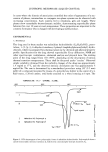
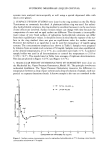
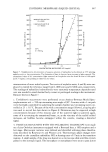
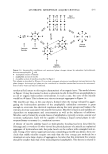
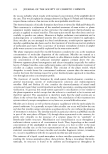
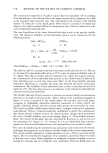
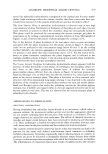
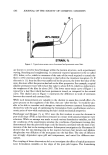
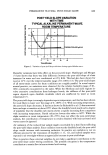
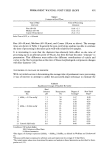
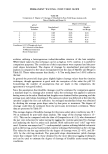
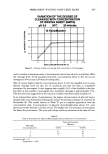
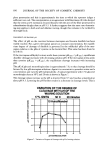
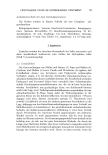
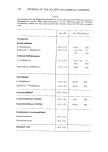
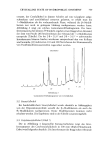
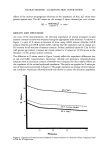
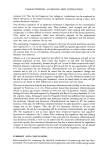
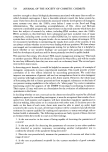
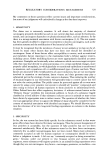
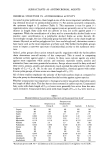
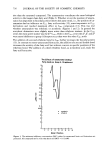
PERMANENT WAVING: POST-YIELD SLOPE 695 VARIATION OF THE DEGREE OF CLEAVAGE WITH CONCENTRATION OF WAVING AGENT (GMTG) pH 6.5 5ffC 20 minutes 1.0 0•4 ! I I lO HairslMandrel I I 0.8 0.6 0.2 2 4 6 8 10 12 14 17 18 GMTG CONCENTRATION 0NT.%) Figure 6. Variation of degree of cleavage with concentration of waving agent. until it reaches a maximum value. Concentrations above this value do not further affect the cleavage level. In the example presented, concentrations above 6-8% are not ad- vantageous if we accept a 20-min processing time. This of course implies that for concentrations above 6-8% the disulfide is at its equi- librium cleavage level for this set of conditions and that the fiber is completely penetrated by mercaptan. It also suggests that roughly 45% of the disulfide in the ker- atin fiber is inaccessible to mercaptan since maximum cleavage is approximately 55%. This has also been suggested for the reaction of sulfite with the keratin disulfide (9). In an independent series of experiments, the degree of penetration of glyceryl mono- thioglycolate was determined utilizing the iodine decoloring technique as reported by Herrmann (8). The results (shown in Table V) are in complete agreement with the concentration data. Concentrations of glyceryl monothioglycolate above 6% com- pletely penetrate the hair in 20 min or less. The higher the concentration of mercaptan, the faster the penetration. The post-yield slope reaches a minimum at the time ofcom- Table V Time of Penetration of Glyceryl Monothioglycolate as a Function of Concentration Time of Penetration Mercaptan (Minutes) Concentration (%) T 50% T 100% 2 19 50 6 11.5 20 12 7 12 Conditions: pH = 6.5 Temperature = 50øC

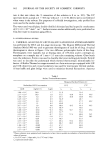
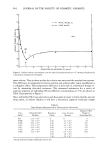
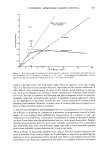
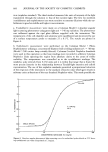
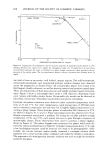
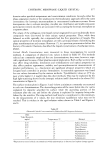
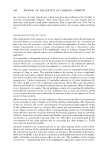
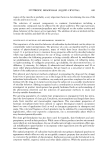
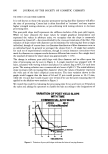
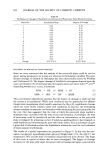
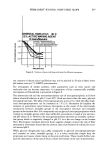
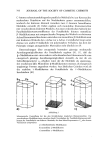
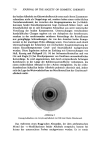
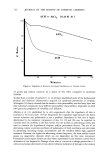
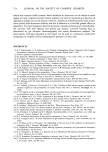
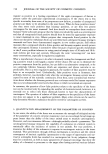
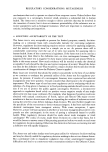
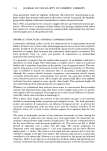
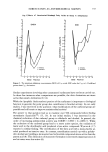
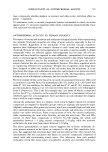
696 JOURNAL OF THE SOCIETY OF COSMETIC CHEMISTS plete penetration and this is approximately the time at which the operator judges a sufficient test curl. This interpretation is in agreement with Herrmann (8) who showed that the stress at 2% extension decayed linearly with the area of the fiber penetrated by ethanolamine thioglycolate at pH 9.3. It further suggests that the same rate-determin- ing step applies to both acid and alkaline waving, though this remains to be verified by thorough study. THE EFFECT OF WAVING pH The effect of pH on the reaction between mercaptan and keratin disulfide has been widely studied. For a given mercaptan species at constant concentration, the equilib- rium degree of cleavage of disulfide is governed by the sulfhydryl pKa of the mer- captan relative to the pKa of cysteine in the keratin fiber. This value has been found to be 9.8 (9). If the mercaptan sulfhydryl is more acidic than cysteine (pK Rsu pK usu ), equilibrium disulfide cleavage increases with decreasing solution pH. If the mercaptan is less acidic than cysteine (pKvau pK ksu), the equilibrium cleavage increases with increasing pH. The pK of glyceryl monothioglycolate is approximately 7.8, so that cleavage should be favored by low pH mercaptan solutions. Again it is convenient to preselect a time and a concentration and vary the pH independently. A typical experiment with 17% glyceryl monothioglycolate at 50øC and 20 min is shown in Figure 7. The cleavage values increase as the pH is lowered from 9.5 and reaches a maximum at about pH 4.5. Lowering the pH further results in a decrease in cleavage levels. This is VARIATION OF THE DEGREE OF CLEAVAGE WITH pH OF THE WAVING SOLUTION 17% GMTG 50 ø C 20 minutes 1.0' i i i 10 HairslMandrel 0.• / 0.2 8 t0 t2 1 pH WAVING SOLUTION Figure 7. ¾ariation ooedcgr½½ ooedcav•g½ w•h pH o•w•v•n•
Purchased for the exclusive use of nofirst nolast (unknown)
From: SCC Media Library & Resource Center (library.scconline.org)