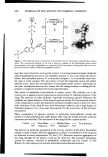
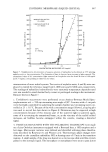
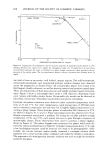
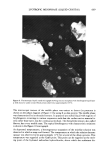
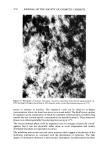
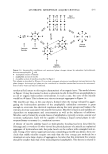
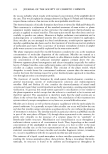
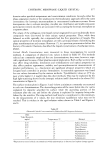
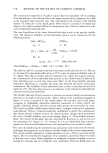
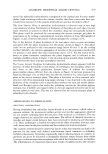
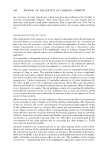
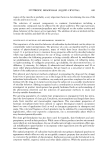
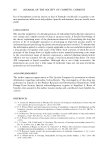
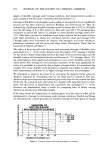
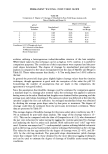
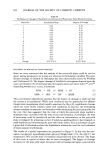
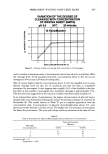
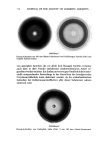
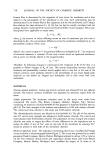
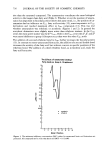
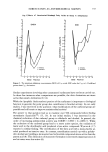
718 JOURNAL OF THE SOCIETY OF COSMETIC CHEMISTS Current flow is determined by the migration of ions across the membrane and is thus related to the permeability of the membrane to the ions. Such relationships may be demonstrated by the Nernst-Planck flux equations and the Nernst-Einstein and Ussing's flux relations for ideal solutions (14, 19, 20), but can best be readily correlated with the analogy between molecular (Fick's Law) and electrical (Ohm's Law) transport. Fick's Law: (intergrated form applicable to steady state) J, = kp where J,, the amount of solute diffusing across an area of membrane per unit time is described by AC,, the concentration difference across the membrane multiplied by k?, the permeability constant. Ohm's Law: I = VR -• where I, the current is equal to V, the potential difference multiplied by R -•, the reciprocal of electrical resistance, a constant. If ions carry current across an epidermal membrane, then J, and I are directly related in the proportionality, kp •-' R -• Therefore, by following changes in conductance (the reciprocal of R) of the skin, it is possible to follow changes in Kp of ions. This inverse relationship between electrical resistance and permeability constant strictly applies only to ions but, in the case of the stratum corneum, most probably extends to the permeability of any small, highly polar molecule as was shown by Dugard and Scheuplein (14) in their work with ionic surfactants. MATERIALS Stratum corneum membrane. Guinea pig stratum corneum was obtained from wax epilated animals. The stratum corneum membrane was separated by ammonia vapors from the tissue. Sample preparation. The aluminum solutions used in this study were made from commercial 50% stocks (The Reheis Company, Berkeley Heights, N.J.). Solution containing 1% aluminum chloride (0.044M A1) was prepared in deionized distilled water at pH 3.42. The ionic strength of the solution was adjusted to 0.5M with sodium chloride. The control and rinse solution in this study was 0.5M sodium chloride. The chlorohydroxide solution was diluted to 0.5% (0.044M A1). The pH of this solution was 4.71 and its ionic strength was adjusted to 0.9M sodium chloride. The control and rinse solutions were 0.9M sodium chloride. The adjustment of ionic strength with sodium chloride was made to negate the effect of ionic differences on the impedance and to reduce the effect, if any, of Na + ions on one side of the membrane by ensuring Na + would be present in both sides of the membrane chamber. Electrical impedance device. The impedance monitoring device was a modified half bridge circuit as shown in the photograph below (Figure 1). The circuit was powered by an audio generator (Heath Company, Benton Harbor, Michigan) adjusted to deliver 1.0V ac (rms) at 5.0 Hz. The resistance decade boxes and capacitance decade boxes both from (Heath Company, Benton Harbor, Michigan) were modified for ranges of 10 ohms to 10

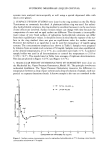
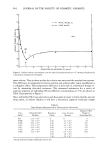
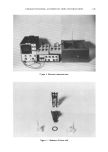
CHARACTERIZING ALUMINUM SKIN INTERACTION 719 Figure 1. Electronic instrumentation. Figure 2. Membrane diffusion cells.
Purchased for the exclusive use of nofirst nolast (unknown)
From: SCC Media Library & Resource Center (library.scconline.org)