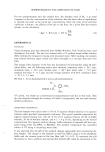
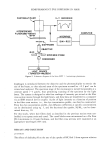
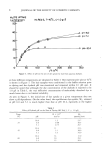
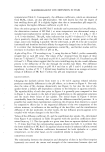
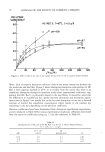
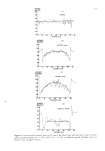
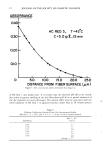
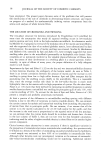
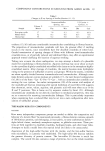
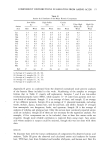
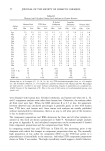
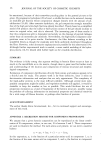
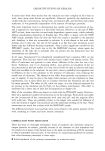
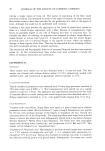
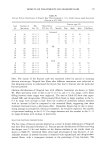
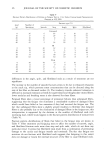
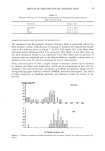
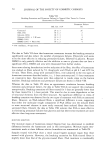
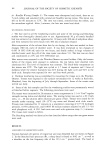
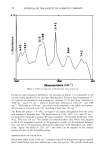
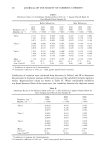
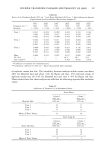
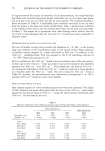
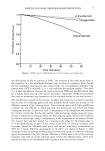
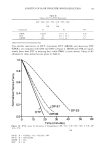
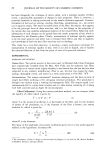
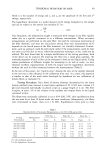
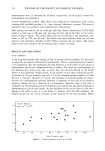
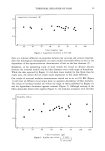
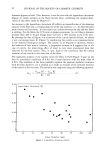
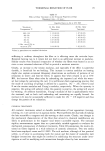
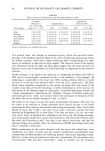
14 JOURNAL OF THE SOCIETY OF COSMETIC CHEMISTS ABSORBANCE o.4ot- 0.30 0.20 O. tO HC RED 3, T =42•C C =5.0 g/l,15 min I I I 5.0 •0.0 15.0 20.0 25.0 DISTANCE FROM FIBER SURFACE (,u. rn) Figure 7. Dye concentration profile determined from Figure 6c. of HC Red 3 into human hair. It is evident that the observed pH effects are mainly due either to greater swelling of the hair fiber above pH 10 or to partial ionization of the dye molecule in lower pH ranges. The solvent effect must be associated with the lower solubility of HC Red 3 in aqueous solution, rather than in 50 volume percent Table V Diffusion Coefficients Calculated From Dye Concentration Profiles (HC Red 3, T = 42øC, pH = 9.5, C = 5.0 g/l, 50 vol.% aqueous ethanol) D(c) X 10 •ø Absorbance (cm2/s) O.O5 5.7 0.10 7.7 0.15 5.8 0.20 5.1 O.25 5.O 0.30 5.0 Average = 5.7

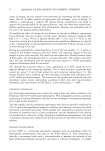
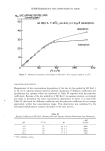
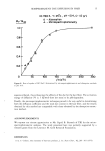
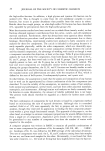
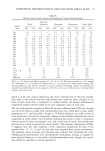
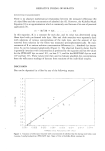
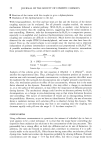
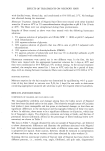
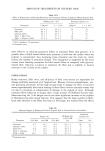
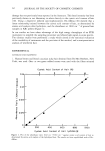
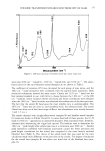
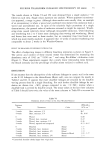
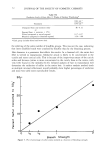
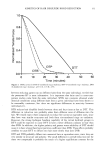
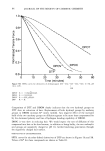
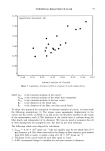
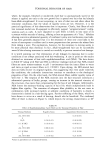
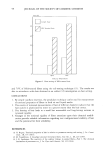
SEMIPERMANENT DYE DIFFUSION IN HAIR 15 Moo HC RED5, T= 25'•C, pH = 10.4, C= 1.0 g/[ (3 - Absorption A - Microspectrophotometry 0.8 0.6 0.4 0 50 •00 t50 200 250 :500 Figure 8. Rate of uptake of HC Red 3 determined by microspectrophotometric and absorption methods at pH 10.4. aqueous ethanol, thus enhancing the affinity of the dye for the hair fiber. The activation energy of diffusion (70 ___ 5 kJ/mol) does not seem to be pH-dependent. Finally, the microspectrophotometric technique proved to be very useful in determining both the diffusion coefficient and the total dye content in the hair fiber, and the results obtained by this method are comparable with those obtained by the absorption-extrac- tion method. ACKNOWLEDGEMENTS We express our sincere appreciation to Ms. Sigrid B. Ruetsch of TRI for the micro- spectrophotometric analyses. The work presented here was partially supported by a research grant from the Lawrence M. Gelb Research Foundation. REFERENCES (1) J. F. Corbett, The chemistry of hair-care products, J. Soc. Dyers Co/o/•r., 92, 285-303 (1976).
Purchased for the exclusive use of nofirst nolast (unknown)
From: SCC Media Library & Resource Center (library.scconline.org)