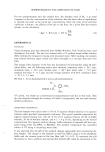
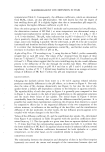
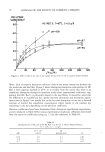
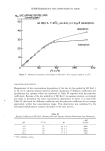
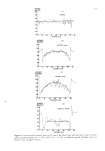
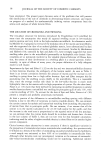
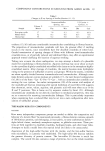
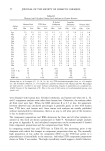
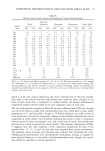
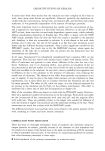
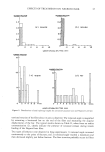
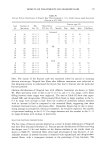
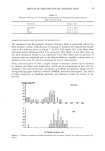
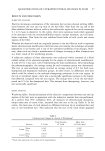
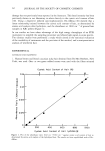
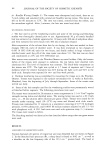
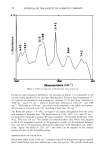
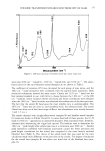
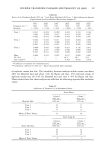
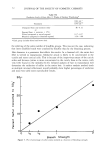
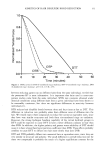
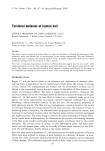
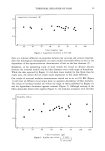
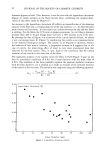
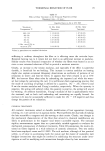
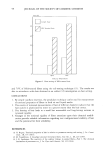
EFFECTS OF TREATMENTS ON NEGROID HAIR 43 NUMBER FRACTION 0.8 0.6 0,4 0.2 NUMBER FRACTION ( a ) 65'/,RH 0,6 0.4 0,2 i i i i 0 .6 .8 1.0 .2 LENGTH OFAXIAL SPLITTING (ram) ( b ) 90'/,RH I , [----'1 | I I I I A .6 .8 1.0 NUMBER FRACTION 0.:5 I 0.2 ( C ) 65%RH 0.1 0 .2 .4 .8 1.0 !mm NUMBER FRACTION 02 0.1 0 (d) WET nn-n n,n, .... LENGTH OFAXIAL SPLITTING (ram) Figure 2. Distributions of axial splitting lengths for untreated Caucasian (a,b) and Negroid (c,d) hair. torsional rotation of the fiber about its axis is observed. The torsional angle is magnified by mounting a horizontal bar on the end of the fiber and measuring the angular displacement of the bar. The typical results shown in Table II, taken from an earlier communication (2), clearly indicate the presence of torsional stresses during tensile loading of the Negroid hair fiber. Two types of behavior were observed in these experiments: 1) torsional angle increased continuously to the point of fracture and 2) torsional angle reached a maximum and then decreased slightly just before fracture. The first situation probably occurs in fibers

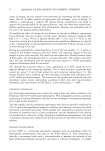
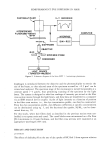
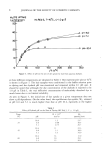
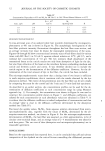
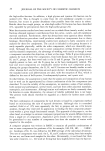
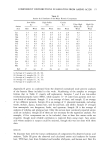
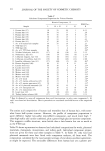
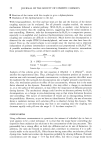
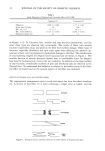
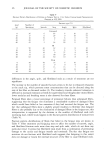
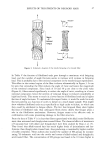
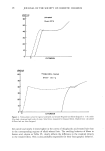
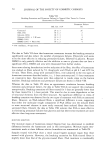
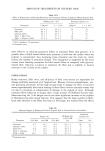
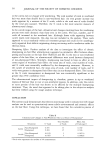
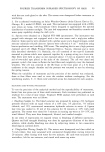
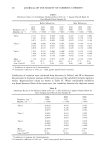
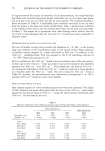
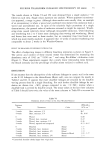
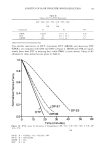
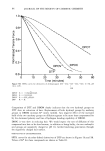
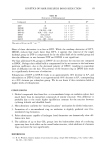
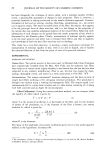
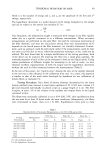
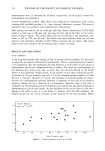
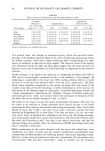
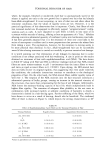
44 JOURNAL OF THE SOCIETY OF COSMETIC CHEMISTS Table II Angle of Torsional Rotation (deg) of Negroid Hair Under Tensile Loading (65% RH, 21øC) Weight (g) 5 10 20 30 40 50 60 70 80 Specimen 2 0 -7 --24 -47 -81 - 174 Brk 6 0 -5 -- 12 -21 -21 -2 11 11 9 0 6 23 45 97 69 69 Brk Brk Note: Sign of the angle refers to right or left handed rotation. already having a crack which grows catastrophically, leading to fracture. The second type of behavior is probably characteristic of fibers which do not have a crack. The reduction in the torsional angle suggests that a crack is generated in the fiber at that load level, leading to some degree of stress relaxation prior to fracture. ROLE OF TENSILE-TORSIONAL FATIGUE IN THE GROOMING OF NEGROID HAIR Combing or stretching of Negroid hair can be considered as involving tensile and torsional fatiguing of fibers in the regions of twist. To study the possible long-range effects of combing and stretching, an accelerated tensile fatigue test was developed the details of the apparatus and experimental procedure were given earlier (2). Fibers were subjected to various load levels for a maximum of 11,000 cycles. A failure distribution was obtained by noting the cycles to failure for each specimen. Specimens surviving 11,000 cycles were subjected to tensile fracture on an Instron machine to determine whether the mechanical properties reflect the effect of fatiguing on the structure of the Table III Lifetime Distributions of Untreated, Superrelaxed (SR), and Thioglycolate-Treated Negroid Hair Fibers Percent of these failures occurring in different frequency ranges Load Failures (g) Treatment (%) Imm. (0 kc) 0-0.5 kc* 2-11 kc Untreated 14 12 18 42 10 SR 20 16 58 14 TGA 11 18 46 18 Untreated 15 25 37 38 20 SR 12 18 54 34 TGA 17 9 31 62 Untreated 31 17 50 30 30 SR 39 29 60 32 TGA 42 32 56 29 Untreated 54 29 53 20 40 SR 79 48 67 16 TGA 82 60 82 7 Includes immediate failures.
Purchased for the exclusive use of nofirst nolast (unknown)
From: SCC Media Library & Resource Center (library.scconline.org)